War in West Asia Continues Despite New Delhi Summit Talks
Saudi fighter jets pound Houthi positions, Iran and Abu Dhabi discuss peace, BRICS Summit shows diplomatic reach.
'%3E%3Crect%20width%3D'96'%20height%3D'96'%20fill%3D'%234A235A'%2F%3E%3Ccircle%20cx%3D'30'%20cy%3D'24'%20r%3D'44'%20fill%3D'%23fff'%20opacity%3D'.12'%2F%3E%3Ccircle%20cx%3D'60'%20cy%3D'74'%20r%3D'40'%20fill%3D'%23000'%20opacity%3D'.10'%2F%3E%3C%2Fg%3E%3Cg%20fill%3D'none'%20stroke%3D'%23fff'%20stroke-width%3D'3'%3E%3Ccircle%20cx%3D'48'%20cy%3D'48'%20r%3D'16'%2F%3E%3Cellipse%20cx%3D'48'%20cy%3D'48'%20rx%3D'6.5'%20ry%3D'16'%2F%3E%3Cline%20x1%3D'32'%20y1%3D'42'%20x2%3D'64'%20y2%3D'42'%2F%3E%3Cline%20x1%3D'32'%20y1%3D'54'%20x2%3D'64'%20y2%3D'54'%2F%3E%3C%2Fg%3E%3C%2Fsvg%3E)
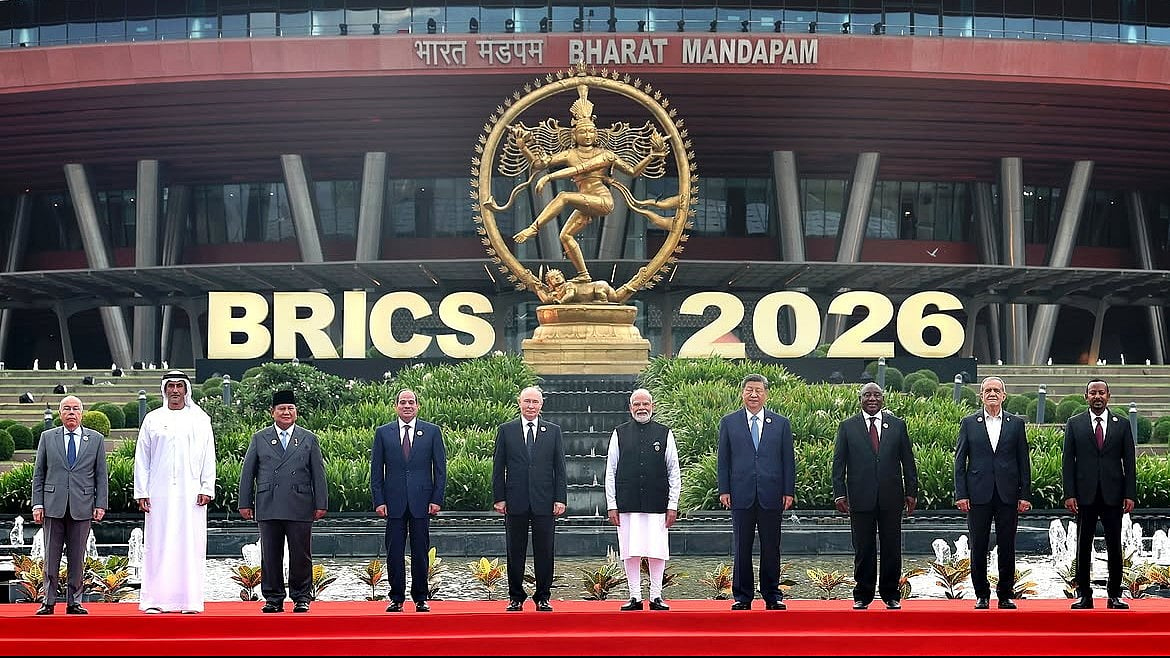
The war in West Asia is ongoing, with Saudi fighter jets targeting Houthi positions, despite a meeting between Iranian President Masoud Pezeshkian and Abu Dhabi Crown Prince Sheikh Khaled bin Mohamed Al Nahyan on the sidelines of the New Delhi BRICS Summit. The meeting was seen as an attempt to bring about a breakthrough in the conflict, which started in February this year.
The Iranian President and the Abu Dhabi Crown Prince met in what was considered a significant development, as it was the first meeting of its kind since the war began. However, a follow-up meeting on Monday, where the Iranians were supposed to unveil their plan for a safe transit corridor through the Strait of Hormuz, seems to have been overshadowed by the war in Yemen.
The Houthis have taken control of the mouth of the Red Sea, and missiles fired from Iraq have damaged the Saudi East-West pipeline, crippling the evacuation of the oil-rich kingdom's natural resources. This has worried Saudi Arabia, which has been pounding Houthi positions with its fighter jets.
Despite the ongoing conflict, the tentative steps taken by the leaders at the New Delhi Summit may still be able to bring about peace if cooler heads were to sit down and work towards that goal. The BRICS Summit, which was attended by leaders from 11 countries, including major energy producers and consumers, showed that diplomatic reach can be a useful tool in preventing a regional war from becoming a global economic shock.
The members of the BRICS grouping unanimously expressed deep concern over the conflict, called for maximum restraint, and condemned attacks on civilian infrastructure and peaceful nuclear facilities under IAEA safeguards, while stressing nuclear safety and security. India, Russia, and China also played a role in steering the diplomacy between Iran and the Gulf states.
The meeting between the Iranian President and the Abu Dhabi Crown Prince demonstrated that Tehran and the Gulf capitals can still talk directly, even as the wider confrontation continues. This is a significant development, as it shows that there are still channels of communication open between the parties involved.
The BRICS Summit also showed that the grouping has a role to play in preventing a regional war from becoming a global economic shock. The members of the grouping have little agreement on the wider geopolitical order, but they share an immediate interest in preventing a conflict that could have far-reaching consequences for the global economy.
In the end, the New Delhi Summit may have provided a glimmer of hope for a resolution to the conflict in West Asia. While the war is still ongoing, the diplomatic efforts made by the leaders at the summit may still be able to bring about peace if the parties involved are willing to work towards that goal.
The situation in West Asia remains grim, with stock markets and currencies collapsing, energy crises erupting, and factories shutting down across the globe. However, the BRICS Summit has shown that diplomatic reach can be a useful tool in preventing a regional war from becoming a global economic shock. It remains to be seen whether the parties involved will be able to build on the tentative steps taken at the summit and work towards a peaceful resolution to the conflict.
The war in West Asia is a complex issue, with multiple parties involved and competing interests at play. However, the New Delhi Summit has shown that there are still opportunities for diplomacy and dialogue, even in the midst of conflict. It is hoped that the parties involved will be able to seize these opportunities and work towards a peaceful resolution to the conflict, which would have far-reaching benefits for the global economy and stability in the region.
In conclusion, the war in West Asia is ongoing, but the New Delhi Summit has provided a glimmer of hope for a resolution to the conflict. The diplomatic efforts made by the leaders at the summit may still be able to bring about peace if the parties involved are willing to work towards that goal. The situation remains grim, but the BRICS Summit has shown that diplomatic reach can be a useful tool in preventing a regional war from becoming a global economic shock.
The international community will be watching the situation in West Asia closely, hoping that the parties involved will be able to find a peaceful resolution to the conflict. The New Delhi Summit has shown that there are still opportunities for diplomacy and dialogue, even in the midst of conflict. It is hoped that these opportunities will be seized, and that the conflict will be brought to an end soon.
The conflict in West Asia has far-reaching consequences for the global economy and stability in the region. The war has already caused significant damage to the global economy, with stock markets and currencies collapsing, energy crises erupting, and factories shutting down across the globe. However, the New Delhi Summit has shown that diplomatic reach can be a useful tool in preventing a regional war from becoming a global economic shock.
The BRICS grouping has a significant role to play in preventing a regional war from becoming a global economic shock. The grouping brings together major energy producers and consumers, including countries with close relationships with Iran, the Gulf states, Russia, China, and India. The members of the grouping have little agreement on the wider geopolitical order, but they share an immediate interest in preventing a conflict that could have far-reaching consequences for the global economy.
In the end, the New Delhi Summit has provided a glimmer of hope for a resolution to the conflict in West Asia. The diplomatic efforts made by the leaders at the summit may still be able to bring about peace if the parties involved are willing to work towards that goal. The situation remains grim, but the BRICS Summit has shown that diplomatic reach can be a useful tool in preventing a regional war from becoming a global economic shock.
Frequently asked questions
What was the outcome of the meeting between Iranian President and Abu Dhabi Crown Prince?
The meeting was seen as an attempt to bring about a breakthrough in the conflict, but no public announcement of breakthroughs was made.
What role does the BRICS grouping play in preventing a regional war from becoming a global economic shock?
The BRICS grouping brings together major energy producers and consumers, and its members have an immediate interest in preventing a conflict that could have far-reaching consequences for the global economy.