9 Killed in Pune Garbage Depot Collapse
Pune's Moshi garbage depot disaster claims 9 lives, rescue operation lasts 84 hours
'%3E%3Crect%20width%3D'96'%20height%3D'96'%20fill%3D'%234A235A'%2F%3E%3Ccircle%20cx%3D'30'%20cy%3D'24'%20r%3D'44'%20fill%3D'%23fff'%20opacity%3D'.12'%2F%3E%3Ccircle%20cx%3D'60'%20cy%3D'74'%20r%3D'40'%20fill%3D'%23000'%20opacity%3D'.10'%2F%3E%3C%2Fg%3E%3Cg%20fill%3D'none'%20stroke%3D'%23fff'%20stroke-width%3D'3'%3E%3Ccircle%20cx%3D'48'%20cy%3D'48'%20r%3D'16'%2F%3E%3Cellipse%20cx%3D'48'%20cy%3D'48'%20rx%3D'6.5'%20ry%3D'16'%2F%3E%3Cline%20x1%3D'32'%20y1%3D'42'%20x2%3D'64'%20y2%3D'42'%2F%3E%3Cline%20x1%3D'32'%20y1%3D'54'%20x2%3D'64'%20y2%3D'54'%2F%3E%3C%2Fg%3E%3C%2Fsvg%3E)
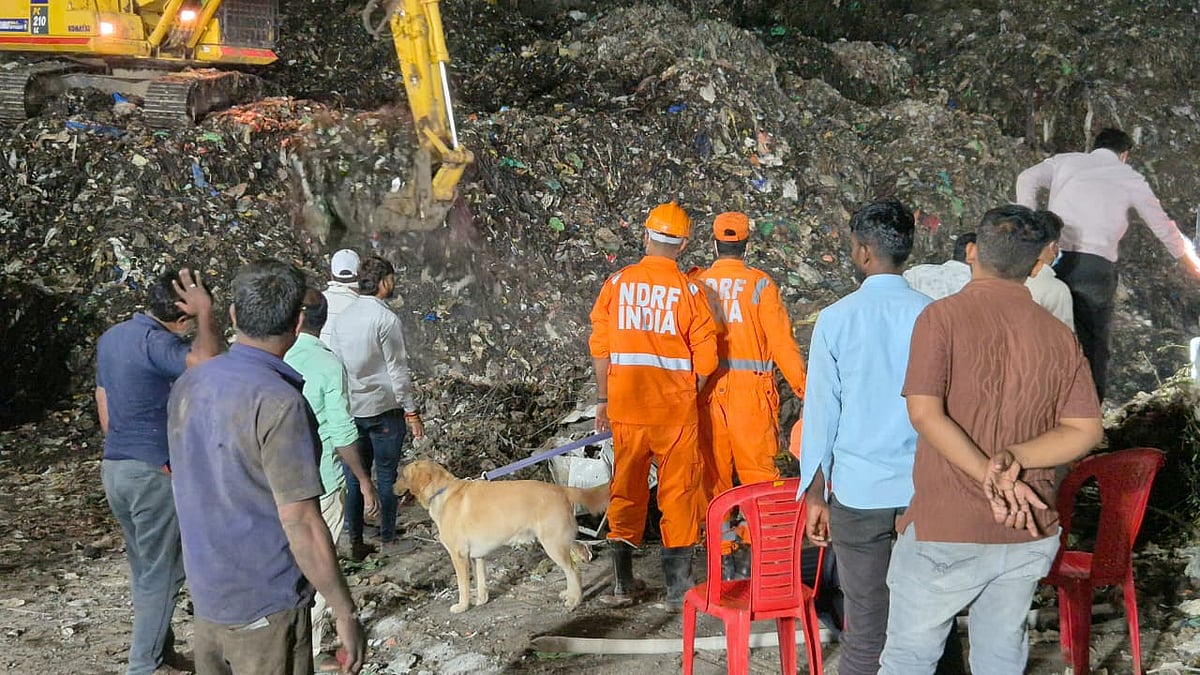
A massive heap of legacy waste collapsed onto the administrative building of the PCMC's Waste-to-Energy plant in Pune's Moshi on July 8, trapping 23 workers. The rescue operation, which lasted for nearly 84 hours, was carried out by teams from the NDRF, Indian Army, PCMC Fire Brigade, PMRDA Fire Brigade, police, and other agencies.
The operation was hampered by unstable garbage, collapsed concrete slabs, methane gas, low oxygen levels, and continuous rainfall. Heavy machinery was used carefully to avoid triggering another collapse. Fourteen workers were rescued alive, while nine lost their lives.
The body of the last missing worker, Waman Dagdu Kasbe, was recovered in the early hours of July 12, bringing the operation to an end. The focus has now shifted to investigations into the cause of the collapse, safety measures at the site, the management of legacy waste, and whether any negligence led to the tragedy.
In the days leading up to the collapse, the Pune region received over 650 mm of rainfall, causing rainwater to seep into the legacy waste mound at the Moshi garbage depot. According to PCMC, methane gas pressure built up inside the landfill, potentially contributing to the collapse.
The rescue operation began on July 8, with a multi-agency team working together to search for those trapped beneath the debris. By late night and early morning, 14 workers were rescued alive, while 9 remained trapped.
As the rescue operation entered its second day, teams battled unstable debris, methane gas, low oxygen levels, and continuous rain. The first body, identified as Bhavesh Vani, was recovered about 20 hours after the collapse.
The Maharashtra Disaster Management Minister visited the site, and an investigation into the cause of the collapse has been launched. The incident has raised concerns about the management of legacy waste and the safety measures in place at the site.
The PCMC Waste-to-Energy plant is a critical infrastructure project aimed at managing the city's waste. However, the collapse has highlighted the need for improved safety measures and better management of legacy waste.
The incident has also sparked a debate about the need for more effective disaster management and emergency response systems in the city. The rescue operation, which lasted for nearly 84 hours, was a testament to the bravery and dedication of the rescue teams.
In the aftermath of the tragedy, the focus will be on ensuring that such incidents do not happen in the future. This will require a thorough investigation into the cause of the collapse and the implementation of measures to prevent similar incidents.
The Moshi garbage depot disaster is a tragic reminder of the importance of prioritizing safety and effective waste management. As the city mourns the loss of nine lives, it is essential to learn from this tragedy and work towards creating a safer and more sustainable environment for all.
The incident has significant implications for the city's waste management systems and highlights the need for improved safety measures and better management of legacy waste. It is crucial to ensure that such incidents do not happen in the future and that the city is better equipped to handle emergencies.
In conclusion, the Moshi garbage depot disaster is a tragic incident that has claimed nine lives and highlighted the need for improved safety measures and better management of legacy waste. As the city moves forward, it is essential to prioritize safety and effective waste management to prevent similar incidents in the future.