BRICS Unveils 4 Green Practice Compendiums
BRICS Environment Ministers launch knowledge compendiums on green practices, fire management and circular economy. The documents reflect leading practices among BRICS member countries.
'%3E%3Crect%20width%3D'96'%20height%3D'96'%20fill%3D'%234A235A'%2F%3E%3Ccircle%20cx%3D'30'%20cy%3D'24'%20r%3D'44'%20fill%3D'%23fff'%20opacity%3D'.12'%2F%3E%3Ccircle%20cx%3D'60'%20cy%3D'74'%20r%3D'40'%20fill%3D'%23000'%20opacity%3D'.10'%2F%3E%3C%2Fg%3E%3Cg%20fill%3D'none'%20stroke%3D'%23fff'%20stroke-width%3D'3'%3E%3Ccircle%20cx%3D'48'%20cy%3D'48'%20r%3D'16'%2F%3E%3Cellipse%20cx%3D'48'%20cy%3D'48'%20rx%3D'6.5'%20ry%3D'16'%2F%3E%3Cline%20x1%3D'32'%20y1%3D'42'%20x2%3D'64'%20y2%3D'42'%2F%3E%3Cline%20x1%3D'32'%20y1%3D'54'%20x2%3D'64'%20y2%3D'54'%2F%3E%3C%2Fg%3E%3C%2Fsvg%3E)
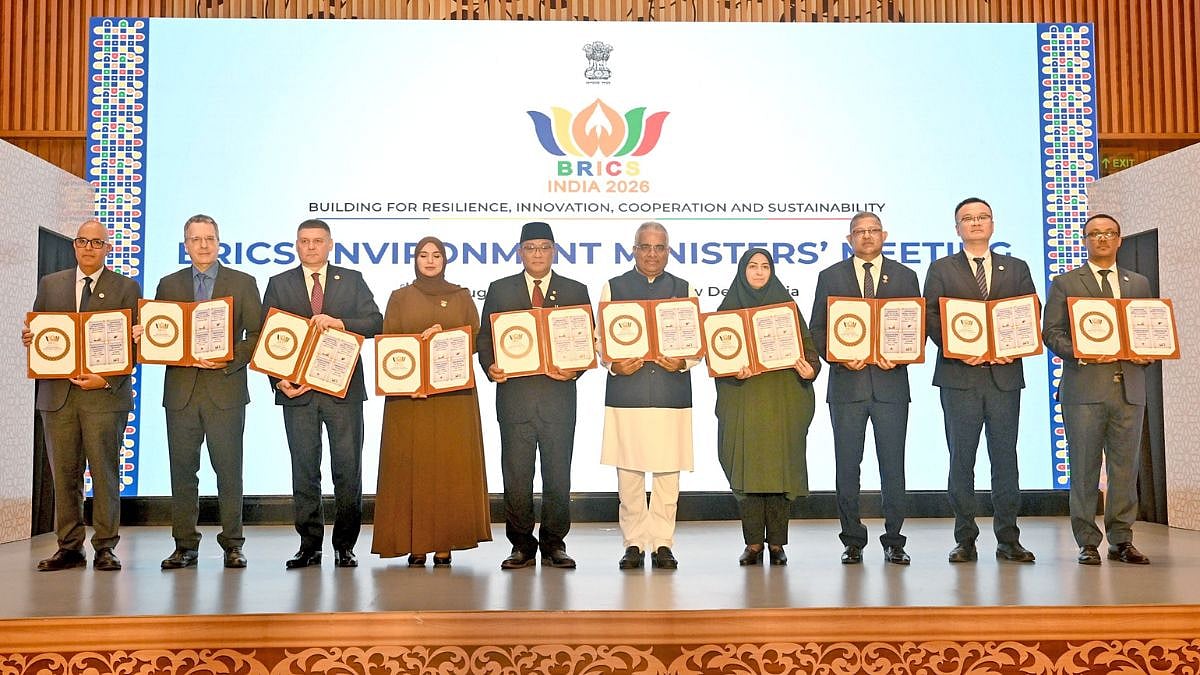
The 12th BRICS Environment Ministers’ Meeting was held in New Delhi on Tuesday, where four knowledge compendiums were unveiled by the BRICS Environment Working Group. These documents were launched by Environment Minister Bhupender Yadav and heads of delegations of BRICS member countries.
The compendiums cover various aspects of environmental conservation, including promoting sustainable lifestyles, integrated fire management, integrated landscape-based greening approaches, and extended producer responsibility frameworks. The first compendium examines how BRICS member countries are translating the concept of sustainable lifestyles into practical action.
The second compendium reflects a shared vision on fire management, spanning prevention and preparedness, early warning and early action, and response and recovery. The third document brings together experiences, good practices and policy approaches from BRICS member countries in addressing interconnected challenges of land degradation, desertification, biodiversity loss, and climate change.
The fourth compendium gathers experiences, policy approaches, regulatory instruments, and institutional models from BRICS member countries in addressing the transition towards a circular and resource-efficient economy. According to officials, the compendiums identify key areas where BRICS cooperation can be strengthened, including knowledge and experience sharing, digital traceability solutions, technical capacity building, and the development of circular business models.
The BRICS Environment Working Group has prepared these documents to reflect leading practices, knowledge systems and innovations among the BRICS member countries. The environment ministry stated that these compendiums will help in advancing resource-efficient, resilient, and sustainable economies.
The launch of these compendiums is a significant step towards promoting environmental conservation and sustainability among the BRICS member countries. It highlights the importance of cooperation and knowledge sharing in addressing environmental challenges.
The 12th BRICS Environment Ministers’ Meeting provided a platform for the environment ministers of the BRICS member countries to discuss and share their experiences on environmental conservation. The meeting emphasized the need for people-centric, implementation-oriented environmental action.
In conclusion, the unveiling of the four knowledge compendiums is a major step towards promoting environmental sustainability and conservation among the BRICS member countries. It reflects the commitment of the BRICS nations to work together in addressing environmental challenges and promoting a sustainable future.
The significance of this event lies in its potential to strengthen cooperation among the BRICS member countries in the field of environmental conservation. It also highlights the importance of knowledge sharing, digital traceability solutions, and technical capacity building in advancing resource-efficient, resilient, and sustainable economies.
Overall, the 12th BRICS Environment Ministers’ Meeting and the launch of the four knowledge compendiums are significant steps towards promoting environmental sustainability and conservation among the BRICS member countries.
Frequently asked questions
What is the purpose of the BRICS Environment Ministers’ Meeting?
The purpose of the meeting is to discuss and share experiences on environmental conservation among the BRICS member countries.
What are the four knowledge compendiums launched by BRICS?
The four compendiums cover promoting sustainable lifestyles, integrated fire management, integrated landscape-based greening approaches, and extended producer responsibility frameworks.