US National Debt Reaches $40 Trillion
US debt surpasses record $40 trillion, sparking economic concerns. Rising spending and interest costs fuel worries.
'%3E%3Crect%20width%3D'96'%20height%3D'96'%20fill%3D'%230B6E4F'%2F%3E%3Ccircle%20cx%3D'30'%20cy%3D'24'%20r%3D'44'%20fill%3D'%23fff'%20opacity%3D'.12'%2F%3E%3Ccircle%20cx%3D'60'%20cy%3D'74'%20r%3D'40'%20fill%3D'%23000'%20opacity%3D'.10'%2F%3E%3C%2Fg%3E%3Cg%20fill%3D'none'%20stroke%3D'%23fff'%20stroke-width%3D'3.2'%20stroke-linecap%3D'round'%20stroke-linejoin%3D'round'%3E%3Cpolyline%20points%3D'31%2C59%2041%2C49%2049%2C54%2063%2C37'%2F%3E%3Cpolyline%20points%3D'55%2C37%2063%2C37%2063%2C45'%2F%3E%3C%2Fg%3E%3C%2Fsvg%3E)
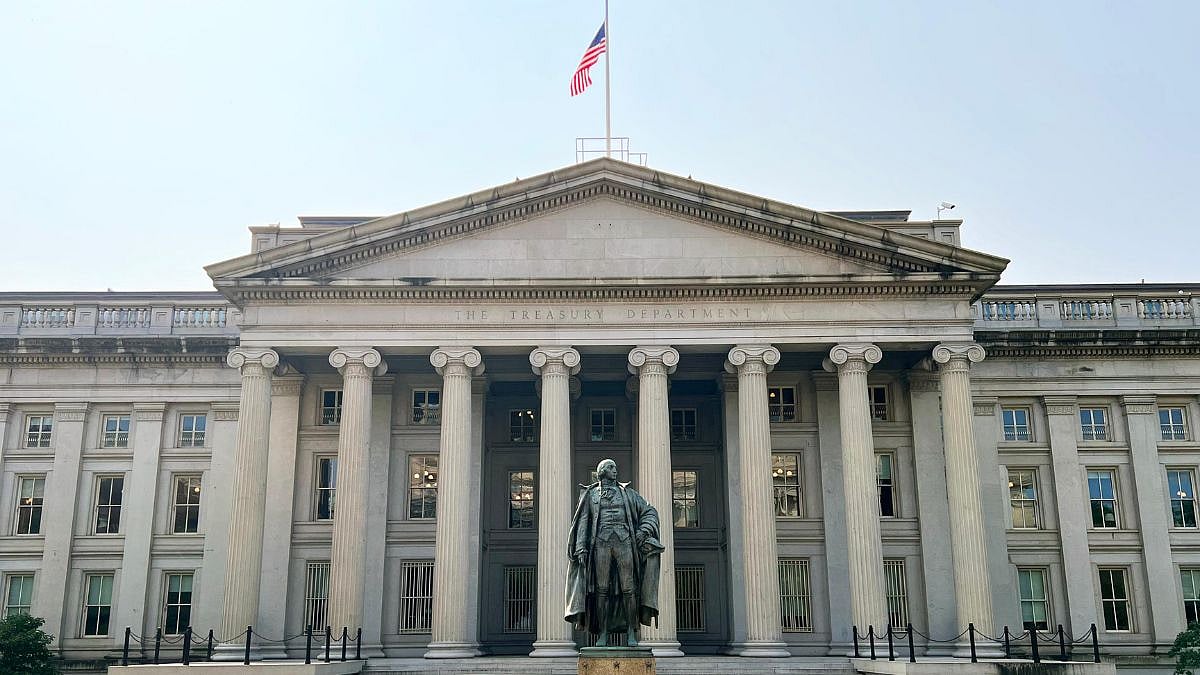
The United States' national debt has surpassed a record $40 trillion, a staggering milestone that highlights the country's growing economic concerns. This figure was reached just five months after the US hit a record $39 trillion debt in March, and $38 trillion five months before that, in October.
The unprecedented $40 trillion figure is largely due to defense costs, social programs such as Social Security and Medicare, and interest on the burgeoning deficit. These expenses make up a significant share of federal spending, sparking worries about the country's fiscal trajectory.
According to Kush Desai, a White House spokesman, the Trump administration has been focused on reducing waste, fraud, and abuse in federal spending while accelerating economic growth. However, experts argue that the exploding debt is already affecting Americans' pocketbooks by raising borrowing costs for things like mortgages and cars, lowering wages, and creating more expensive goods and services.
Advocates for a balanced budget warn that the long-term trend of borrowing more and paying more in interest will force Americans to face tougher fiscal tradeoffs ahead. Margaret Spellings, president and CEO of the Bipartisan Policy Center, stated that the federal debt is already raising the cost of living and choking out other spending and investment, threatening the economy and Americans' long-term prosperity.
The US is subject to a statutory debt limit, which Congress has the authority to set, adjust, or abolish. The Bipartisan Policy Center estimates that the US will likely reach the debt limit of $41.1 trillion sometime between late winter and mid-summer of 2027, requiring Congress to vote on whether to raise or suspend the debt limit.
The US' fiscal position is currently the worst among other developed countries, according to recent data analysis from the Organization for Economic Co-operation and Development. This milestone serves as a reminder of the need for fiscal responsibility and sustainable economic growth.
The impact of the national debt on Americans is significant, with rising borrowing costs and lower wages affecting individuals and businesses alike. As the debt continues to grow, it is essential for policymakers to address the issue and work towards a more sustainable fiscal trajectory.
In conclusion, the US national debt reaching $40 trillion is a significant milestone that highlights the country's growing economic concerns. It is crucial for policymakers to address the issue and work towards a more sustainable fiscal trajectory to ensure the long-term prosperity of the US economy.
The US national debt has significant implications for the global economy, as it can affect trade, investment, and economic growth. As the US continues to navigate its fiscal challenges, it is essential to monitor the situation closely and work towards a more stable and sustainable economic future.
Ultimately, the US national debt reaching $40 trillion serves as a reminder of the need for fiscal responsibility and sustainable economic growth. It is crucial for policymakers to address the issue and work towards a more sustainable fiscal trajectory to ensure the long-term prosperity of the US economy.
Frequently asked questions
What is the current US national debt?
The current US national debt is over $40 trillion.
What are the implications of the US national debt reaching $40 trillion?
The implications include rising borrowing costs, lower wages, and a potential impact on the global economy.