Volcanic Rock Spreads on Farms to Capture Carbon
Scientists use crushed volcanic rock to remove carbon from air, improving soil health and crop yields.
'%3E%3Crect%20width%3D'96'%20height%3D'96'%20fill%3D'%23B3261E'%2F%3E%3Ccircle%20cx%3D'30'%20cy%3D'24'%20r%3D'44'%20fill%3D'%23fff'%20opacity%3D'.12'%2F%3E%3Ccircle%20cx%3D'60'%20cy%3D'74'%20r%3D'40'%20fill%3D'%23000'%20opacity%3D'.10'%2F%3E%3C%2Fg%3E%3Cg%20fill%3D'%23fff'%3E%3Crect%20x%3D'29'%20y%3D'49'%20width%3D'8'%20height%3D'19'%20rx%3D'1'%2F%3E%3Crect%20x%3D'39'%20y%3D'40'%20width%3D'9'%20height%3D'28'%20rx%3D'1'%2F%3E%3Crect%20x%3D'50'%20y%3D'45'%20width%3D'8'%20height%3D'23'%20rx%3D'1'%2F%3E%3Crect%20x%3D'60'%20y%3D'53'%20width%3D'7'%20height%3D'15'%20rx%3D'1'%2F%3E%3Crect%20x%3D'41'%20y%3D'34'%20width%3D'5'%20height%3D'6'%2F%3E%3C%2Fg%3E%3C%2Fsvg%3E)
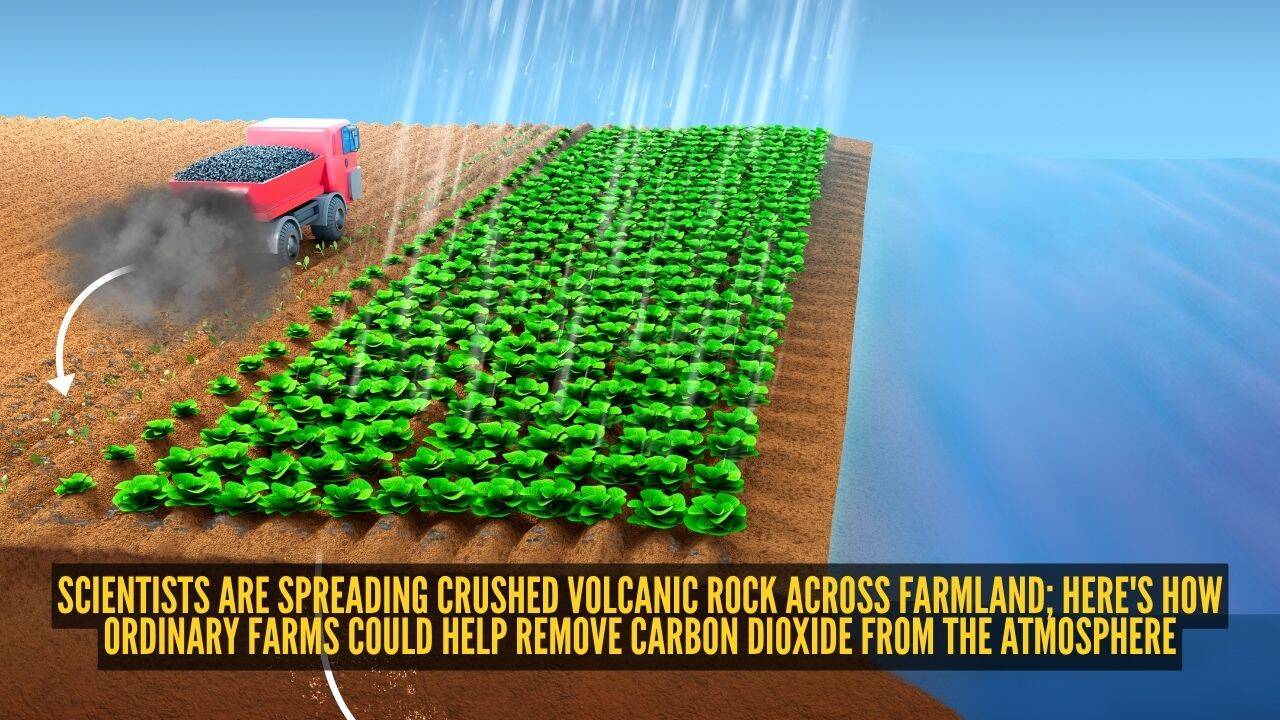
Scientists have discovered a novel method to capture carbon from the air by spreading crushed volcanic rock on farms. This innovative approach accelerates natural carbon capture processes, converting atmospheric carbon dioxide into stable bicarbonate ions for storage. The use of crushed volcanic rock, specifically basalt, not only helps in carbon removal but also releases essential nutrients, thereby improving soil health and crop yields.
The concept of using volcanic rock to capture carbon is based on the natural process of chemical weathering, where the rock reacts with carbon dioxide and water to form bicarbonate ions. These ions are then stored in the soil, reducing the amount of carbon dioxide in the atmosphere. Field experiments have shown significant potential for carbon removal using this method, alongside the added benefits of improved soil fertility and increased crop yields.
The use of basalt as a means of carbon capture is particularly promising, as it is a readily available and abundant resource. Basalt is a type of volcanic rock that is rich in minerals such as calcium and magnesium, which are essential for plant growth. When basalt is crushed and applied to soil, it releases these nutrients, improving soil health and fertility.
Researchers are currently conducting ongoing field experiments to verify the effectiveness of this method and to integrate farms into carbon removal strategies. The goal is to develop a scalable and sustainable approach to carbon capture, one that can be implemented on farms around the world. By leveraging the natural processes of chemical weathering and nutrient release, scientists hope to create a win-win situation for both the environment and agriculture.
The potential benefits of this approach are twofold. Not only can it help to reduce the amount of carbon dioxide in the atmosphere, but it can also improve soil health and increase crop yields. This can have a positive impact on food security, particularly in regions where soil degradation and nutrient depletion are significant concerns.
As the world continues to grapple with the challenges of climate change, innovative solutions like the use of crushed volcanic rock on farms offer a promising avenue for carbon removal. By harnessing the power of natural processes and leveraging the benefits of sustainable agriculture, scientists and farmers can work together to create a more sustainable and environmentally-friendly food system.
The integration of carbon capture and agriculture has the potential to be a game-changer in the fight against climate change. By using crushed volcanic rock to capture carbon and improve soil health, farmers can play a critical role in reducing greenhouse gas emissions while also improving the productivity and sustainability of their farms. As research continues to advance and the effectiveness of this method is verified, it is likely that we will see a growing adoption of this approach on farms around the world.
In conclusion, the use of crushed volcanic rock on farms offers a promising solution for carbon capture and soil improvement. With its potential to accelerate natural carbon capture processes, improve soil health, and increase crop yields, this approach has the potential to make a significant impact on the environment and agriculture. As scientists and farmers continue to work together to develop and implement this method, we can expect to see a more sustainable and environmentally-friendly food system emerge in the years to come.
The significance of this approach for India and the world cannot be overstated. As a major agricultural producer, India has a critical role to play in reducing greenhouse gas emissions and promoting sustainable agriculture. By adopting innovative solutions like the use of crushed volcanic rock, Indian farmers can contribute to a global effort to combat climate change while also improving the productivity and sustainability of their farms.
Frequently asked questions
What is the purpose of spreading crushed volcanic rock on farms?
The purpose is to capture carbon from the air and improve soil health and crop yields.
How does the crushed volcanic rock capture carbon?
It accelerates natural carbon capture processes, converting atmospheric carbon dioxide into stable bicarbonate ions for storage.