Kalyan Ganeshotsav Tableau Highlights Anti-Defection Law
A Ganeshotsav tableau in Kalyan raises questions on political loyalty and democracy. The display critiques political defections and erosion of voter trust.
'%3E%3Crect%20width%3D'96'%20height%3D'96'%20fill%3D'%23B3261E'%2F%3E%3Ccircle%20cx%3D'30'%20cy%3D'24'%20r%3D'44'%20fill%3D'%23fff'%20opacity%3D'.12'%2F%3E%3Ccircle%20cx%3D'60'%20cy%3D'74'%20r%3D'40'%20fill%3D'%23000'%20opacity%3D'.10'%2F%3E%3C%2Fg%3E%3Cg%20fill%3D'%23fff'%3E%3Crect%20x%3D'29'%20y%3D'49'%20width%3D'8'%20height%3D'19'%20rx%3D'1'%2F%3E%3Crect%20x%3D'39'%20y%3D'40'%20width%3D'9'%20height%3D'28'%20rx%3D'1'%2F%3E%3Crect%20x%3D'50'%20y%3D'45'%20width%3D'8'%20height%3D'23'%20rx%3D'1'%2F%3E%3Crect%20x%3D'60'%20y%3D'53'%20width%3D'7'%20height%3D'15'%20rx%3D'1'%2F%3E%3Crect%20x%3D'41'%20y%3D'34'%20width%3D'5'%20height%3D'6'%2F%3E%3C%2Fg%3E%3C%2Fsvg%3E)
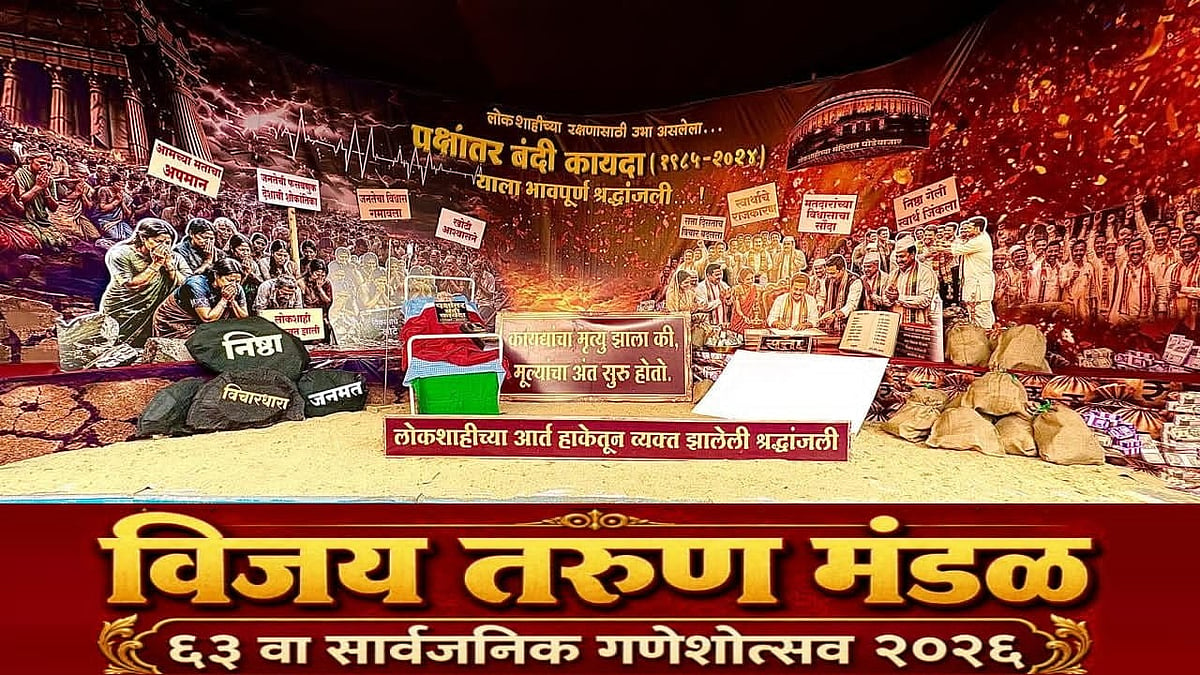
The 63rd public Ganeshotsav organised by Vijay Tarun Mandal in Rambaug, Kalyan, has used its festive platform to raise pointed questions about political defections and the state of democracy.
This year’s tableau, based on the anti-defection law and political developments over the decades, presents a sharp commentary on the alleged erosion of political loyalty and the value of the voters’ mandate.
The tableau focuses on the anti-defection law introduced in 1985 and portrays political developments from 1985 to 2024 as a reflection of what the organisers describe as the “pain of democracy”.
Rather than limiting the display to religious themes, the mandal has used symbolism and strong messaging to draw attention to the growing debate over political defections.
Several messages displayed in the tableau directly question the conduct of elected representatives. These include “Insult to our vote”, “Betrayal of the people”, “A deal over voters’ trust”, “Ideologies changed the moment power was in sight” and “Loyalty lost, self-interest won.”
The tableau uses the figure of the goddess of justice to symbolically represent the Constitution, democracy, loyalty, ideology and the people’s mandate.
These values are shown confronting the lure of political power and self-interest. The presentation also raises a central question for voters: Is the people’s mandate greater, or the attraction of power?
The mandal has sought to highlight how political switching can raise questions over the trust placed by voters in elected representatives.
The organisers argue that an electoral mandate is not merely a ticket to power but a responsibility towards the people who cast their votes.
Vijay Salvi, chief of Vijay Tarun Mandal, said the tableau is intended to encourage voters to look beyond political faces and election promises.
According to him, voters should assess candidates on their loyalty, ideology and character before exercising their franchise.
The tableau carries a broader message that the death of laws or institutions can eventually lead to the erosion of democratic values.
Its concluding appeal is unequivocal: the people’s mandate cannot become anyone’s personal property, and democracy cannot remain a slave to political power.
With its political theme and direct messaging, the tableau has added a sharp civic and democratic dimension to this year’s Ganeshotsav celebrations in Kalyan.
The event serves as a reminder of the importance of upholding democratic values and the need for elected representatives to remain true to the people who elected them.
In the context of Indian democracy, the tableau’s message is particularly relevant, as the country continues to grapple with issues of political defections and the erosion of voter trust.
The use of a public festival like Ganeshotsav to raise awareness about these issues is a testament to the power of community engagement and the importance of civic participation in shaping the democratic discourse.
Ultimately, the tableau’s message serves as a call to action for voters to remain vigilant and demand accountability from their elected representatives, ensuring that the people’s mandate is respected and upheld.
Frequently asked questions
What is the theme of the Kalyan Ganeshotsav tableau this year?
The theme of the tableau is the anti-defection law and the erosion of political loyalty and voter trust.
What message does the tableau convey to voters?
The tableau encourages voters to look beyond political faces and election promises and assess candidates on their loyalty, ideology and character.