Mumbai Metro 7A Viaduct May Need Reconstruction
Mumbai Metro 7A viaduct at risk, height clearance issue, reconstruction possible
'%3E%3Crect%20width%3D'96'%20height%3D'96'%20fill%3D'%23B3261E'%2F%3E%3Ccircle%20cx%3D'30'%20cy%3D'24'%20r%3D'44'%20fill%3D'%23fff'%20opacity%3D'.12'%2F%3E%3Ccircle%20cx%3D'60'%20cy%3D'74'%20r%3D'40'%20fill%3D'%23000'%20opacity%3D'.10'%2F%3E%3C%2Fg%3E%3Cg%20fill%3D'%23fff'%3E%3Crect%20x%3D'29'%20y%3D'49'%20width%3D'8'%20height%3D'19'%20rx%3D'1'%2F%3E%3Crect%20x%3D'39'%20y%3D'40'%20width%3D'9'%20height%3D'28'%20rx%3D'1'%2F%3E%3Crect%20x%3D'50'%20y%3D'45'%20width%3D'8'%20height%3D'23'%20rx%3D'1'%2F%3E%3Crect%20x%3D'60'%20y%3D'53'%20width%3D'7'%20height%3D'15'%20rx%3D'1'%2F%3E%3Crect%20x%3D'41'%20y%3D'34'%20width%3D'5'%20height%3D'6'%2F%3E%3C%2Fg%3E%3C%2Fsvg%3E)
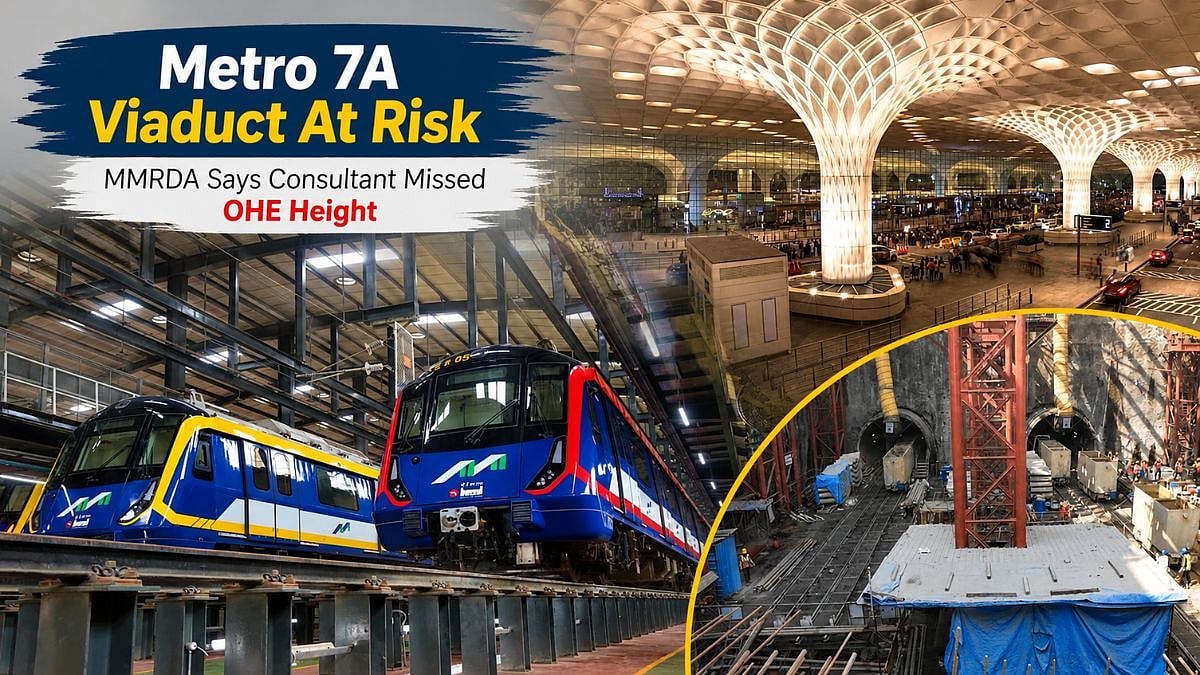
A portion of the Mumbai Metro 7A elevated viaduct may need to be dismantled and rebuilt due to a height clearance issue with the Airport Authority of India (AAI). The general consultant for the project, SYSTRA-CEG-SMCIPL, missed the required height for the overhead electrification (OHE) system.
According to MMRDA Director, Metro Project, Basavaraj MB, the consultant was responsible for coordinating the design and statutory requirements, including aviation-related height restrictions. However, the additional height required for OHE poles was not adequately highlighted and factored in at the appropriate stage of design and planning.
The Airport Colony station is within the approved height limits, but the ramp requires an additional 2.4 meters to accommodate OHE poles. Other locations on the elevated alignment require additional height ranging from 0.025 meters to 2.244 meters.
MMRDA has been pursuing the matter with AAI, Mumbai International Airport Limited, and the Ministry of Civil Aviation since April 2024. The authority has sent several letters to AAI, including on April 25 and September 24, 2024, and January 29, March 20, and May 29, 2025.
If the additional height is not approved, portions of the viaduct may require modification or reconstruction, putting civil works worth over Rs 260 crore at risk. This could lead to cost escalation and delays.
MMRDA and AAI had signed a memorandum of understanding on October 11, 2021, as a substantial portion of Metro 7A passes through airport authority land. The project is currently awaiting AAI's final technical report on applicable height clearances and any modifications that may be required.
The Mumbai Metro 7A project is a crucial infrastructure development for the city, aiming to improve connectivity and reduce traffic congestion. However, the current height clearance issue may pose a significant challenge to the project's timeline and budget.
In the event that reconstruction is necessary, it could lead to significant delays and cost overruns. MMRDA is working to resolve the issue as soon as possible to avoid any disruptions to the project.
The height clearance issue highlights the importance of careful planning and coordination in large-scale infrastructure projects. It also underscores the need for effective communication and collaboration between stakeholders to ensure that all requirements are met.
As the project moves forward, MMRDA will need to work closely with AAI and other stakeholders to find a solution to the height clearance issue. The authority will also need to ensure that any modifications or reconstruction work is carried out efficiently and effectively to minimize delays and cost overruns.
In conclusion, the Mumbai Metro 7A viaduct height clearance issue is a significant challenge that needs to be addressed urgently. MMRDA and AAI must work together to find a solution that meets the requirements of all stakeholders and ensures the project's timely completion.
The outcome of this issue will have a significant impact on the project's timeline and budget. If resolved efficiently, it could help to avoid delays and cost overruns, ensuring that the project is completed on time and within budget.
For Mumbai residents, the completion of the Metro 7A project will bring significant benefits, including improved connectivity and reduced traffic congestion. It is essential that the project is completed as soon as possible to realize these benefits.
The Mumbai Metro 7A project is a critical infrastructure development for the city, and its successful completion will have a significant impact on the quality of life for Mumbai residents. MMRDA and AAI must work together to ensure that the project is completed efficiently and effectively.
The height clearance issue is a reminder that large-scale infrastructure projects require careful planning, coordination, and collaboration between stakeholders. It highlights the importance of effective communication and problem-solving to ensure that projects are completed on time and within budget.
As the project moves forward, it is essential that MMRDA and AAI prioritize effective communication and collaboration to ensure that the height clearance issue is resolved efficiently. This will help to minimize delays and cost overruns, ensuring that the project is completed as soon as possible.
In the end, the successful completion of the Mumbai Metro 7A project will depend on the ability of MMRDA and AAI to work together to resolve the height clearance issue. If they can find a solution that meets the requirements of all stakeholders, the project can be completed on time and within budget, bringing significant benefits to Mumbai residents.
Frequently asked questions
What is the height clearance issue with the Mumbai Metro 7A viaduct?
The viaduct requires additional height to accommodate OHE poles, ranging from 0.025 meters to 2.244 meters.
What are the potential consequences of not resolving the height clearance issue?
If the issue is not resolved, portions of the viaduct may require modification or reconstruction, putting civil works worth over Rs 260 crore at risk and potentially leading to cost escalation and delays.