Scientists Freeze Optical Fibre to Boost Light-Sound Interaction
Breakthrough in optical fibre technology, light and sound interact 1,000x more
'%3E%3Crect%20width%3D'96'%20height%3D'96'%20fill%3D'%23B3261E'%2F%3E%3Ccircle%20cx%3D'30'%20cy%3D'24'%20r%3D'44'%20fill%3D'%23fff'%20opacity%3D'.12'%2F%3E%3Ccircle%20cx%3D'60'%20cy%3D'74'%20r%3D'40'%20fill%3D'%23000'%20opacity%3D'.10'%2F%3E%3C%2Fg%3E%3Cg%20fill%3D'%23fff'%3E%3Crect%20x%3D'29'%20y%3D'49'%20width%3D'8'%20height%3D'19'%20rx%3D'1'%2F%3E%3Crect%20x%3D'39'%20y%3D'40'%20width%3D'9'%20height%3D'28'%20rx%3D'1'%2F%3E%3Crect%20x%3D'50'%20y%3D'45'%20width%3D'8'%20height%3D'23'%20rx%3D'1'%2F%3E%3Crect%20x%3D'60'%20y%3D'53'%20width%3D'7'%20height%3D'15'%20rx%3D'1'%2F%3E%3Crect%20x%3D'41'%20y%3D'34'%20width%3D'5'%20height%3D'6'%2F%3E%3C%2Fg%3E%3C%2Fsvg%3E)
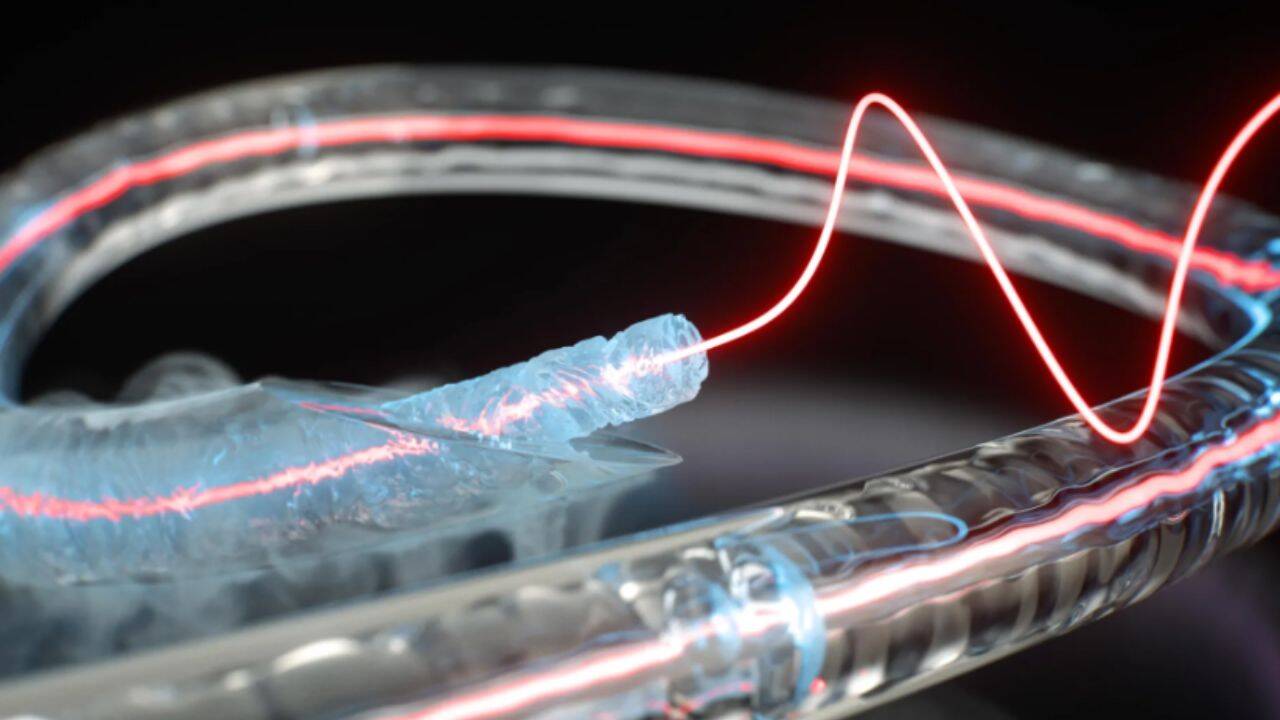
Scientists have achieved a significant breakthrough in optical fibre technology by freezing the liquid inside a special fibre to a temperature of -196°C. This extreme cooling has created conditions where light and sound waves interact more than 1,000 times more strongly than in ordinary fibres.
The team of researchers was able to demonstrate that the frozen fibre could still guide light and hypersonic sound waves, paving the way for potential applications in various fields. The breakthrough has also enabled the demonstration of optoacoustic memory, a phenomenon that could have a significant impact on the development of lower-energy photonic computing, quantum information processing, and high-precision sensing.
The discovery is a result of the unique properties of the frozen fibre, which allows for a much stronger interaction between light and sound waves. In ordinary fibres, this interaction is relatively weak, limiting the potential applications of the technology. However, by freezing the fibre to an extremely low temperature, the researchers were able to create an environment where light and sound waves can interact much more strongly.
The potential applications of this breakthrough are significant, with possibilities ranging from more efficient computing and sensing technologies to new approaches to quantum information processing. The demonstration of optoacoustic memory, in particular, could have a major impact on the development of new computing architectures and sensing technologies.
The use of frozen optical fibres could also enable the creation of more sensitive sensors, capable of detecting even slight changes in their environment. This could have significant implications for a range of fields, from medicine to materials science.
The breakthrough is also expected to have a major impact on the development of quantum computing and quantum information processing. By enabling the creation of more efficient and sensitive optical fibres, the researchers may have paved the way for the development of new quantum computing architectures and technologies.
In conclusion, the discovery of the strong interaction between light and sound waves in frozen optical fibres is a significant breakthrough with major potential implications for a range of fields. The demonstration of optoacoustic memory and the potential applications of this technology make it an exciting and promising area of research.
The breakthrough is a testament to the power of innovative research and the potential for new discoveries to drive technological advancements. As researchers continue to explore the properties and potential applications of frozen optical fibres, it is likely that we will see significant advancements in a range of fields, from computing and sensing to quantum information processing and beyond.
What this means for the future of technology is that we can expect to see more efficient, sensitive, and powerful devices and systems, capable of processing and transmitting information in new and innovative ways. The potential for breakthroughs in fields such as medicine, materials science, and quantum computing is significant, and the discovery of the strong interaction between light and sound waves in frozen optical fibres is an exciting step towards realizing these possibilities.
Frequently asked questions
What is the significance of freezing optical fibre to -196°C?
Freezing the fibre to -196°C creates conditions where light and sound waves interact more than 1,000 times more strongly than in ordinary fibres.
What are the potential applications of optoacoustic memory?
Optoacoustic memory could have potential applications in lower-energy photonic computing, quantum information processing, and high-precision sensing.