9/11 Mastermind's Confession Ruled Inadmissible
Khalid Shaikh Mohammed's FBI confessions barred, US case suffers setback
'%3E%3Crect%20width%3D'96'%20height%3D'96'%20fill%3D'%234A235A'%2F%3E%3Ccircle%20cx%3D'30'%20cy%3D'24'%20r%3D'44'%20fill%3D'%23fff'%20opacity%3D'.12'%2F%3E%3Ccircle%20cx%3D'60'%20cy%3D'74'%20r%3D'40'%20fill%3D'%23000'%20opacity%3D'.10'%2F%3E%3C%2Fg%3E%3Cg%20fill%3D'none'%20stroke%3D'%23fff'%20stroke-width%3D'3'%3E%3Ccircle%20cx%3D'48'%20cy%3D'48'%20r%3D'16'%2F%3E%3Cellipse%20cx%3D'48'%20cy%3D'48'%20rx%3D'6.5'%20ry%3D'16'%2F%3E%3Cline%20x1%3D'32'%20y1%3D'42'%20x2%3D'64'%20y2%3D'42'%2F%3E%3Cline%20x1%3D'32'%20y1%3D'54'%20x2%3D'64'%20y2%3D'54'%2F%3E%3C%2Fg%3E%3C%2Fsvg%3E)
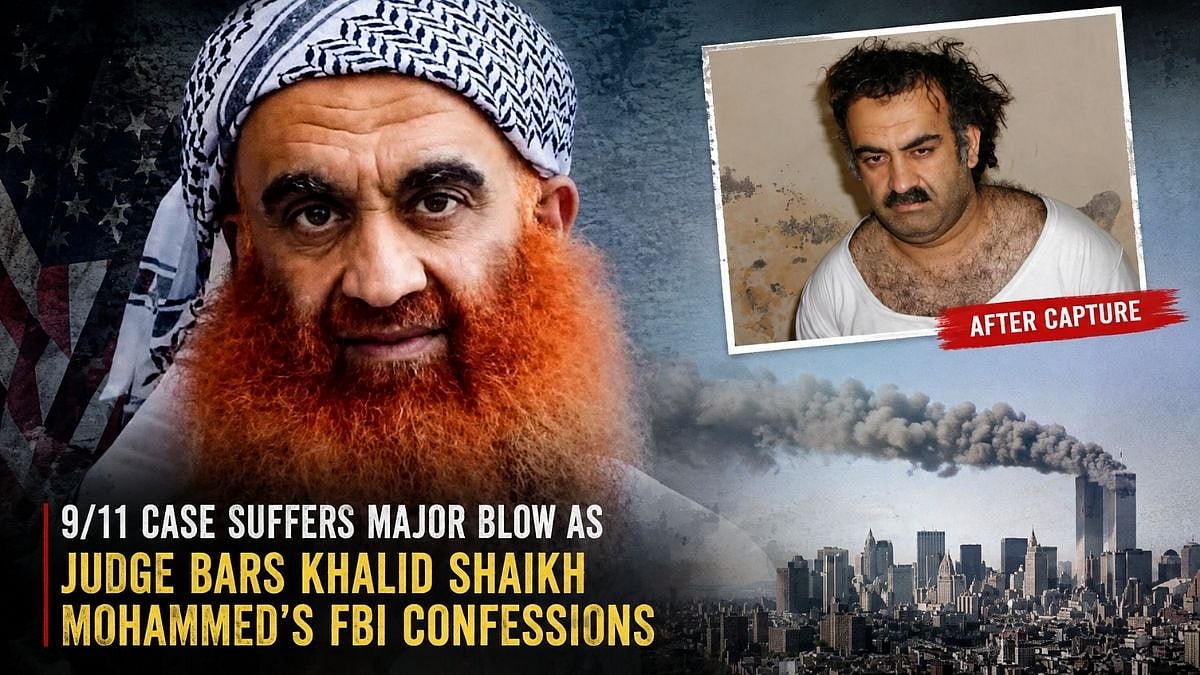
A military judge has ruled that Khalid Shaikh Mohammed's confessions to FBI agents cannot be used at his trial due to concerns over their voluntariness. Mohammed, accused of masterminding the September 11 attacks, was brutally interrogated by the CIA in secret overseas prisons before being transferred to Guantánamo Bay in 2006.
The central issue in this case is the treatment of Mohammed before FBI agents questioned him at the US Navy base in Guantánamo Bay, Cuba, in 2007. He was subjected to 183 rounds of waterboarding and other forms of severe coercion during his CIA interrogations. Prosecutors had already excluded statements Mohammed made during those interrogations from the case.
However, military judge Lt Col Michael Schrama went further, ruling that Mohammed's later statements to FBI agents in 2007 were also inadmissible. The judge cited several factors, including the continuation of the CIA's psychological conditioning and severe coercion when Mohammed was questioned at Guantánamo in 2007.
The ruling is a significant setback for the US case against Mohammed, which has remained stuck in pretrial proceedings since the defendants were arraigned in 2012. The decision to exclude Mohammed's 2007 interrogations strikes at the heart of the prosecution's case and underlines how the methods used to interrogate him years earlier continue to shape the legal proceedings.
Defence lawyers had argued that CIA torture, combined with years of isolation and solitary confinement, had conditioned Mohammed to later tell FBI agents what they wanted to hear. The judge also found that FBI agents intentionally failed to explicitly tell Mohammed that he had the right to remain silent and consult a lawyer, and that his statements could be used against him at trial.
The ruling could have serious consequences for a death-penalty case that is already scheduled to begin on June 5, 2028. If prosecutors appeal against the decision, it could further delay the trial. The case has significant implications for the use of torture and coercion in interrogations and the admissibility of evidence obtained through such means.
The September 11 attacks, which killed nearly 3,000 people in New York, Pennsylvania, and at the Pentagon, were a pivotal moment in modern history. The case against Mohammed is one of the most high-profile and complex in recent years, and the ruling is a significant development in the ongoing legal proceedings.
In conclusion, the ruling by military judge Lt Col Michael Schrama is a major setback for the US case against Khalid Shaikh Mohammed. The decision to exclude Mohammed's 2007 interrogations highlights the ongoing challenges in prosecuting cases involving torture and coercion, and the need for careful consideration of the admissibility of evidence obtained through such means.
The case will continue to be closely watched, and the implications of the ruling will be carefully considered by prosecutors, defence lawyers, and the wider legal community. The use of torture and coercion in interrogations is a highly contentious issue, and the ruling is a significant development in the ongoing debate about the admissibility of evidence obtained through such means.
The ruling is also a reminder of the complexities and challenges involved in prosecuting high-profile cases involving national security and terrorism. The case against Mohammed is a significant test of the US legal system, and the ruling is a major development in the ongoing proceedings.
Frequently asked questions
What was the reason for the judge's ruling?
The judge ruled that Khalid Shaikh Mohammed's confessions were not voluntary due to the CIA's use of torture and coercion.
What are the implications of the ruling?
The ruling could delay the trial and strike at the heart of the prosecution's case.