Bombay HC Rules Against Fresh Stamp Duty on Final Conveyance
Bombay HC sets aside Rs 2.60 crore stamp duty demand, rules final conveyance is part of earlier transaction.
'%3E%3Crect%20width%3D'96'%20height%3D'96'%20fill%3D'%23B3261E'%2F%3E%3Ccircle%20cx%3D'30'%20cy%3D'24'%20r%3D'44'%20fill%3D'%23fff'%20opacity%3D'.12'%2F%3E%3Ccircle%20cx%3D'60'%20cy%3D'74'%20r%3D'40'%20fill%3D'%23000'%20opacity%3D'.10'%2F%3E%3C%2Fg%3E%3Cg%20fill%3D'%23fff'%3E%3Crect%20x%3D'29'%20y%3D'49'%20width%3D'8'%20height%3D'19'%20rx%3D'1'%2F%3E%3Crect%20x%3D'39'%20y%3D'40'%20width%3D'9'%20height%3D'28'%20rx%3D'1'%2F%3E%3Crect%20x%3D'50'%20y%3D'45'%20width%3D'8'%20height%3D'23'%20rx%3D'1'%2F%3E%3Crect%20x%3D'60'%20y%3D'53'%20width%3D'7'%20height%3D'15'%20rx%3D'1'%2F%3E%3Crect%20x%3D'41'%20y%3D'34'%20width%3D'5'%20height%3D'6'%2F%3E%3C%2Fg%3E%3C%2Fsvg%3E)
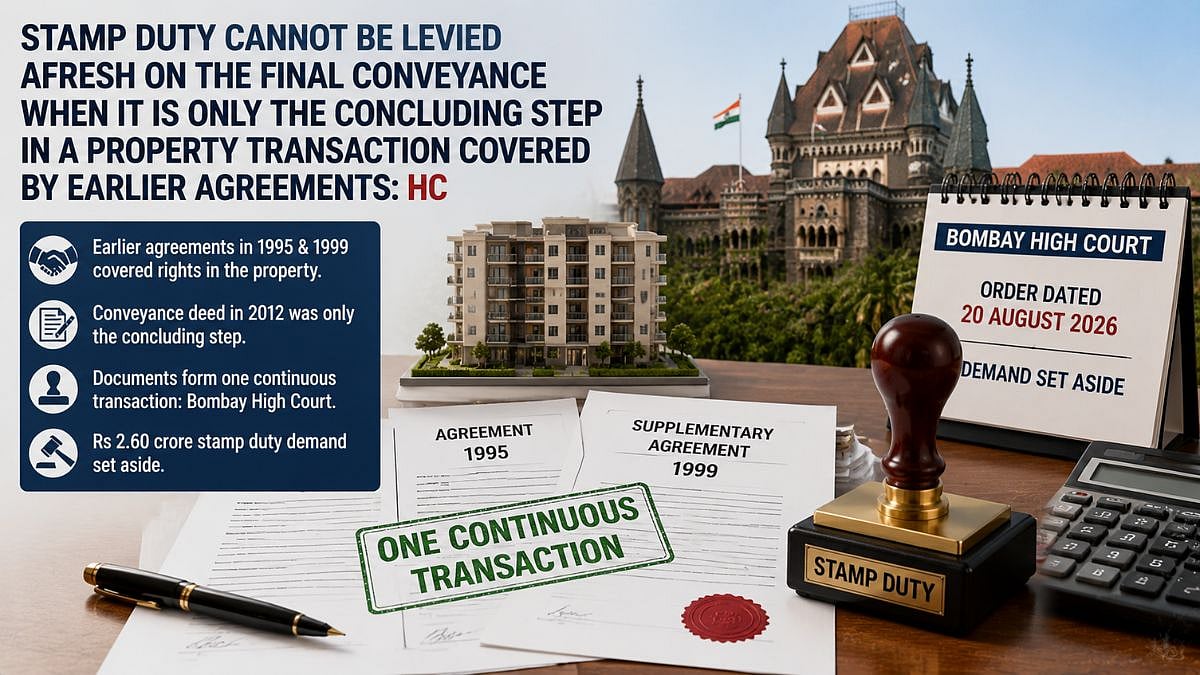
The Bombay High Court has ruled that stamp duty cannot be levied afresh on the final conveyance of a property when it is only the concluding step in a property transaction covered by earlier agreements.
On August 20, Justice Amit Borkar set aside a Rs 2.60 crore stamp duty demand against Pune-based Kumar Housing Corporation Private Limited, along with the penalty and other charges. The court held that the documents had to be viewed as part of one continuous transaction.
The dispute relates to land at Pashan in Pune, where the company had entered into agreements in 1995 and 1999 with the landowners for rights in the property and development. The agreements involved a total consideration of Rs 5 crore, and stamp duty of Rs 5 lakh was paid on the two agreements.
Later, a conveyance deed was executed in March 2012, for which the company paid another Rs 45 lakh as stamp duty. However, in 2013, the Sub-Registrar claimed that the market value of the property was around Rs 61.09 crore and demanded an additional Rs 2.60 crore in stamp duty.
The company argued that the earlier agreements, supplementary agreements, and the 2012 conveyance were all connected and formed one continuous transaction. The High Court agreed with this argument, observing that the contents of the document, the rights created under it, the nature of possession, and the legal effect of the document must be examined while deciding stamp duty liability.
The court relied on Section 4 of the Maharashtra Stamp Act, which deals with cases where several instruments are used to complete a single transaction. Justice Borkar said the provision prevents the same transaction from being treated as separate transactions simply because more than one document was executed.
The court quashed the orders passed by the stamp authorities and set aside the Rs 2,60,49,475 demand, along with the penalty and other charges. It clarified that the company was not exempt from stamp duty, but the transaction had to be considered as a whole under Section 4.
This ruling provides clarity on the application of stamp duty in cases where multiple documents are executed to complete a single transaction. It emphasizes the importance of considering the transaction as a whole, rather than treating each document as a separate transaction.
The decision is likely to have implications for property transactions in Maharashtra, where multiple documents are often executed to complete a single transaction. It may also lead to a review of similar cases where stamp duty has been levied on final conveyances.
In conclusion, the Bombay High Court's ruling provides a significant clarification on the application of stamp duty in property transactions. It highlights the need to consider the transaction as a whole, rather than treating each document as a separate transaction.
The ruling is a welcome move for property developers and buyers, as it provides clarity and certainty on the application of stamp duty. It is also likely to lead to a reduction in disputes and litigation related to stamp duty.
Overall, the Bombay High Court's decision is a significant development in the realm of property transactions in Maharashtra. It provides a clear and concise guidance on the application of stamp duty and is likely to have far-reaching implications for the property industry.
The court's decision is also a testament to the importance of considering the transaction as a whole, rather than treating each document as a separate transaction. It emphasizes the need for a holistic approach to property transactions, taking into account all the documents and agreements involved.
In the end, the Bombay High Court's ruling is a significant step forward in providing clarity and certainty on the application of stamp duty in property transactions. It is likely to have a positive impact on the property industry and provide a welcome relief to property developers and buyers.
Frequently asked questions
What was the dispute about in the Kumar Housing Corporation case?
The dispute was about the levy of fresh stamp duty on the final conveyance of a property in Pune, which was part of an earlier transaction.
What did the Bombay High Court rule in the case?
The court ruled that stamp duty cannot be levied afresh on the final conveyance when it is only the concluding step in a property transaction covered by earlier agreements.