Delhi HC Refuses To Transfer Probe From Accused Officer
Delhi HC defends due process, refuses to remove officer from inquiry. Allegations against officer not enough to justify removal.
'%3E%3Crect%20width%3D'96'%20height%3D'96'%20fill%3D'%231A5276'%2F%3E%3Ccircle%20cx%3D'30'%20cy%3D'24'%20r%3D'44'%20fill%3D'%23fff'%20opacity%3D'.12'%2F%3E%3Ccircle%20cx%3D'60'%20cy%3D'74'%20r%3D'40'%20fill%3D'%23000'%20opacity%3D'.10'%2F%3E%3C%2Fg%3E%3Cg%20fill%3D'%23fff'%3E%3Cpath%20d%3D'M31%2041%20L48%2031%20L65%2041%20Z'%2F%3E%3Crect%20x%3D'33'%20y%3D'43'%20width%3D'4'%20height%3D'17'%2F%3E%3Crect%20x%3D'41'%20y%3D'43'%20width%3D'4'%20height%3D'17'%2F%3E%3Crect%20x%3D'51'%20y%3D'43'%20width%3D'4'%20height%3D'17'%2F%3E%3Crect%20x%3D'59'%20y%3D'43'%20width%3D'4'%20height%3D'17'%2F%3E%3Crect%20x%3D'30'%20y%3D'62'%20width%3D'36'%20height%3D'4'%20rx%3D'1'%2F%3E%3C%2Fg%3E%3C%2Fsvg%3E)
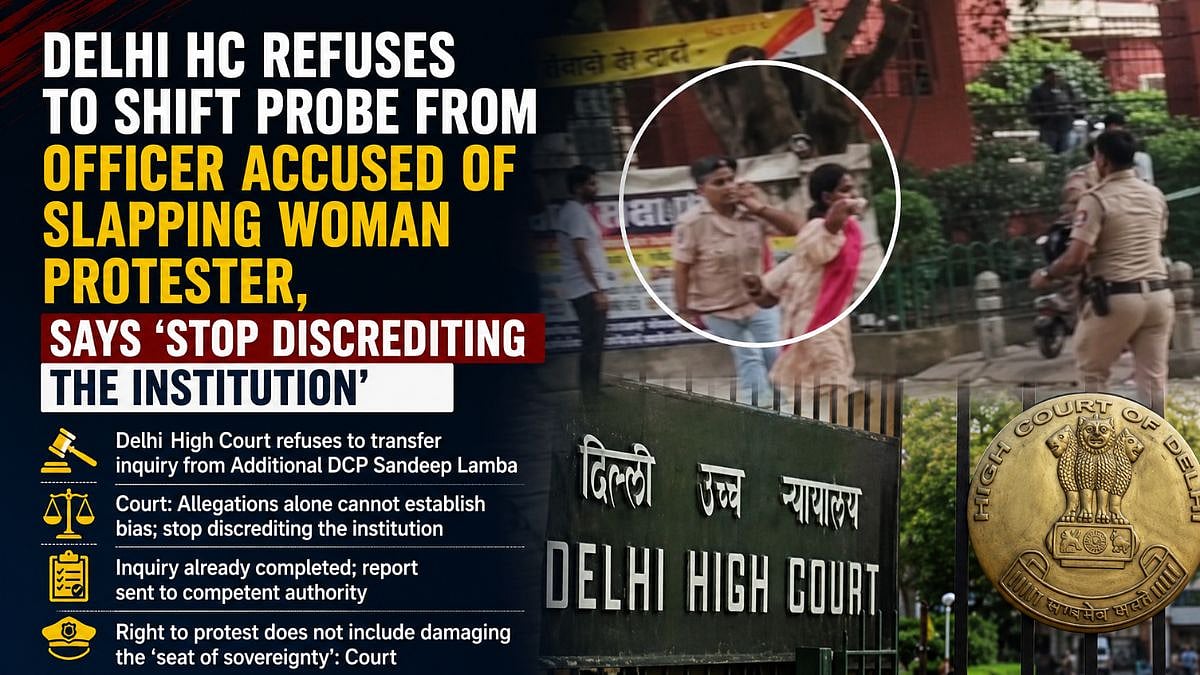
The Delhi High Court on Tuesday refused to transfer a court-directed police inquiry from the supervision of Additional Deputy Commissioner of Police (DCP) Sandeep Lamba. This decision came after videos surfaced allegedly showing Lamba slapping a woman during the Chalo Jantar Mantar protest.
Justice Girish Kathpalia observed that allegations against an officer cannot justify removing him from an inquiry without due process. The Court stressed that if Lamba had committed any wrongdoing, he would face consequences in accordance with the law, but he could not be presumed guilty before a fair trial.
The petitioner's counsel argued that Lamba's alleged act of slapping a woman had created a reasonable apprehension of bias, particularly because the petitioner herself had alleged police excesses. However, the Court questioned whether such reasoning would cast doubt on the entire Delhi Police.
The Court further observed that transferring the inquiry solely because of the allegations against Lamba would amount to holding him guilty without trial. It noted that every officer is entitled to a fair inquiry and that allegations in one incident do not automatically establish bias in every matter handled by that officer.
Referring to the viral video, Justice Kathpalia remarked that the Court could not tarnish an officer's reputation merely because he was seen allegedly slapping a lady in a video. He also pointed to the challenges faced by police during large protests, saying many people are unaware of the ground realities.
The Additional Solicitor General informed the Court that the inquiry had already been completed, with the petitioner's statement recorded and the inquiry report forwarded to the competent authority for an appropriate decision. The Court held that nothing further survived for consideration and dismissed the petition as infructuous.
Even after the order was dictated, the petitioner's counsel sought to continue pressing the plea, arguing that subsequent developments involving Lamba had strengthened the apprehension of bias. However, the Court declined to entertain the request, reiterating that allegations against the officer could not be treated as proof of prejudice in every case.
The Delhi High Court's decision highlights the importance of due process and the need to presume innocence until proven guilty. The Court's observations also underscore the challenges faced by law enforcement during large protests and the need to consider the ground realities.
In the context of the Chalo Jantar Mantar protest, the Court's decision is significant as it upholds the principle of fairness and impartiality in investigations. The decision also emphasizes the need to distinguish between allegations and proof, and to avoid discrediting institutions based on unproven allegations.
The implications of the Court's decision are far-reaching, as it sets a precedent for the handling of similar cases in the future. The decision also serves as a reminder of the importance of upholding the rule of law and ensuring that investigations are conducted in a fair and impartial manner.
In conclusion, the Delhi High Court's refusal to transfer the probe from the accused officer is a significant decision that highlights the importance of due process and the need to presume innocence until proven guilty. The decision is a reminder of the importance of upholding the rule of law and ensuring that investigations are conducted in a fair and impartial manner.
The Court's decision is also a reflection of the complexities and challenges involved in handling large protests and the need to consider the ground realities. The decision serves as a reminder of the importance of balancing the need to maintain law and order with the need to protect individual rights and freedoms.
Ultimately, the Delhi High Court's decision is a significant step towards upholding the principles of justice and fairness, and ensuring that investigations are conducted in a manner that is consistent with the rule of law.
Frequently asked questions
What was the Delhi High Court's decision regarding the probe into the alleged slapping of a woman protester?
The Delhi High Court refused to transfer the probe from the supervision of Additional Deputy Commissioner of Police (DCP) Sandeep Lamba.
What was the basis for the Court's decision?
The Court held that allegations against an officer cannot justify removing him from an inquiry without due process, and that every officer is entitled to a fair inquiry.