Mehbooba Mufti Criticizes Centre Over Wangchuk's Fast
PDP chief slams government's silence on hunger strike, Wangchuk protests NEET irregularities.
'%3E%3Crect%20width%3D'96'%20height%3D'96'%20fill%3D'%231A5276'%2F%3E%3Ccircle%20cx%3D'30'%20cy%3D'24'%20r%3D'44'%20fill%3D'%23fff'%20opacity%3D'.12'%2F%3E%3Ccircle%20cx%3D'60'%20cy%3D'74'%20r%3D'40'%20fill%3D'%23000'%20opacity%3D'.10'%2F%3E%3C%2Fg%3E%3Cg%20fill%3D'%23fff'%3E%3Cpath%20d%3D'M31%2041%20L48%2031%20L65%2041%20Z'%2F%3E%3Crect%20x%3D'33'%20y%3D'43'%20width%3D'4'%20height%3D'17'%2F%3E%3Crect%20x%3D'41'%20y%3D'43'%20width%3D'4'%20height%3D'17'%2F%3E%3Crect%20x%3D'51'%20y%3D'43'%20width%3D'4'%20height%3D'17'%2F%3E%3Crect%20x%3D'59'%20y%3D'43'%20width%3D'4'%20height%3D'17'%2F%3E%3Crect%20x%3D'30'%20y%3D'62'%20width%3D'36'%20height%3D'4'%20rx%3D'1'%2F%3E%3C%2Fg%3E%3C%2Fsvg%3E)
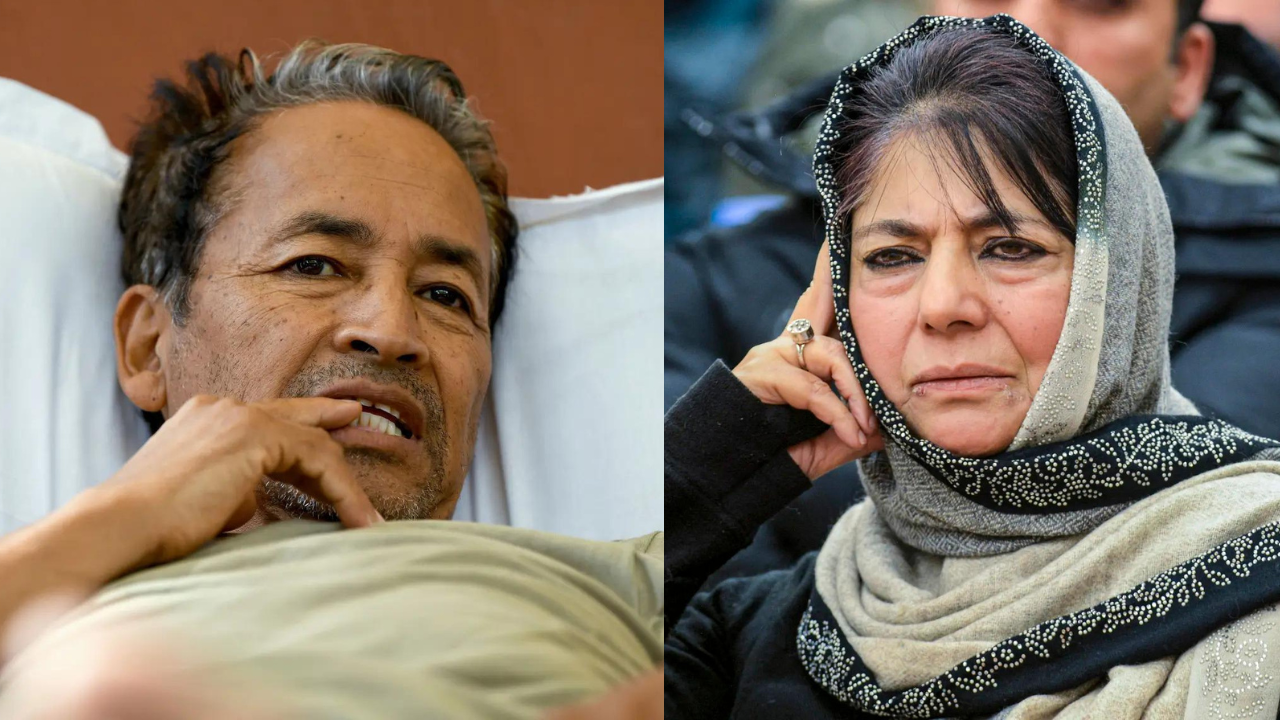
PDP chief Mehbooba Mufti has criticized the central government for its silence on the indefinite hunger strike by Sonam Wangchuk. Wangchuk has been on a hunger strike for twenty days, demanding action against alleged irregularities in the NEET examination and paper leaks.
Mehbooba Mufti slammed the government's response, stating that the silence is a sign of a colonial mindset. She expressed concern over the government's lack of action, despite Wangchuk's deteriorating health. Doctors have warned that if the hunger strike continues, Wangchuk's health could be at critical risk.
Wangchuk has vowed to continue his protest until July 20th, unless the government responds to his demands. He is seeking action against those responsible for the alleged irregularities in the NEET examination and paper leaks. The protest has sparked concerns about the fairness of the examination system and the need for greater transparency.
The NEET examination is a critical entrance exam for medical and dental colleges in India. The alleged irregularities and paper leaks have raised questions about the integrity of the examination system. Wangchuk's protest has highlighted the need for the government to take immediate action to address these concerns.
Mehbooba Mufti's criticism of the government's silence is a reflection of the growing concern about the government's response to social and political issues. The PDP chief has been a vocal critic of the government's policies, particularly with regards to the rights of citizens and the need for greater transparency and accountability.
The government's silence on Wangchuk's hunger strike has sparked widespread criticism, with many calling for immediate action to address the concerns raised by the protest. The protest has also highlighted the need for greater awareness and discussion about the issues affecting the country's education system.
In recent years, there have been several instances of paper leaks and irregularities in entrance examinations, including the NEET examination. These incidents have raised concerns about the fairness and transparency of the examination system. The government has faced criticism for its handling of these incidents, with many calling for greater action to prevent such irregularities in the future.
The outcome of Wangchuk's protest remains to be seen, but it has already sparked a significant debate about the need for greater transparency and accountability in the country's education system. The government's response to the protest will be closely watched, particularly in light of the growing concerns about the fairness and integrity of the examination system.
The issue has significant implications for the country's education system and the rights of citizens. The government's response to the protest will be a critical test of its commitment to transparency and accountability. As the protest continues, it remains to be seen how the government will respond to the demands raised by Wangchuk and the growing concerns about the education system.
In conclusion, Mehbooba Mufti's criticism of the government's silence on Wangchuk's hunger strike has highlighted the need for greater transparency and accountability in the country's education system. The protest has sparked a significant debate about the fairness and integrity of the examination system, and the government's response will be closely watched. The outcome of the protest will have significant implications for the country's education system and the rights of citizens.