US Sanctions On Iran May Hit India's Basmati Rice Trade
India's basmati rice exports to Iran worth $1.63 billion at risk due to US sanctions
'%3E%3Crect%20width%3D'96'%20height%3D'96'%20fill%3D'%234A235A'%2F%3E%3Ccircle%20cx%3D'30'%20cy%3D'24'%20r%3D'44'%20fill%3D'%23fff'%20opacity%3D'.12'%2F%3E%3Ccircle%20cx%3D'60'%20cy%3D'74'%20r%3D'40'%20fill%3D'%23000'%20opacity%3D'.10'%2F%3E%3C%2Fg%3E%3Cg%20fill%3D'none'%20stroke%3D'%23fff'%20stroke-width%3D'3'%3E%3Ccircle%20cx%3D'48'%20cy%3D'48'%20r%3D'16'%2F%3E%3Cellipse%20cx%3D'48'%20cy%3D'48'%20rx%3D'6.5'%20ry%3D'16'%2F%3E%3Cline%20x1%3D'32'%20y1%3D'42'%20x2%3D'64'%20y2%3D'42'%2F%3E%3Cline%20x1%3D'32'%20y1%3D'54'%20x2%3D'64'%20y2%3D'54'%2F%3E%3C%2Fg%3E%3C%2Fsvg%3E)
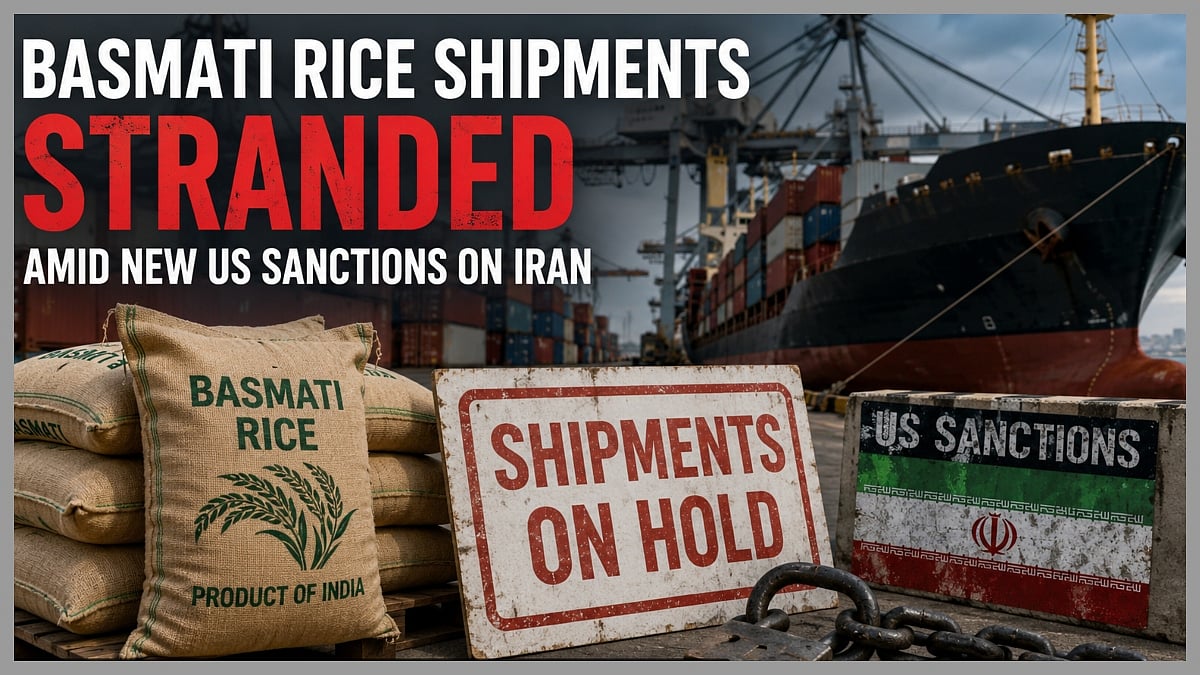
The Trump administration has announced 'Operation Economic Outcast' against Iran, aiming to weaken its economy through severe sanctions. This move has created a risk for India's basmati rice exporters, as Iran is the second-largest buyer of Indian basmati rice, accounting for around 18-20 percent of India's exports.
The new restrictions could affect nearly USD 1.63 billion in bilateral trade between India and Iran. The US has warned countries that continue trading with Tehran that they could face secondary sanctions. Treasury Secretary Scott Bessent has stressed that Iran must not be permitted to threaten international commerce or use the global financial system to fund its activities.
The United Arab Emirates has stopped trade, commercial dealings, and financial transactions with Iran, which was an important route for Indian exports, including rice, tea, and medicines. A large share of India's basmati shipments to Iran moved through Dubai ports. As a result, about 1,00,000 tonnes of basmati meant for Iran is stuck at Gujarat's Kandla and Mundra ports due to West Asian tensions and fears over US sanctions.
The Indian Rice Exporters Federation has said that alternative routes, such as Turkey, could significantly increase delivery times and freight costs. Geostrategist Brahma Chellaney has noted that the success of US sanctions depends largely on China, Iran's biggest oil buyer, which has repeatedly ignored American restrictions on Tehran.
India, however, may follow the US position, having stopped importing Iranian crude oil in 2019 and sharply reduced its trade with Iran. The Indian government has not yet made an official statement on the matter, but the uncertainty surrounding the US sanctions has already started to affect India's basmati rice trade.
The US sanctions on Iran are part of a broader effort to isolate the country economically and diplomatically. The Trump administration has been increasing pressure on Iran since withdrawing from the nuclear deal in 2018. The latest sanctions are aimed at cutting off sources of revenue to the Iranian regime and limiting its ability to fund its activities.
The impact of the US sanctions on India's basmati rice trade is still uncertain, but it is clear that the move has created a significant risk for Indian exporters. The Indian government will need to navigate the complex geopolitical situation carefully to protect the interests of its exporters and maintain its trade relationships with Iran.
In the meantime, Indian basmati rice exporters are exploring alternative routes and markets to mitigate the impact of the US sanctions. However, the uncertainty surrounding the situation is likely to continue, and the Indian government will need to monitor the situation closely to ensure that the interests of its exporters are protected.
The US sanctions on Iran are a significant development in the ongoing tensions between the two countries. The move has far-reaching implications for global trade and diplomacy, and India will need to carefully consider its position in the matter to protect its interests and maintain its relationships with both the US and Iran.
In conclusion, the US sanctions on Iran have created a significant risk for India's basmati rice trade, and the Indian government will need to navigate the complex geopolitical situation carefully to protect the interests of its exporters. The situation is still uncertain, but it is clear that the move has significant implications for global trade and diplomacy.
Frequently asked questions
What is the value of India's basmati rice exports to Iran?
India's basmati rice exports to Iran are worth around $1.63 billion.
Why are US sanctions on Iran a risk for India's basmati rice trade?
The US sanctions on Iran may lead to secondary sanctions on countries that continue trading with Tehran, which could affect India's basmati rice exports to Iran.