Mumbai Woman Loses ₹7.21 Crore In Cyber Scam
A 68-year-old retired woman was duped of ₹7.21 crore by cyber fraudsters. An FIR has been registered.
'%3E%3Crect%20width%3D'96'%20height%3D'96'%20fill%3D'%23B3261E'%2F%3E%3Ccircle%20cx%3D'30'%20cy%3D'24'%20r%3D'44'%20fill%3D'%23fff'%20opacity%3D'.12'%2F%3E%3Ccircle%20cx%3D'60'%20cy%3D'74'%20r%3D'40'%20fill%3D'%23000'%20opacity%3D'.10'%2F%3E%3C%2Fg%3E%3Cg%20fill%3D'%23fff'%3E%3Crect%20x%3D'29'%20y%3D'49'%20width%3D'8'%20height%3D'19'%20rx%3D'1'%2F%3E%3Crect%20x%3D'39'%20y%3D'40'%20width%3D'9'%20height%3D'28'%20rx%3D'1'%2F%3E%3Crect%20x%3D'50'%20y%3D'45'%20width%3D'8'%20height%3D'23'%20rx%3D'1'%2F%3E%3Crect%20x%3D'60'%20y%3D'53'%20width%3D'7'%20height%3D'15'%20rx%3D'1'%2F%3E%3Crect%20x%3D'41'%20y%3D'34'%20width%3D'5'%20height%3D'6'%2F%3E%3C%2Fg%3E%3C%2Fsvg%3E)
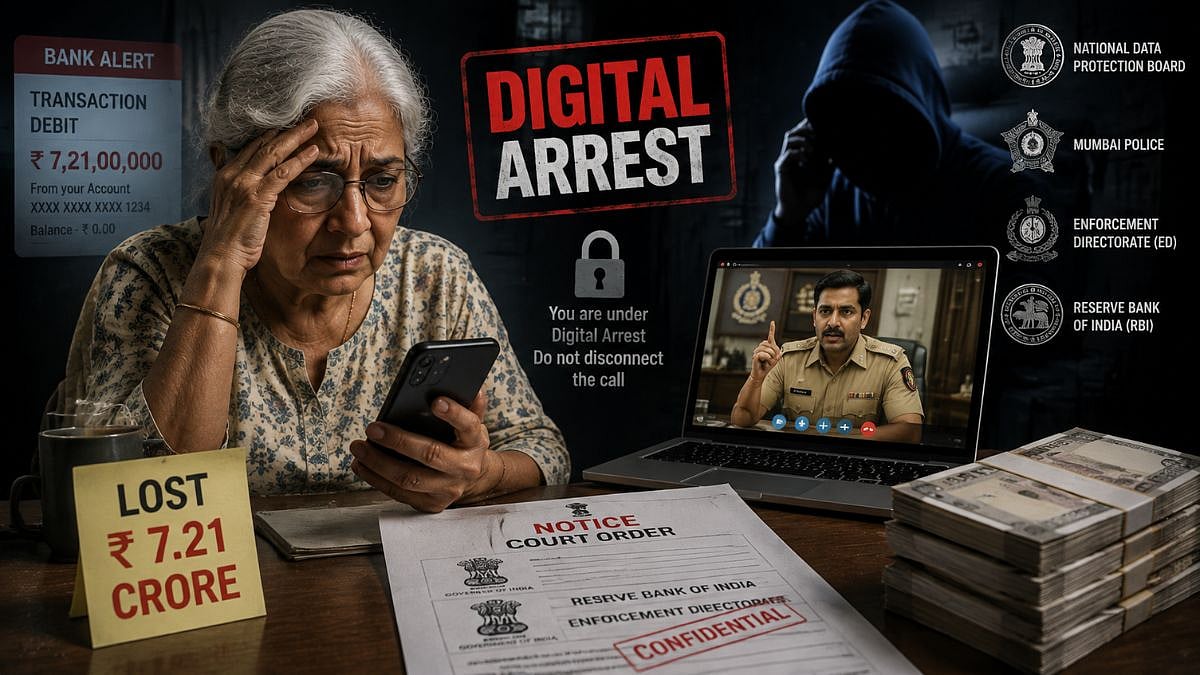
A 68-year-old retired woman from Dhobi Talao, Mumbai, was allegedly duped of ₹7.21 crore by cyber fraudsters who posed as officials of the National Data Protection Board, police, and other central agencies.
The victim, who had retired from Trail Blazer Tours India Pvt Ltd in 2024, earns her livelihood from investments in fixed deposits, mutual funds, and shares. On April 8, she received a phone call from a person who introduced himself as Rajkumar Das and claimed to be calling from the “National Data Protection Board of India”.
The caller allegedly told her that a mobile number registered in her name had been obtained from Nashik and was linked to a money-laundering case involving 249 bank accounts and debit cards. He further claimed that one of the accounts was in the victim's name and that funds had allegedly been transferred to terrorists and the banned Popular Front of India (PFI).
The fraudster warned the victim not to disclose details of the investigation to anyone. He also allegedly sent a Canara Bank debit card bearing the victim's name, convincing her that the caller was a genuine official. Later the same day, the victim received a WhatsApp video call from another number.
The caller allegedly introduced himself as ACP John Matthew from Panchavati Police Station, Nashik, and questioned her about her bank accounts, investments, and financial transactions. The fraudsters allegedly told the victim that her name had appeared in a serious criminal investigation and that her bank accounts had to be verified.
They allegedly sent her purported notices and orders in the name of courts, the Reserve Bank of India (RBI), Enforcement Directorate (ED), and other government agencies. Believing the claims to be genuine, the victim shared details of her bank accounts and investments with the accused.
The fraudsters then allegedly provided her with several bank account numbers and instructed her to transfer money to prove that her funds were legitimate. According to the complaint, the victim broke her fixed deposits, mutual funds, and savings and transferred money through RTGS.
The fraudsters allegedly continued to demand money and subsequently instructed her to use cryptocurrency. The accused allegedly directed the victim to create a Binance account and purchase USDT through P2P transactions.
She was then instructed to transfer the cryptocurrency to a wallet allegedly controlled by the fraudsters. According to the complaint, between June 27 and August 2, the victim transferred cryptocurrency worth approximately ₹1.55 crore.
Between August 3 and August 11, she allegedly transferred another ₹61.40 lakh. The total amount transferred through these transactions was approximately ₹2.06 crore.
An FIR has been registered in the South cyber police station. The Mumbai police are investigating the matter. This incident highlights the growing concern of cyber fraud in the city, where scammers are using sophisticated methods to cheat innocent people.
The police have advised citizens to be cautious while sharing personal and financial information over the phone or online. It is essential to verify the authenticity of the caller and the information provided before taking any action.
In this case, the victim lost a significant amount of money, which could have been avoided if she had been more cautious and verified the information provided by the scammers.
The incident serves as a reminder to be vigilant and take necessary precautions to avoid falling prey to such scams. The Mumbai police are working to prevent such incidents and are taking measures to educate citizens about the dangers of cyber fraud.
Frequently asked questions
What was the amount lost by the woman in the cyber scam?
The woman lost ₹7.21 crore in the cyber scam.
How did the scammers target the woman?
The scammers posed as officials of the National Data Protection Board, police, and other central agencies and kept her under a prolonged “digital arrest”.