Supreme Court Orders Elephant Clinics and Health Checks
The Supreme Court has directed the Union government to establish elephant clinics and ensure periodic health checks for captive elephants. Over 2,700 elephants will benefit from the new guidelines.
'%3E%3Crect%20width%3D'96'%20height%3D'96'%20fill%3D'%23B3261E'%2F%3E%3Ccircle%20cx%3D'30'%20cy%3D'24'%20r%3D'44'%20fill%3D'%23fff'%20opacity%3D'.12'%2F%3E%3Ccircle%20cx%3D'60'%20cy%3D'74'%20r%3D'40'%20fill%3D'%23000'%20opacity%3D'.10'%2F%3E%3C%2Fg%3E%3Cg%20fill%3D'%23fff'%3E%3Crect%20x%3D'29'%20y%3D'49'%20width%3D'8'%20height%3D'19'%20rx%3D'1'%2F%3E%3Crect%20x%3D'39'%20y%3D'40'%20width%3D'9'%20height%3D'28'%20rx%3D'1'%2F%3E%3Crect%20x%3D'50'%20y%3D'45'%20width%3D'8'%20height%3D'23'%20rx%3D'1'%2F%3E%3Crect%20x%3D'60'%20y%3D'53'%20width%3D'7'%20height%3D'15'%20rx%3D'1'%2F%3E%3Crect%20x%3D'41'%20y%3D'34'%20width%3D'5'%20height%3D'6'%2F%3E%3C%2Fg%3E%3C%2Fsvg%3E)
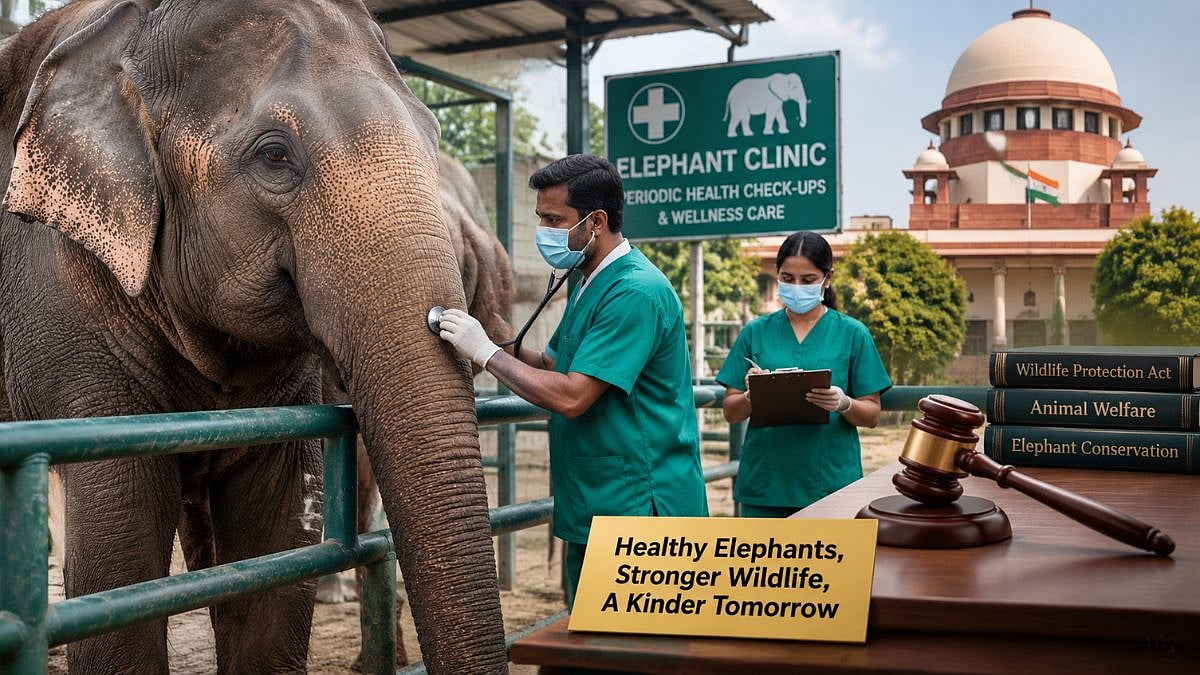
The Supreme Court on Tuesday issued a directive to the Union government to establish elephant clinics with specialized facilities for captive elephants. The clinics will provide periodic health check-ups for the elephants, and a medical record will be maintained for each animal. The Court's decision aims to improve the health and welfare of over 2,700 captive elephants across India.
A Bench of Chief Justice of India Surya Kant and Justices Joymalya Bagchi and V Mohana issued the directions while hearing a 2014 public interest litigation (PIL) concerning the captivity, trafficking, treatment, and rehabilitation of elephants across India. The Court ordered the Union government to issue mandatory guidelines and coordinate with states to introduce an effective and transparent mechanism for the establishment of elephant clinics.
The directions require owners of captive elephants to take their animals to the clinics for periodic check-ups. A medical record of each captive elephant will be maintained, and treatment will be provided regularly. The Court has sought to create a system in which the health of captive elephants can be monitored, rather than addressed only when an animal becomes seriously ill.
The Captive Elephant Health Care and Welfare Committee, formed under Project Elephant and constituted by the Ministry of Environment, Forest and Climate Change (MoEFCC), has been asked to submit a report on the status of measures it has proposed for the welfare of captive elephants. The committee must also lay down minimum standards for the housing and upkeep of elephants in captivity.
The Court has also sought information on the status of DNA profiling of captive elephants in India, whose number is estimated at over 2,700. DNA profiling is intended to track the movement of captive elephants and prevent their illegal transfer. According to the Court, 1,678 captive elephants are currently with private individuals, 47 with circuses, and 9 with other organizations.
The Supreme Court's decision is a significant step towards improving the welfare of captive elephants in India. The establishment of elephant clinics and the maintenance of medical records will help ensure that these animals receive regular veterinary care and attention. The Court's directions will also help prevent the illegal transfer and trafficking of captive elephants.
The welfare of captive elephants has been a concern in India for many years. Many of these animals are kept in poor conditions, without adequate food, water, or shelter. The Supreme Court's decision is a welcome move towards addressing these concerns and ensuring that captive elephants are treated with dignity and respect.
In conclusion, the Supreme Court's directive to establish elephant clinics and ensure periodic health checks for captive elephants is a significant step towards improving the welfare of these animals. The decision will help ensure that captive elephants receive regular veterinary care and attention, and will also help prevent the illegal transfer and trafficking of these animals.
The Indian government has been working to improve the welfare of captive elephants in recent years. The Ministry of Environment, Forest and Climate Change has launched several initiatives to protect and conserve elephants, including the establishment of elephant sanctuaries and the implementation of anti-poaching laws. The Supreme Court's decision is a welcome addition to these efforts, and will help ensure that captive elephants are treated with dignity and respect.
Overall, the Supreme Court's decision is a significant step towards improving the welfare of captive elephants in India. The establishment of elephant clinics and the maintenance of medical records will help ensure that these animals receive regular veterinary care and attention, and will also help prevent the illegal transfer and trafficking of captive elephants.
Frequently asked questions
What is the Supreme Court's directive on captive elephants?
The Supreme Court has directed the Union government to establish elephant clinics and ensure periodic health checks for captive elephants.
How many captive elephants are there in India?
There are over 2,700 captive elephants in India, with 1,678 currently with private individuals.