Penguin Random House India Pulls Sonia Gandhi's Autobiography
Penguin Random House India has withdrawn Sonia Gandhi's autobiography, 'Belonging'. The book was slated for a November release.
'%3E%3Crect%20width%3D'96'%20height%3D'96'%20fill%3D'%231A5276'%2F%3E%3Ccircle%20cx%3D'30'%20cy%3D'24'%20r%3D'44'%20fill%3D'%23fff'%20opacity%3D'.12'%2F%3E%3Ccircle%20cx%3D'60'%20cy%3D'74'%20r%3D'40'%20fill%3D'%23000'%20opacity%3D'.10'%2F%3E%3C%2Fg%3E%3Cg%20fill%3D'%23fff'%3E%3Cpath%20d%3D'M31%2041%20L48%2031%20L65%2041%20Z'%2F%3E%3Crect%20x%3D'33'%20y%3D'43'%20width%3D'4'%20height%3D'17'%2F%3E%3Crect%20x%3D'41'%20y%3D'43'%20width%3D'4'%20height%3D'17'%2F%3E%3Crect%20x%3D'51'%20y%3D'43'%20width%3D'4'%20height%3D'17'%2F%3E%3Crect%20x%3D'59'%20y%3D'43'%20width%3D'4'%20height%3D'17'%2F%3E%3Crect%20x%3D'30'%20y%3D'62'%20width%3D'36'%20height%3D'4'%20rx%3D'1'%2F%3E%3C%2Fg%3E%3C%2Fsvg%3E)
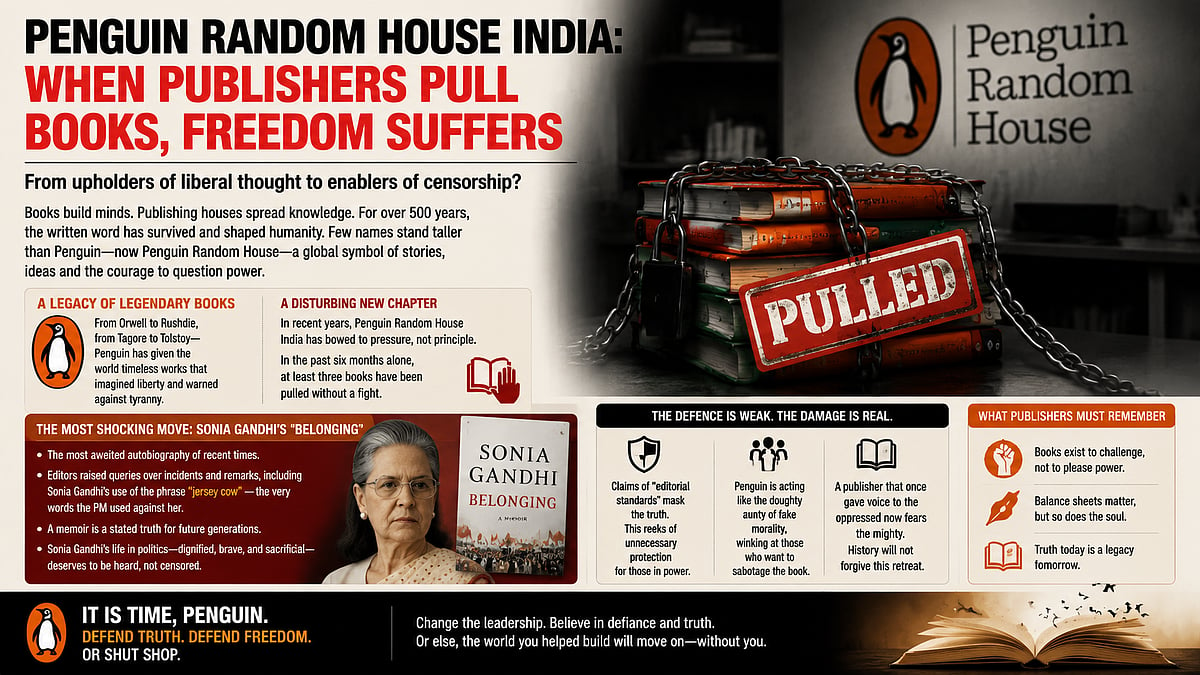
Penguin Random House India, a leading publishing house, has pulled the plug on the highly anticipated autobiography of Sonia Gandhi, 'Belonging'. The book, which was expected to be released in November, has been withdrawn by the publisher due to certain concerns raised by their editors.
The editors at Penguin had posed questions about certain incidents and comments in the book, including Sonia Gandhi's mention of the phrase 'jersey cow', which was allegedly used by the Prime Minister against her. This move has been seen as an attempt by Penguin to be overly protective of the government, rather than standing up for the freedom of expression that books embody.
Penguin Random House India has been criticized for its decision to withdraw the book, with many seeing it as a betrayal of the values that the publishing house has long stood for. The company has been accused of prioritizing its balance sheet over its commitment to publishing works that challenge the status quo and promote dissenting voices.
The withdrawal of Sonia Gandhi's autobiography is not an isolated incident. Over the past six months, Penguin Random House India has pulled at least three books, all of which were seen as critical of the government. This has raised concerns about the publisher's willingness to cave in to pressure from the ruling party, rather than standing up for the rights of authors and the freedom of expression.
Sonia Gandhi's autobiography, 'Belonging', was highly anticipated and was expected to provide a unique insight into the life of one of India's most prominent politicians. The book was seen as an opportunity for future generations to learn about the life and times of Sonia Gandhi, who has led an exemplary life in politics, marked by dignity, silent defiance, and sacrifice.
The decision to withdraw the book has been met with widespread criticism, with many seeing it as a blow to the freedom of expression and the publishing industry as a whole. It has also raised questions about the role of publishing houses in promoting dissenting voices and challenging the status quo.
Penguin Random House India's decision to withdraw Sonia Gandhi's autobiography is a stark reminder of the challenges faced by authors and publishers in India today. The country has a long tradition of promoting freedom of expression and dissenting voices, but recent events have raised concerns about the willingness of publishers to stand up for these values.
In recent years, Penguin Random House India has faced criticism for its handling of controversial books. The company has been accused of prioritizing its commercial interests over its commitment to publishing works that challenge the status quo. This has led to calls for the company to change its leadership and prioritize its commitment to freedom of expression and dissenting voices.
The withdrawal of Sonia Gandhi's autobiography is a significant blow to the publishing industry in India. It has raised concerns about the willingness of publishers to stand up for the freedom of expression and the rights of authors. It has also highlighted the need for publishing houses to prioritize their commitment to promoting dissenting voices and challenging the status quo, rather than caving in to pressure from the ruling party.
In conclusion, the decision by Penguin Random House India to withdraw Sonia Gandhi's autobiography is a significant setback for the publishing industry in India. It has raised concerns about the willingness of publishers to stand up for the freedom of expression and the rights of authors. It has also highlighted the need for publishing houses to prioritize their commitment to promoting dissenting voices and challenging the status quo, rather than caving in to pressure from the ruling party.
The incident has sparked a wider debate about the role of publishing houses in promoting freedom of expression and dissenting voices. It has also raised questions about the impact of government pressure on the publishing industry and the need for publishers to stand up for their values and principles.
As the publishing industry in India continues to evolve, it is essential that publishers prioritize their commitment to freedom of expression and dissenting voices. This requires a willingness to stand up for the rights of authors and to challenge the status quo, even in the face of pressure from the ruling party. Only by doing so can publishers ensure that they remain true to their values and principles, and that they continue to play a vital role in promoting the freedom of expression and the growth of the human mind.
The decision by Penguin Random House India to withdraw Sonia Gandhi's autobiography is a stark reminder of the challenges faced by authors and publishers in India today. It has highlighted the need for publishers to prioritize their commitment to freedom of expression and dissenting voices, and to stand up for the rights of authors, even in the face of pressure from the ruling party.
In the end, the withdrawal of Sonia Gandhi's autobiography is a significant blow to the publishing industry in India. It has raised concerns about the willingness of publishers to stand up for the freedom of expression and the rights of authors. It has also highlighted the need for publishing houses to prioritize their commitment to promoting dissenting voices and challenging the status quo, rather than caving in to pressure from the ruling party.
Frequently asked questions
Why did Penguin Random House India pull Sonia Gandhi's autobiography?
The publisher cited concerns over certain incidents and comments in the book, including Sonia Gandhi's mention of the phrase 'jersey cow'.
What is the significance of Sonia Gandhi's autobiography?
The book was expected to provide a unique insight into the life of one of India's most prominent politicians and was seen as an opportunity for future generations to learn about her life and times.