Nashik Dam Water Storage Reaches 82.94%
Nashik dam water storage increases, several reservoirs fill to capacity
'%3E%3Crect%20width%3D'96'%20height%3D'96'%20fill%3D'%23B3261E'%2F%3E%3Ccircle%20cx%3D'30'%20cy%3D'24'%20r%3D'44'%20fill%3D'%23fff'%20opacity%3D'.12'%2F%3E%3Ccircle%20cx%3D'60'%20cy%3D'74'%20r%3D'40'%20fill%3D'%23000'%20opacity%3D'.10'%2F%3E%3C%2Fg%3E%3Cg%20fill%3D'%23fff'%3E%3Crect%20x%3D'29'%20y%3D'49'%20width%3D'8'%20height%3D'19'%20rx%3D'1'%2F%3E%3Crect%20x%3D'39'%20y%3D'40'%20width%3D'9'%20height%3D'28'%20rx%3D'1'%2F%3E%3Crect%20x%3D'50'%20y%3D'45'%20width%3D'8'%20height%3D'23'%20rx%3D'1'%2F%3E%3Crect%20x%3D'60'%20y%3D'53'%20width%3D'7'%20height%3D'15'%20rx%3D'1'%2F%3E%3Crect%20x%3D'41'%20y%3D'34'%20width%3D'5'%20height%3D'6'%2F%3E%3C%2Fg%3E%3C%2Fsvg%3E)
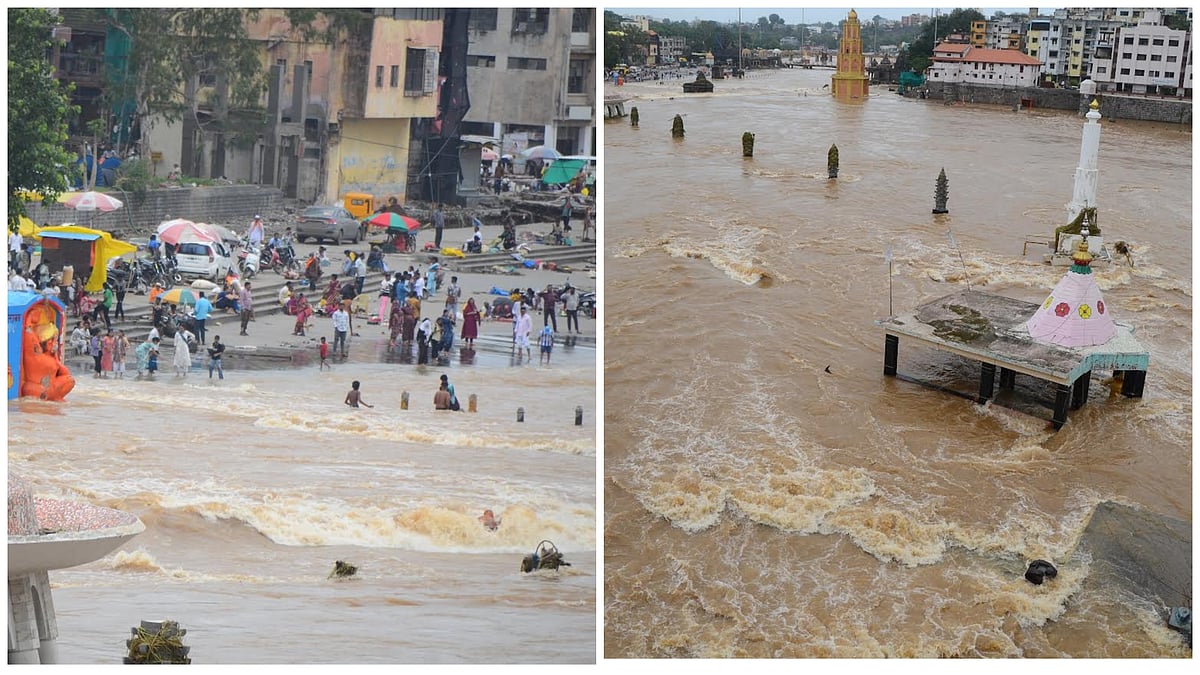
Nashik district's usable water storage in major and medium dams has reached 82.94% as of Monday morning, July 28.
The total designed usable storage capacity across 26 dams is 70,619 million cubic feet (MCFT), with 58,568 MCFT of water currently available.
This is a significant increase from the same day last year, when the storage level stood at 70.53% (49,805 MCFT).
The Gangapur dam complex, which supplies drinking water to Nashik city, currently holds 88.44% of its storage capacity.
The individual dams within the complex have the following storage levels: Gangapur at 83.96%, Kashyapi at 93.20%, Gautami Godavari at 92.18%, and Alandi at 100%.
Other dams in the district have also reached full capacity, including Bhavli, Valdevi, Bham, Bhojapur, Haranbari, and Kelzar.
The Darna dam is filled to 86.33%, while the Mukane dam holds 62.33% storage, and the Kadwa dam holds 83.12%.
The Palkhed dam complex holds 77.94% water, and the Girna valley dam complex holds 86.63%.
A total of 70,296 cusecs of water is currently being discharged from the dams, with the highest volume of 43,068 cusecs being released from the Nandur-Madhyameshwar weir.
This inflow is reaching the Jayakwadi Dam, raising hopes of relief for the Marathwada region.
The Irrigation Department is constantly monitoring dam storage levels and discharge rates, taking rainfall forecasts into account.
Assurances have been given that the water supply to Nashik city and its surrounding areas will remain uninterrupted.
The increased water storage in Nashik's dams is a result of this year's rainfall, which has led to a significant increase in storage levels.
Many dams have filled to 100% capacity, and large-scale discharge is underway.
The situation is being closely monitored by the Irrigation Department to ensure that the water supply remains stable and uninterrupted.
The department is working to manage the water levels and discharge rates to provide relief to the affected regions.
In conclusion, the increased water storage in Nashik's dams is a positive development, and the Irrigation Department's efforts to manage the water levels and discharge rates are crucial in providing relief to the affected regions.
The situation will continue to be monitored, and necessary steps will be taken to ensure that the water supply remains stable and uninterrupted.
Frequently asked questions
What is the current water storage level in Nashik's dams?
The current water storage level in Nashik's dams is 82.94%.
Which dams have filled to 100% capacity?
The dams that have filled to 100% capacity include Alandi, Bhavli, Valdevi, Bham, Bhojapur, Haranbari, and Kelzar.