Marathi Abhyas Kendra Opposes SCERT Language Initiative
Marathi Abhyas Kendra opposes SCERT's language initiative, seeks withdrawal. Initiative adds burden on students and teachers.
'%3E%3Crect%20width%3D'96'%20height%3D'96'%20fill%3D'%23B3261E'%2F%3E%3Ccircle%20cx%3D'30'%20cy%3D'24'%20r%3D'44'%20fill%3D'%23fff'%20opacity%3D'.12'%2F%3E%3Ccircle%20cx%3D'60'%20cy%3D'74'%20r%3D'40'%20fill%3D'%23000'%20opacity%3D'.10'%2F%3E%3C%2Fg%3E%3Cg%20fill%3D'%23fff'%3E%3Crect%20x%3D'29'%20y%3D'49'%20width%3D'8'%20height%3D'19'%20rx%3D'1'%2F%3E%3Crect%20x%3D'39'%20y%3D'40'%20width%3D'9'%20height%3D'28'%20rx%3D'1'%2F%3E%3Crect%20x%3D'50'%20y%3D'45'%20width%3D'8'%20height%3D'23'%20rx%3D'1'%2F%3E%3Crect%20x%3D'60'%20y%3D'53'%20width%3D'7'%20height%3D'15'%20rx%3D'1'%2F%3E%3Crect%20x%3D'41'%20y%3D'34'%20width%3D'5'%20height%3D'6'%2F%3E%3C%2Fg%3E%3C%2Fsvg%3E)
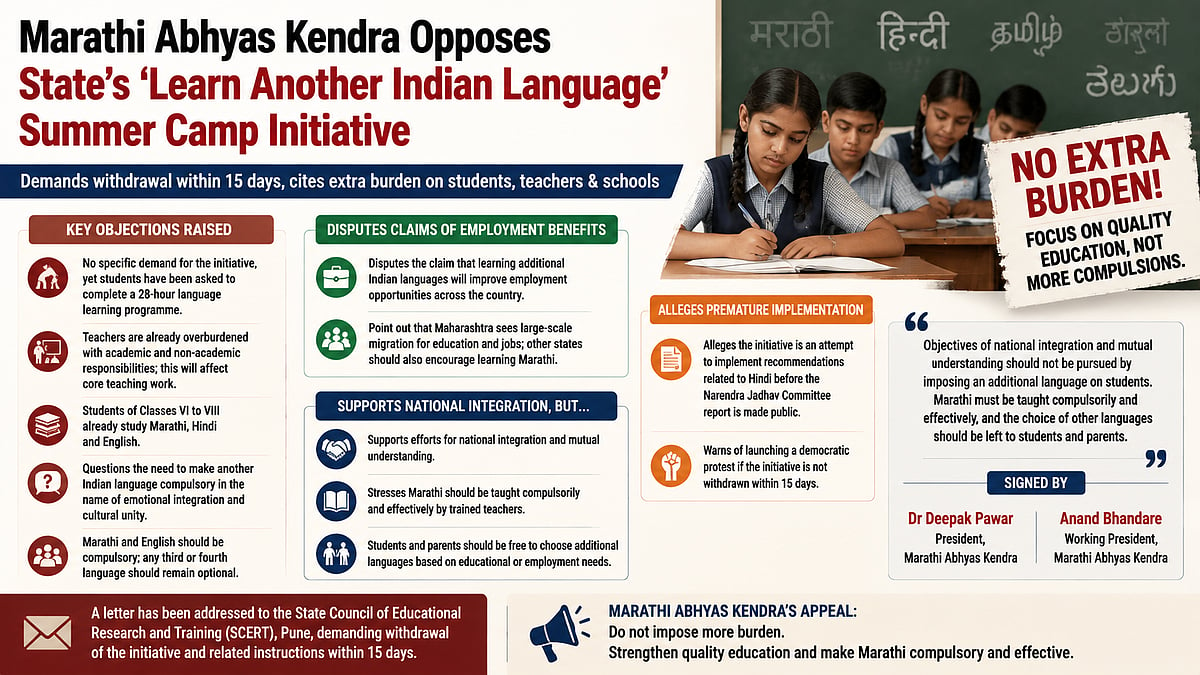
The Marathi Abhyas Kendra has opposed the State Council of Educational Research and Training's (SCERT) proposed 'Learn Another Indian Language' initiative under the Indian Languages Summer Camp.
The organisation has submitted a letter to SCERT, demanding the withdrawal of the initiative within 15 days, citing that it would place an additional academic burden on students, teachers, and schools.
According to the Marathi Abhyas Kendra, students in Classes VI to VIII are already studying Marathi, Hindi, and English, and there is no need to make another Indian language compulsory. The organisation argued that introducing another compulsory activity could affect the core teaching work of teachers, who are already burdened with several academic and non-academic responsibilities.
The Marathi Abhyas Kendra also disputed the claim that learning additional Indian languages would improve employment opportunities across the country. Instead, it suggested that other states should also encourage the learning of Marathi, given the significant migration of people from Maharashtra to other states for education and employment.
While supporting efforts to promote national integration and mutual understanding, the Marathi Abhyas Kendra said these objectives should not be pursued by imposing an additional language on students. The organisation stressed that Marathi should be taught compulsorily and effectively by trained teachers, while students and parents should be free to decide which additional languages are relevant to their educational or employment needs.
The Marathi Abhyas Kendra alleged that the initiative appeared to be an attempt to implement recommendations related to Hindi before the report of the Narendra Jadhav Committee had been made public. The organisation warned that it would consider launching a democratic protest if the initiative was not withdrawn within the stipulated period.
The letter was signed by Dr Deepak Pawar, president of the Marathi Abhyas Kendra, and Anand Bhandare, the organisation's working president.
The opposition to the SCERT's initiative highlights the ongoing debate about language education in India. The Marathi Abhyas Kendra's concerns about the additional burden on students and teachers are valid, and it remains to be seen how SCERT will respond to the organisation's demands.
In the context of Maharashtra, where Marathi is the official language, the Marathi Abhyas Kendra's emphasis on promoting the language is understandable. However, the organisation's opposition to the SCERT's initiative also raises questions about the role of language education in promoting national integration and cultural unity.
Ultimately, the decision to introduce another Indian language as a compulsory subject will depend on the outcome of the Marathi Abhyas Kendra's demands and the response of SCERT. The issue is likely to be closely watched by educators, policymakers, and language advocates in Maharashtra and beyond.
The Marathi Abhyas Kendra's stance on the issue reflects the complex and often contentious nature of language education in India. As the country continues to grapple with the challenges of promoting national integration and cultural unity, the debate over language education is likely to remain a contentious issue.
In conclusion, the Marathi Abhyas Kendra's opposition to the SCERT's 'Learn Another Indian Language' initiative highlights the need for a nuanced and thoughtful approach to language education in India. By considering the concerns of educators, policymakers, and language advocates, it is possible to promote national integration and cultural unity while also respecting the diversity of languages and cultures in India.
The issue is significant for Mumbai and Maharashtra, as it affects the education system and the promotion of the Marathi language. The Marathi Abhyas Kendra's demands and the response of SCERT will be closely watched, and the outcome will have implications for language education in the state.
Frequently asked questions
What is the Marathi Abhyas Kendra's objection to the SCERT's language initiative?
The Marathi Abhyas Kendra objects to the initiative because it would place an additional academic burden on students, teachers, and schools.
What is the Marathi Abhyas Kendra's stance on the promotion of national integration and cultural unity?
The Marathi Abhyas Kendra supports efforts to promote national integration and mutual understanding, but opposes the imposition of an additional language on students.