Sensex Opens 0.17% Lower At 77,131
Indian equity benchmarks decline, metal and IT stocks lead decline.
'%3E%3Crect%20width%3D'96'%20height%3D'96'%20fill%3D'%230B6E4F'%2F%3E%3Ccircle%20cx%3D'30'%20cy%3D'24'%20r%3D'44'%20fill%3D'%23fff'%20opacity%3D'.12'%2F%3E%3Ccircle%20cx%3D'60'%20cy%3D'74'%20r%3D'40'%20fill%3D'%23000'%20opacity%3D'.10'%2F%3E%3C%2Fg%3E%3Cg%20fill%3D'none'%20stroke%3D'%23fff'%20stroke-width%3D'3.2'%20stroke-linecap%3D'round'%20stroke-linejoin%3D'round'%3E%3Cpolyline%20points%3D'31%2C59%2041%2C49%2049%2C54%2063%2C37'%2F%3E%3Cpolyline%20points%3D'55%2C37%2063%2C37%2063%2C45'%2F%3E%3C%2Fg%3E%3C%2Fsvg%3E)
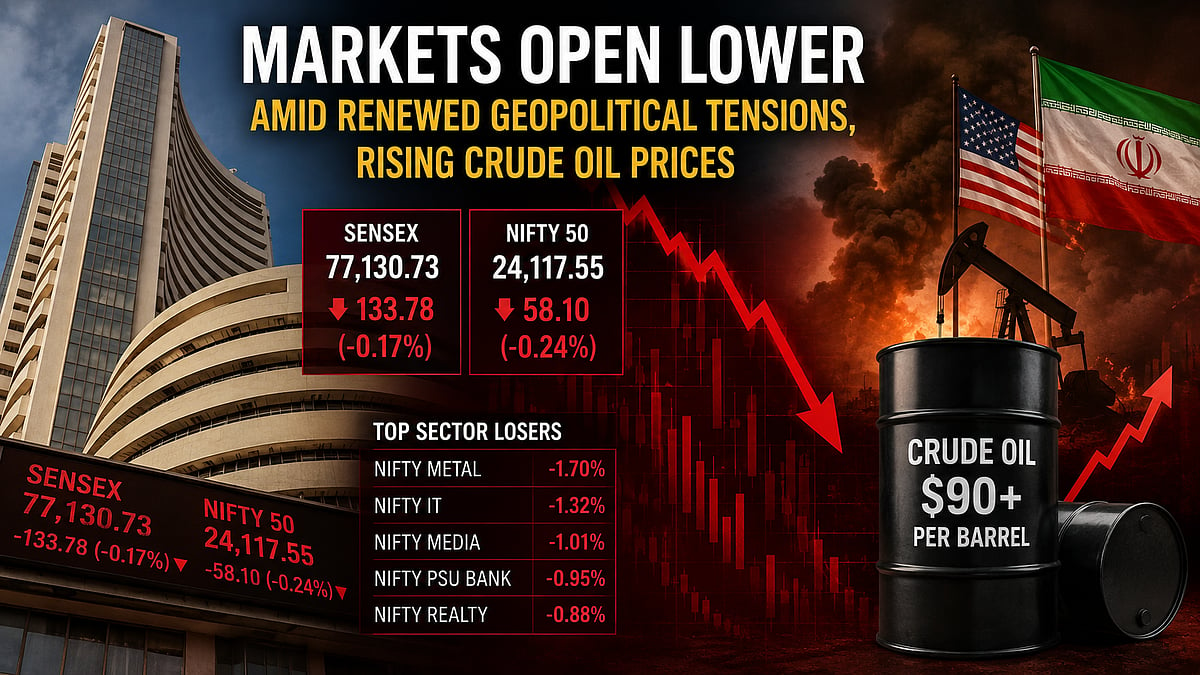
Indian equity benchmarks opened lower on Monday, with the Sensex declining 133.78 points to 77,130.73 and the Nifty falling 58.10 points to 24,117.55. The decline was attributed to weak Asian markets, rising crude oil prices, and renewed geopolitical tensions in the Middle East.
The selling was visible across most sectors, with Nifty Metal emerging as the biggest laggard, falling 1.70 per cent. Nifty IT declined 1.32 per cent, while media and PSU Bank indices slipped up to 1 per cent. Realty, cement, chemicals, and FMCG stocks also remained under pressure.
However, Nifty Private Bank bucked the trend, edging 0.06 per cent higher. The renewed US-Iran tensions pushed international oil prices sharply higher, with Brent crude climbing more than 2 per cent to $90.67 a barrel and WTI crude advancing 2.06 per cent to $85.09.
Investors were also assessing US Federal Reserve Chair Kevin Warsh's hawkish comments, which raised expectations of a possible rate increase at the September 15-16 FOMC meeting. The negative global cues added to domestic pressure, with Japan's Nikkei declining more than 1 per cent, South Korea's KOSPI falling over 1 per cent, and Hong Kong's Hang Seng dropping around 0.7 per cent.
HDFC Bank also remained in focus amid speculation over the successor to CEO Sasidhar Jagadishan. Technically, 24,060 remains an important level for Nifty, and a move above 24,215 could indicate renewed strength. However, a sustained break below 24,060 could expose the index to further downside.
The Indian equity market is likely to remain cautious in the near term, with the 78,000 and 24,400 levels acting as key hurdles for the bulls. The market will be closely watching the developments in the Middle East and the US Federal Reserve's decision on interest rates.
The decline in the Indian equity market is a reflection of the global economic uncertainty and the impact of geopolitical tensions on the market. The rise in crude oil prices is also a concern for India, as it is a major importer of crude oil.
In conclusion, the Indian equity market opened lower on Monday, with the Sensex and Nifty declining due to weak Asian markets, rising crude oil prices, and renewed geopolitical tensions. The market is likely to remain cautious in the near term, with the 78,000 and 24,400 levels acting as key hurdles for the bulls.
The Indian economy is closely linked to the global economy, and any developments in the global market can have a significant impact on the Indian market. The rise in crude oil prices and the geopolitical tensions in the Middle East are likely to continue to impact the Indian market in the near term.
Overall, the Indian equity market is expected to remain volatile in the near term, with the global economic uncertainty and the geopolitical tensions in the Middle East being the major factors driving the market.
Frequently asked questions
Why did the Indian equity market decline on Monday?
The decline was attributed to weak Asian markets, rising crude oil prices, and renewed geopolitical tensions in the Middle East.
What is the current level of Brent crude?
Brent crude climbed more than 2 per cent to $90.67 a barrel.