Sheikh Hasina Vows Return to Bangladesh
Former PM defends handling of 2024 unrest, alleges extremist forces hijacked protests
'%3E%3Crect%20width%3D'96'%20height%3D'96'%20fill%3D'%234A235A'%2F%3E%3Ccircle%20cx%3D'30'%20cy%3D'24'%20r%3D'44'%20fill%3D'%23fff'%20opacity%3D'.12'%2F%3E%3Ccircle%20cx%3D'60'%20cy%3D'74'%20r%3D'40'%20fill%3D'%23000'%20opacity%3D'.10'%2F%3E%3C%2Fg%3E%3Cg%20fill%3D'none'%20stroke%3D'%23fff'%20stroke-width%3D'3'%3E%3Ccircle%20cx%3D'48'%20cy%3D'48'%20r%3D'16'%2F%3E%3Cellipse%20cx%3D'48'%20cy%3D'48'%20rx%3D'6.5'%20ry%3D'16'%2F%3E%3Cline%20x1%3D'32'%20y1%3D'42'%20x2%3D'64'%20y2%3D'42'%2F%3E%3Cline%20x1%3D'32'%20y1%3D'54'%20x2%3D'64'%20y2%3D'54'%2F%3E%3C%2Fg%3E%3C%2Fsvg%3E)
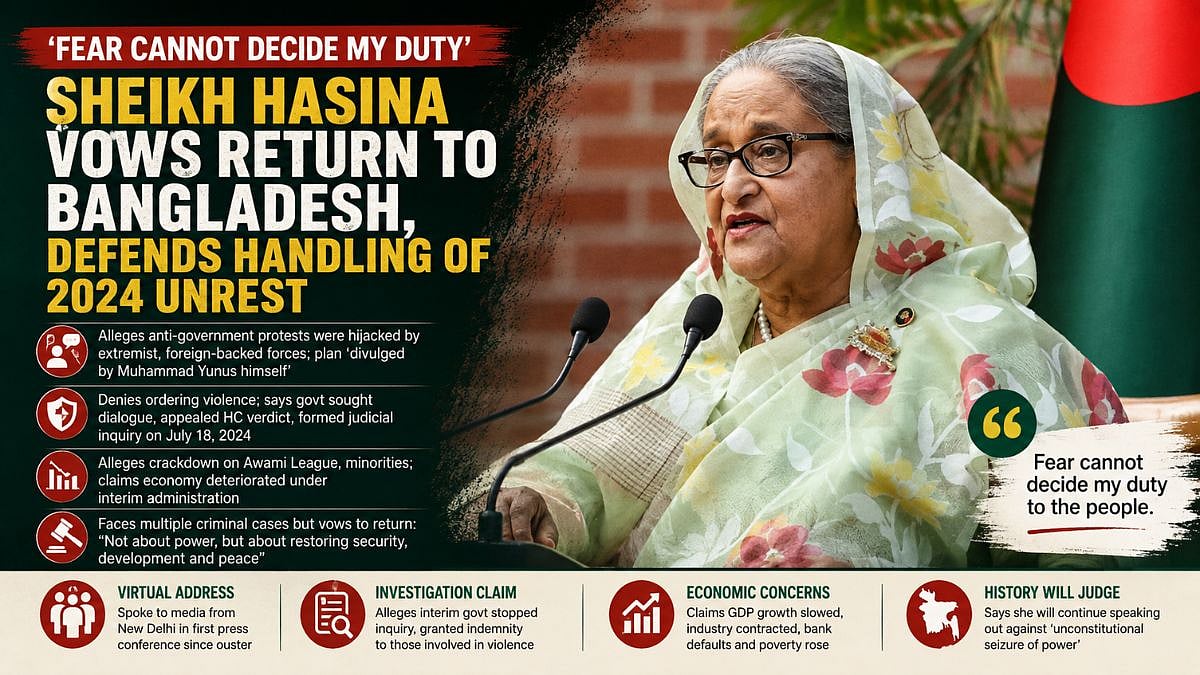
Former Bangladesh Prime Minister Sheikh Hasina has vowed to return to Bangladesh despite facing multiple criminal cases. In her first press conference since her ouster, Hasina defended her government's handling of the July-August 2024 unrest, saying 'fear cannot decide my duty to the people'.
She addressed reporters virtually from New Delhi, alleging that the anti-government protests were hijacked by extremist and foreign-backed forces seeking to overthrow her elected government. Hasina claimed that the plan had been 'divulged by Muhammad Yunus himself', the interim leader of Bangladesh.
Hasina rejected allegations that her administration had ordered indiscriminate violence against protesters, maintaining that security forces exercised restraint despite widespread unrest. She said her government had sought to resolve the quota issue through dialogue and had invited student leaders for talks.
However, she alleged that organised groups used the agitation to seize power 'outside the ballot box'. Hasina said police personnel, Awami League workers, journalists, and civilians were among those killed during the violence. She accused 'terrorist groups' of carrying out coordinated attacks on government installations and security personnel.
Hasina claimed that her government had constituted a judicial inquiry commission on July 18, 2024, to investigate every death and incident of violence during the unrest. She alleged that the interim administration led by Yunus stopped the investigation after assuming power and granted indemnity to those involved in the violence.
Hasina also alleged that thousands of Awami League leaders, workers, and supporters, as well as police personnel, journalists, lawyers, judges, and members of minority communities, had faced arrests, torture, and violence since her ouster. She described the 2024 movement as 'a coordinated assault on the Constitution' and accused the current dispensation of suppressing dissent and targeting people associated with Bangladesh's Liberation War.
Furthermore, Hasina claimed that Bangladesh's economy had deteriorated sharply over the past year, with GDP growth slowing, industrial production contracting for the first time in decades, bank defaults rising, poverty increasing, and investment weakening. She alleged that the government was borrowing 700-900 crore taka every month from Bangladesh Bank to meet its expenses.
According to Hasina, several factories had shut down, while a number of industrialists and business owners had either fled the country or gone into hiding.
The situation in Bangladesh remains volatile, with Hasina's vow to return likely to exacerbate tensions. The international community will be watching closely as the situation unfolds.
In conclusion, Sheikh Hasina's determination to return to Bangladesh despite the challenges she faces is a significant development in the country's ongoing political crisis. Her allegations of extremist forces hijacking protests and the current government's suppression of dissent will likely have far-reaching implications for the country's future.
Frequently asked questions
What is Sheikh Hasina's current status?
She is the former Prime Minister of Bangladesh, currently facing multiple criminal cases.
What were the circumstances surrounding the 2024 unrest in Bangladesh?
The unrest was sparked by anti-government protests, which were allegedly hijacked by extremist and foreign-backed forces.