FPIs Invest ₹15,157 Crore In Indian Equities In July
Foreign investors return to Indian stocks, investing over ₹15,000 crore in July.

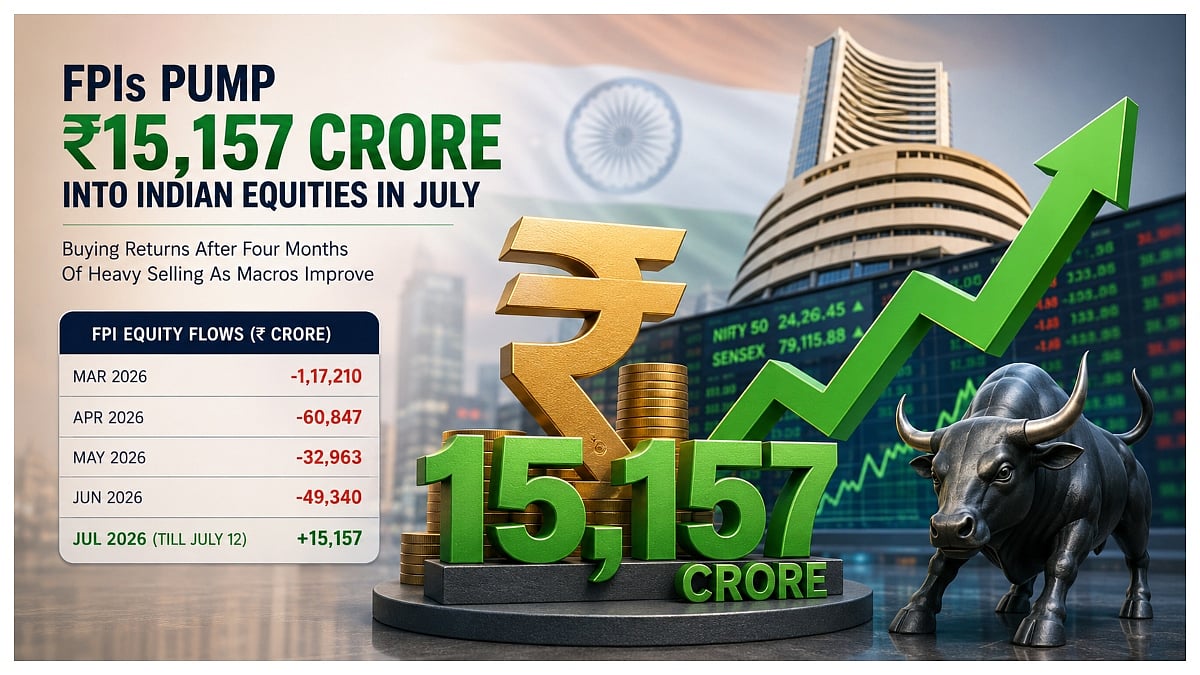
Foreign portfolio investors (FPIs) have made a significant comeback to Indian equities in July, investing ₹15,157 crore, according to data from the Central Depository Services (India) Limited (CDSL). This marks a notable turnaround after four months of continuous withdrawals from the domestic stock market.
The improvement in domestic economic conditions, a stable rupee, and enhancing global market sentiment have encouraged overseas investors to increase their exposure to Indian stocks. In the previous four months, FPIs had pulled out a substantial amount of money from the Indian equities market, with net outflows of ₹49,340 crore in June, ₹32,963 crore in May, ₹60,847 crore in April, and ₹1.17 lakh crore in March.
Despite the positive trend in July, FPIs remain net sellers for the year, having withdrawn a net ₹2.6 lakh crore from Indian equities so far in 2026. This compares to net outflows of ₹1.66 lakh crore during the same period last year. However, the return of FPIs to the Indian equities market in July is a promising sign for the domestic stock market.
In addition to equities, foreign investors have also continued to invest in India's debt market. They invested ₹6,625 crore through the Fully Accessible Route (FAR) and another ₹3,228 crore through the general debt investment route during July.
Market experts believe that the Nifty is facing immediate resistance between 24,500 and 24,600. A sustained move above this range could trigger fresh buying and support further gains. On the downside, support is seen at 23,800 and 23,700, and a fall below these levels could weaken market sentiment and invite fresh selling.
The return of FPIs to the Indian equities market is a significant development, indicating an improvement in investor sentiment. The stability of the rupee and the enhancement of global market sentiment have also contributed to this positive trend. As the Indian economy continues to grow, it is likely that FPIs will remain interested in investing in the country's equities market.
The Indian stock market has been volatile in recent months, with FPIs playing a significant role in shaping market trends. The return of FPIs in July has provided a much-needed boost to the market, and it will be interesting to see how the market performs in the coming months.
In the context of the Indian economy, the return of FPIs is a positive sign, indicating that overseas investors are becoming increasingly confident in the country's growth prospects. The government's efforts to improve the business environment and enhance economic growth have likely contributed to this trend.
Overall, the investment of ₹15,157 crore by FPIs in Indian equities in July is a significant development, indicating an improvement in investor sentiment and a positive trend for the domestic stock market. As the Indian economy continues to grow, it is likely that FPIs will remain interested in investing in the country's equities market, providing a much-needed boost to the market.
The significance of this development for Mumbai, as a financial hub, cannot be overstated. The return of FPIs to the Indian equities market is likely to have a positive impact on the city's economy, with increased investment and economic activity expected to follow. As the Indian economy continues to grow, Mumbai is likely to remain a key destination for overseas investors, providing a boost to the city's economy and cementing its position as a major financial hub.
In conclusion, the investment of ₹15,157 crore by FPIs in Indian equities in July is a positive development for the Indian stock market and the economy as a whole. The return of FPIs is likely to provide a much-needed boost to the market, and it will be interesting to see how the market performs in the coming months. With the Indian economy continuing to grow, it is likely that FPIs will remain interested in investing in the country's equities market, providing a positive trend for the domestic stock market and the economy.