Rasagola Dibasa Celebrated in Odisha
Rasagola Dibasa coincides with end of Rath Yatra, honouring Odisha's iconic sweet
'%3E%3Crect%20width%3D'96'%20height%3D'96'%20fill%3D'%231B5E20'%2F%3E%3Ccircle%20cx%3D'30'%20cy%3D'24'%20r%3D'44'%20fill%3D'%23fff'%20opacity%3D'.12'%2F%3E%3Ccircle%20cx%3D'60'%20cy%3D'74'%20r%3D'40'%20fill%3D'%23000'%20opacity%3D'.10'%2F%3E%3C%2Fg%3E%3Cg%3E%3Ccircle%20cx%3D'48'%20cy%3D'48'%20r%3D'15'%20fill%3D'%23fff'%2F%3E%3Cpath%20d%3D'M43%2034%20Q50%2048%2043%2062'%20fill%3D'none'%20stroke%3D'%238a94a6'%20stroke-width%3D'2.4'%2F%3E%3Cpath%20d%3D'M47%2033%20Q54%2048%2047%2063'%20fill%3D'none'%20stroke%3D'%238a94a6'%20stroke-width%3D'1.8'%20stroke-dasharray%3D'1.5%203'%2F%3E%3C%2Fg%3E%3C%2Fsvg%3E)
The Jagannatha Rath Yatra, one of the most celebrated religious festivals in India, is set to conclude in Puri, Odisha. As the festival comes to an end, the people of Odisha are gearing up to celebrate Rasagola Dibasa, a unique festival that honours the state's iconic sweet, Odisha Rasagola.
Rasagola Dibasa is celebrated on Niladri Bije, the final day of the Rath Yatra, when Lord Jagannath, Lord Balabhadra, and Devi Subhadra return to the sanctum of the Jagannath Temple in Puri after their nine-day journey. This year, the festival is set to be observed on Monday, July 27.
According to tradition, Goddess Lakshmi becomes upset with Lord Jagannath for leaving her behind during the Rath Yatra. When the Lord returns to the temple, she initially refuses to let him enter. To seek her forgiveness, Lord Jagannath offers her Rasagola. Pleased by the sweet offering, Goddess Lakshmi forgives him and allows him back into the temple.
The festival is closely linked to the famous ritual known as Rasagola Bhoga. Rasagola Dibasa was first observed on July 20, 2015, to celebrate Odisha's rich culinary and cultural heritage. It also gained prominence during the geographical indication (GI) tag debate over the origin of Rasagola. In 2019, Odisha's version, known as Odisha Rasagola, received the prestigious GI tag, recognising its unique recipe and historical significance.
Unlike the spongy white Bengali rosogolla, the traditional Odisha Rasagola has a light brown colour due to caramelised sugar and is prepared using an age-old recipe. It has been associated with the Jagannath Temple traditions for centuries.
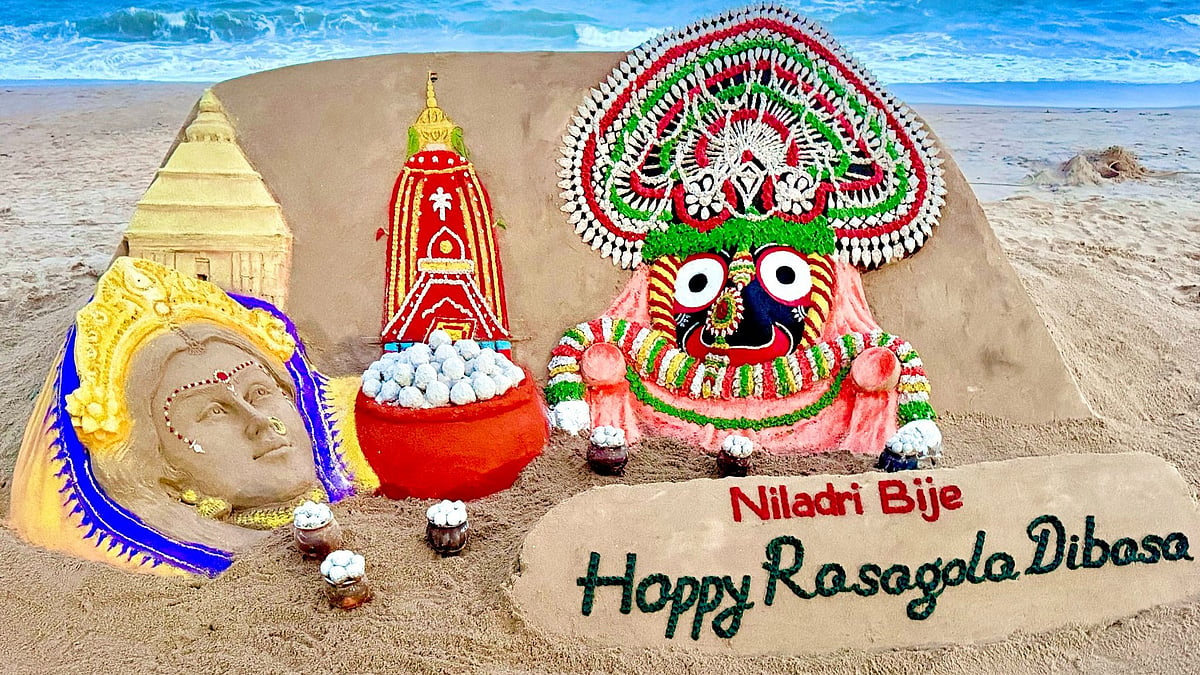
The people of Odisha are celebrating Rasagola Dibasa with great enthusiasm, and sand artist Sudarsan Pattnaik has created a 7-foot sand sculpture at Puri Beach showcasing Lord Jagannath and Goddess Lakshmi.
Rasagola Dibasa is a significant festival in Odisha, and it marks the conclusion of the grand Rath Yatra. The festival is a celebration of the state's rich cultural heritage and its iconic sweet, Odisha Rasagola.
In recent years, Rasagola Dibasa has gained popularity, and people from all over the world are taking part in the celebrations. The festival is a great opportunity for people to come together and celebrate the unique culture and traditions of Odisha.
The significance of Rasagola Dibasa lies in its ability to bring people together and promote the rich cultural heritage of Odisha. The festival is a celebration of the state's iconic sweet, Odisha Rasagola, and its deep-rooted connection with Lord Jagannath and the annual Rath Yatra.
In conclusion, Rasagola Dibasa is a unique festival that honours the state's iconic sweet, Odisha Rasagola, and its deep-rooted connection with Lord Jagannath and the annual Rath Yatra. The festival is a celebration of the state's rich cultural heritage and is observed on Niladri Bije, the final day of the Rath Yatra.
The festival has a significant impact on the people of Odisha, and it promotes the state's rich cultural heritage. Rasagola Dibasa is a great opportunity for people to come together and celebrate the unique culture and traditions of Odisha.
Overall, Rasagola Dibasa is a significant festival in Odisha, and it marks the conclusion of the grand Rath Yatra. The festival is a celebration of the state's rich cultural heritage and its iconic sweet, Odisha Rasagola.
Frequently asked questions
What is Rasagola Dibasa?
Rasagola Dibasa is a festival that honours Odisha's iconic sweet, Odisha Rasagola, and its deep-rooted connection with Lord Jagannath and the annual Rath Yatra.
When is Rasagola Dibasa celebrated?
Rasagola Dibasa is celebrated on Niladri Bije, the final day of the Rath Yatra, when Lord Jagannath, Lord Balabhadra, and Devi Subhadra return to the sanctum of the Jagannath Temple in Puri after their nine-day journey.