Mumbai Police Bust Engineering Admission Racket
A BTech graduate allegedly ran an admission racket, cheating 35 people of Rs50 lakh. Nine unemployed engineers were recruited from four states.
'%3E%3Crect%20width%3D'96'%20height%3D'96'%20fill%3D'%23B3261E'%2F%3E%3Ccircle%20cx%3D'30'%20cy%3D'24'%20r%3D'44'%20fill%3D'%23fff'%20opacity%3D'.12'%2F%3E%3Ccircle%20cx%3D'60'%20cy%3D'74'%20r%3D'40'%20fill%3D'%23000'%20opacity%3D'.10'%2F%3E%3C%2Fg%3E%3Cg%20fill%3D'%23fff'%3E%3Crect%20x%3D'29'%20y%3D'49'%20width%3D'8'%20height%3D'19'%20rx%3D'1'%2F%3E%3Crect%20x%3D'39'%20y%3D'40'%20width%3D'9'%20height%3D'28'%20rx%3D'1'%2F%3E%3Crect%20x%3D'50'%20y%3D'45'%20width%3D'8'%20height%3D'23'%20rx%3D'1'%2F%3E%3Crect%20x%3D'60'%20y%3D'53'%20width%3D'7'%20height%3D'15'%20rx%3D'1'%2F%3E%3Crect%20x%3D'41'%20y%3D'34'%20width%3D'5'%20height%3D'6'%2F%3E%3C%2Fg%3E%3C%2Fsvg%3E)
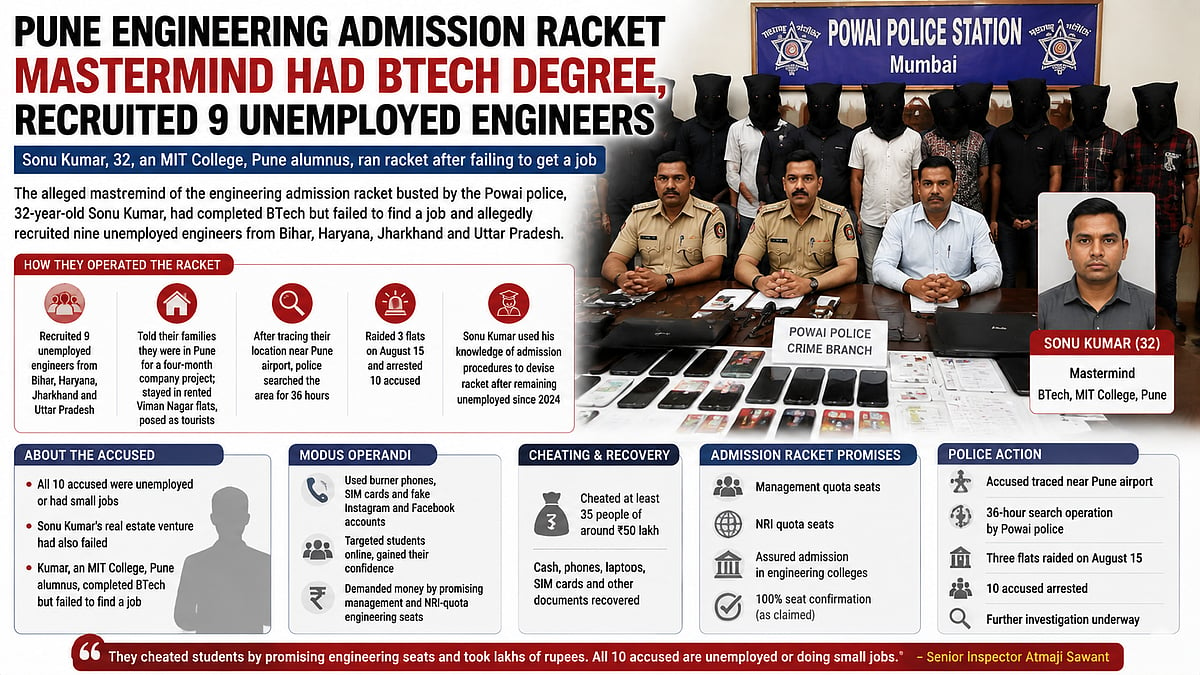
A 32-year-old BTech graduate, Sonu Kumar, has been accused of masterminding an engineering admission racket in Mumbai. Kumar, who completed his degree from MIT College in Pune, allegedly failed to find a job and devised the racket using his knowledge of admission procedures.
The police said Kumar recruited nine unemployed engineers from Bihar, Haryana, Jharkhand, and Uttar Pradesh to help him run the racket. The accused told their families they were in Pune for a company project, while they stayed in rented flats in Viman Nagar and posed as tourists.
The police traced the location of the accused near Pune airport and searched the area for 36 hours before raiding three flats on August 15. The accused allegedly used burner phones, SIM cards, and fake social media accounts to target students online and demand money.
According to the police, the accused cheated at least 35 people of around Rs50 lakh by promising management and NRI-quota engineering seats. Senior inspector Atmaji Sawant said all 10 accused, including Kumar, were unemployed or had small jobs, and Kumar's real estate venture had also failed.
The racket was busted by the Powai police, who said the accused used their knowledge of admission procedures to deceive students and their families. The police are investigating the case and have arrested the accused.
The incident highlights the issue of unemployment among engineers in India, with many graduates struggling to find jobs. The accused allegedly used their knowledge of admission procedures to take advantage of desperate students and their families.
The police have warned students and parents to be cautious when dealing with admission consultants and to verify the authenticity of any offers. The case is a reminder of the need for strict quality checks in educational institutions to prevent such rackets.
The accused will face charges of cheating and conspiracy, and the police are working to recover the money lost by the victims. The incident has sparked concern among students and parents, who are demanding stricter regulations to prevent such rackets.
In a statement, Minister Dadaji Bhuse said there would be no compromise on student welfare and directed strict quality checks in Maharashtra schools. The incident has highlighted the need for greater vigilance and regulation in the education sector to prevent such rackets and protect students from exploitation.
The case is a significant one, with implications for the education sector and the issue of unemployment among engineers. The police are working to prevent such rackets and protect students from exploitation, and the incident serves as a reminder of the need for caution and vigilance when dealing with admission consultants.
The accused will face trial, and the police are working to recover the money lost by the victims. The incident has sparked concern among students and parents, who are demanding stricter regulations to prevent such rackets. The case highlights the need for greater vigilance and regulation in the education sector to prevent exploitation and protect students.
In conclusion, the busting of the engineering admission racket in Mumbai is a significant development, with implications for the education sector and the issue of unemployment among engineers. The police are working to prevent such rackets and protect students from exploitation, and the incident serves as a reminder of the need for caution and vigilance when dealing with admission consultants.
Frequently asked questions
What was the engineering admission racket about?
The racket involved cheating students and their families by promising management and NRI-quota engineering seats.
How much money was cheated from the victims?
The accused cheated at least 35 people of around Rs50 lakh.