Allahabad High Court: Banks Can Recover Loan Dues From Guarantors Directly
Court rules banks can recover unpaid loans from guarantors without first going after borrowers. Guarantors liable for entire amount.
'%3E%3Crect%20width%3D'96'%20height%3D'96'%20fill%3D'%230B6E4F'%2F%3E%3Ccircle%20cx%3D'30'%20cy%3D'24'%20r%3D'44'%20fill%3D'%23fff'%20opacity%3D'.12'%2F%3E%3Ccircle%20cx%3D'60'%20cy%3D'74'%20r%3D'40'%20fill%3D'%23000'%20opacity%3D'.10'%2F%3E%3C%2Fg%3E%3Cg%20fill%3D'none'%20stroke%3D'%23fff'%20stroke-width%3D'3.2'%20stroke-linecap%3D'round'%20stroke-linejoin%3D'round'%3E%3Cpolyline%20points%3D'31%2C59%2041%2C49%2049%2C54%2063%2C37'%2F%3E%3Cpolyline%20points%3D'55%2C37%2063%2C37%2063%2C45'%2F%3E%3C%2Fg%3E%3C%2Fsvg%3E)
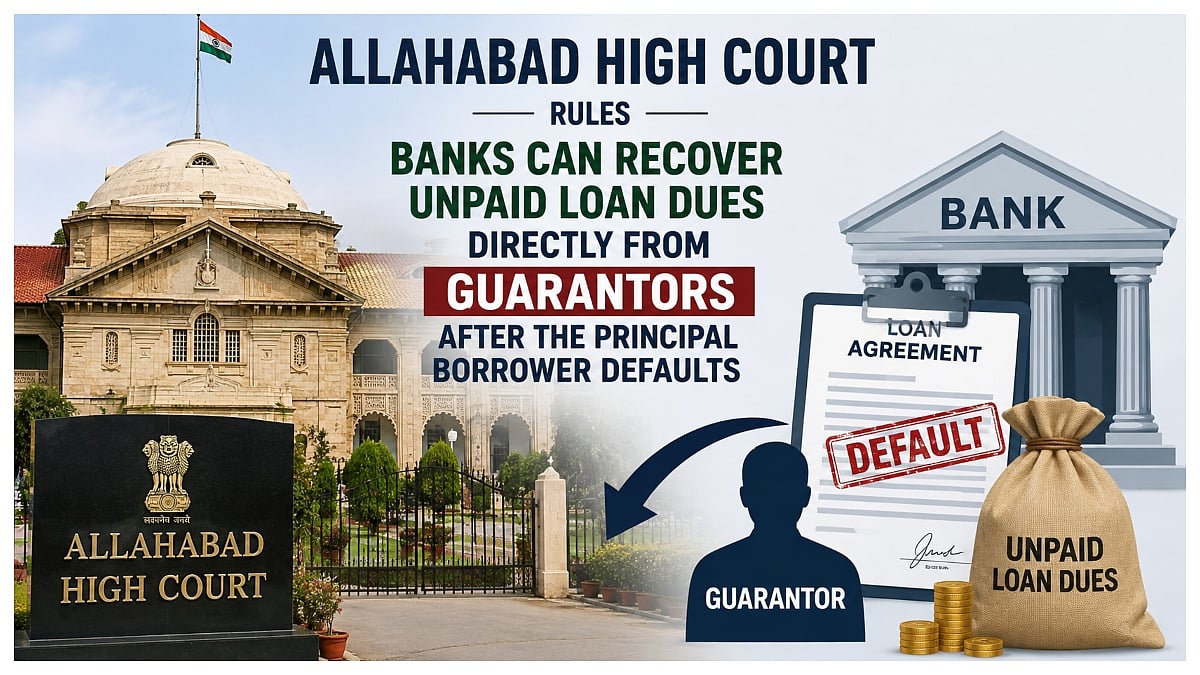
The Allahabad High Court has made a significant ruling regarding loan defaults and guarantors. In a recent decision, the court stated that banks can recover unpaid loan dues directly from guarantors when the main borrower defaults. This means that the bank does not have to first complete recovery proceedings against the borrower before taking action against the guarantor.
The ruling came in response to two separate petitions filed by Vineet Pandey and Anoop Kumar Mishra, who had acted as guarantors for loans taken by their colleague Vikrant Dubey from UP Postal Primary Cooperative Bank Ltd. Dubey had taken three loans during 2022-23, totaling Rs 71,000, but failed to repay them.
The bank began recovery proceedings and asked the Postal Department to deduct Rs 10,000 each month from the salaries of both guarantors. The guarantors argued that the bank should first recover the money from Dubey and that they could only be approached if some amount remained unpaid. However, the court rejected these arguments, citing Section 128 of the Indian Contract Act, 1872.
According to the court, a guarantor's liability is equal to the borrower's liability unless the guarantee agreement specifically says otherwise. Since the agreements contained no condition delaying the guarantors' responsibility, the bank was legally allowed to make monthly salary deductions. The court also stated that there was no fixed order requiring the lender to first act against the borrower.
The bench upheld the monthly deduction of Rs 10,000 and dismissed both petitions. This ruling has significant implications for guarantors, as it means that they can be held liable for the entire amount of the loan, regardless of whether the borrower has been pursued for recovery.
In this case, the guarantors can legally seek repayment or contribution from the principal borrower after paying the bank. However, the court's decision makes it clear that guarantors cannot avoid their responsibilities by claiming that the bank should first recover the money from the borrower.
The Indian Contract Act, 1872, provides the framework for guarantee agreements, and Section 128 specifically deals with the liability of guarantors. The court's ruling is consistent with the principles of this act and provides clarity on the rights and responsibilities of guarantors.
This decision is likely to have far-reaching consequences for lenders and guarantors alike. It highlights the importance of carefully considering the terms of guarantee agreements and the potential risks involved. For guarantors, it is essential to understand their liability and the potential consequences of default.
In conclusion, the Allahabad High Court's ruling provides a clear understanding of the rights and responsibilities of guarantors in loan agreements. It emphasizes the importance of carefully considering the terms of guarantee agreements and the potential risks involved.
The court's decision is a significant development in the realm of banking and finance, and it is likely to have a lasting impact on the way lenders and guarantors interact. As the financial landscape continues to evolve, it is essential to stay informed about the latest developments and rulings that can affect individuals and businesses.
The ruling also underscores the need for guarantors to be aware of their obligations and the potential consequences of default. By understanding their liability and the terms of the guarantee agreement, guarantors can make informed decisions and avoid potential pitfalls.
In the end, the court's decision provides a clear and concise understanding of the rights and responsibilities of guarantors in loan agreements. It is a significant development that is likely to have far-reaching consequences for lenders and guarantors alike.
Frequently asked questions
Can a bank recover loan dues from a guarantor without first going after the borrower?
Yes, according to the Allahabad High Court, a bank can recover unpaid loan dues directly from a guarantor when the main borrower defaults.
What is the liability of a guarantor in a loan agreement?
A guarantor's liability is equal to the borrower's liability unless the guarantee agreement specifically says otherwise.