Lok Sabha Witnesses Gender-Insensitive Remarks
Politicians make sexist comments, objectify women leaders
'%3E%3Crect%20width%3D'96'%20height%3D'96'%20fill%3D'%231A5276'%2F%3E%3Ccircle%20cx%3D'30'%20cy%3D'24'%20r%3D'44'%20fill%3D'%23fff'%20opacity%3D'.12'%2F%3E%3Ccircle%20cx%3D'60'%20cy%3D'74'%20r%3D'40'%20fill%3D'%23000'%20opacity%3D'.10'%2F%3E%3C%2Fg%3E%3Cg%20fill%3D'%23fff'%3E%3Cpath%20d%3D'M31%2041%20L48%2031%20L65%2041%20Z'%2F%3E%3Crect%20x%3D'33'%20y%3D'43'%20width%3D'4'%20height%3D'17'%2F%3E%3Crect%20x%3D'41'%20y%3D'43'%20width%3D'4'%20height%3D'17'%2F%3E%3Crect%20x%3D'51'%20y%3D'43'%20width%3D'4'%20height%3D'17'%2F%3E%3Crect%20x%3D'59'%20y%3D'43'%20width%3D'4'%20height%3D'17'%2F%3E%3Crect%20x%3D'30'%20y%3D'62'%20width%3D'36'%20height%3D'4'%20rx%3D'1'%2F%3E%3C%2Fg%3E%3C%2Fsvg%3E)
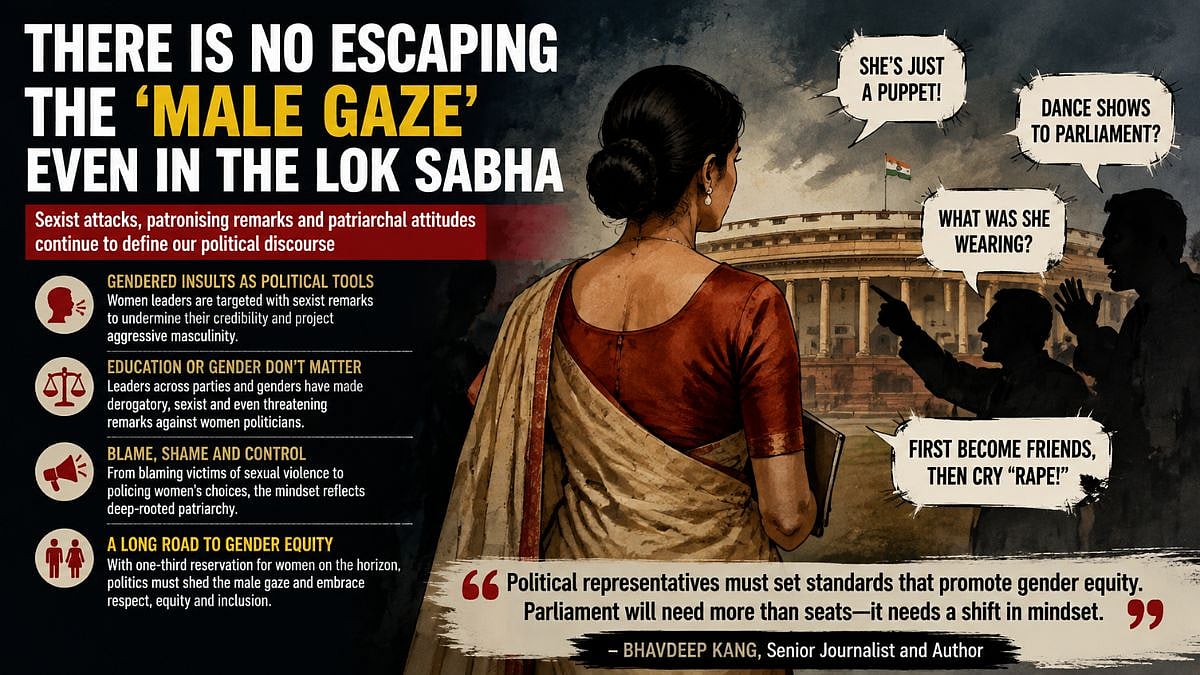
A recent incident in the Lok Sabha has highlighted the prevalence of the 'male gaze' in Indian politics. Tamil Nadu Opposition leader Udhaynidhi Stalin made a snide comment about the rumoured relationship between state Chief Minister C. Joseph Vijay and actor Trisha. This remark was not only sexist but also aimed to undermine the CM's political competence by suggesting he was under feminine control.
The incident is not an isolated one, as many women politicians have been subjected to similar sexist comments and objectification. Politicians like Mayawati, Smriti Irani, Jaya Prada, Hema Malini, Kangana Ranaut, and Priyanka Gandhi have all been targets of such remarks. These comments are often made to project an image of aggressive leadership and to undermine the credibility of women leaders.
Sanjay Nirupam, a former Congress MP, reportedly made a sexist comment about Smriti Irani, saying she used to charge money for dance shows on TV. Similarly, J. Jayalalithaa was physically assaulted in the Assembly before she became Chief Minister, and Indira Gandhi was denigrated as 'goongi gudiya' (dumb doll). Former Congress president Sonia Gandhi also suffered racist remarks.
The use of gendered insults is a common phenomenon in Indian politics, and it is not limited to men. A woman Congress spokesperson made a derogatory comment about Kangana Ranaut, referencing the dual meaning of 'Mandi' (her Lok Sabha constituency). Randeep Surjewala, a Congress leader, made a disrespectful comment about BJP MP Hema Malini during a public meeting.
The Samajwadi Party's Mohammad Azam Khan publicly stated that he had discovered his rival Jaya Prada wore 'khaki underwear'. Such comments are not only sexist but also reflect a deeper societal problem. Politicians have been known to threaten rape of female family members as punishment for rivals, suggest death for victims of rape, describe unmarried daughters as 'liabilities', and undermine the reproductive rights of women.
The prevalence of such comments in Indian politics is a cause for concern. It highlights the need for greater awareness and sensitivity towards gender issues. The objectification of women leaders is not only sexist but also undermines their credibility and competence. It is essential to create a more inclusive and respectful political environment where women leaders can participate without fear of sexism and objectification.
The Lok Sabha incident is a reminder that there is no escaping the 'male gaze' in Indian politics. However, it is essential to recognize the problem and work towards creating a more gender-sensitive political environment. This can be achieved through education, awareness, and a commitment to respecting the dignity and credibility of women leaders.
In conclusion, the use of gendered insults in Indian politics is a serious issue that needs to be addressed. It is essential to create a more inclusive and respectful political environment where women leaders can participate without fear of sexism and objectification. The Lok Sabha incident is a reminder that there is still much work to be done to achieve this goal.
The significance of this issue extends beyond the realm of politics. It reflects a deeper societal problem that needs to be addressed. The objectification of women and the use of gendered insults are not only sexist but also undermine the dignity and credibility of women. It is essential to recognize the problem and work towards creating a more gender-sensitive society where women can participate without fear of sexism and objectification.
Ultimately, the creation of a more inclusive and respectful political environment requires a commitment to respecting the dignity and credibility of women leaders. It is essential to recognize the problem of gendered insults and work towards addressing it. This can be achieved through education, awareness, and a commitment to creating a more gender-sensitive society.
Frequently asked questions
What is the 'male gaze' in Indian politics?
The 'male gaze' refers to the prevalence of sexist and objectifying comments made by politicians towards women leaders.
Which women politicians have been subjected to sexist comments?
Many women politicians, including Mayawati, Smriti Irani, Jaya Prada, Hema Malini, Kangana Ranaut, and Priyanka Gandhi, have been targets of sexist comments.