China's Straw Grids Reduce Desert Size
China's innovative approach helps deserts shrink. Straw grids and saplings make a difference.
'%3E%3Crect%20width%3D'96'%20height%3D'96'%20fill%3D'%234A235A'%2F%3E%3Ccircle%20cx%3D'30'%20cy%3D'24'%20r%3D'44'%20fill%3D'%23fff'%20opacity%3D'.12'%2F%3E%3Ccircle%20cx%3D'60'%20cy%3D'74'%20r%3D'40'%20fill%3D'%23000'%20opacity%3D'.10'%2F%3E%3C%2Fg%3E%3Cg%20fill%3D'none'%20stroke%3D'%23fff'%20stroke-width%3D'3'%3E%3Ccircle%20cx%3D'48'%20cy%3D'48'%20r%3D'16'%2F%3E%3Cellipse%20cx%3D'48'%20cy%3D'48'%20rx%3D'6.5'%20ry%3D'16'%2F%3E%3Cline%20x1%3D'32'%20y1%3D'42'%20x2%3D'64'%20y2%3D'42'%2F%3E%3Cline%20x1%3D'32'%20y1%3D'54'%20x2%3D'64'%20y2%3D'54'%2F%3E%3C%2Fg%3E%3C%2Fsvg%3E)
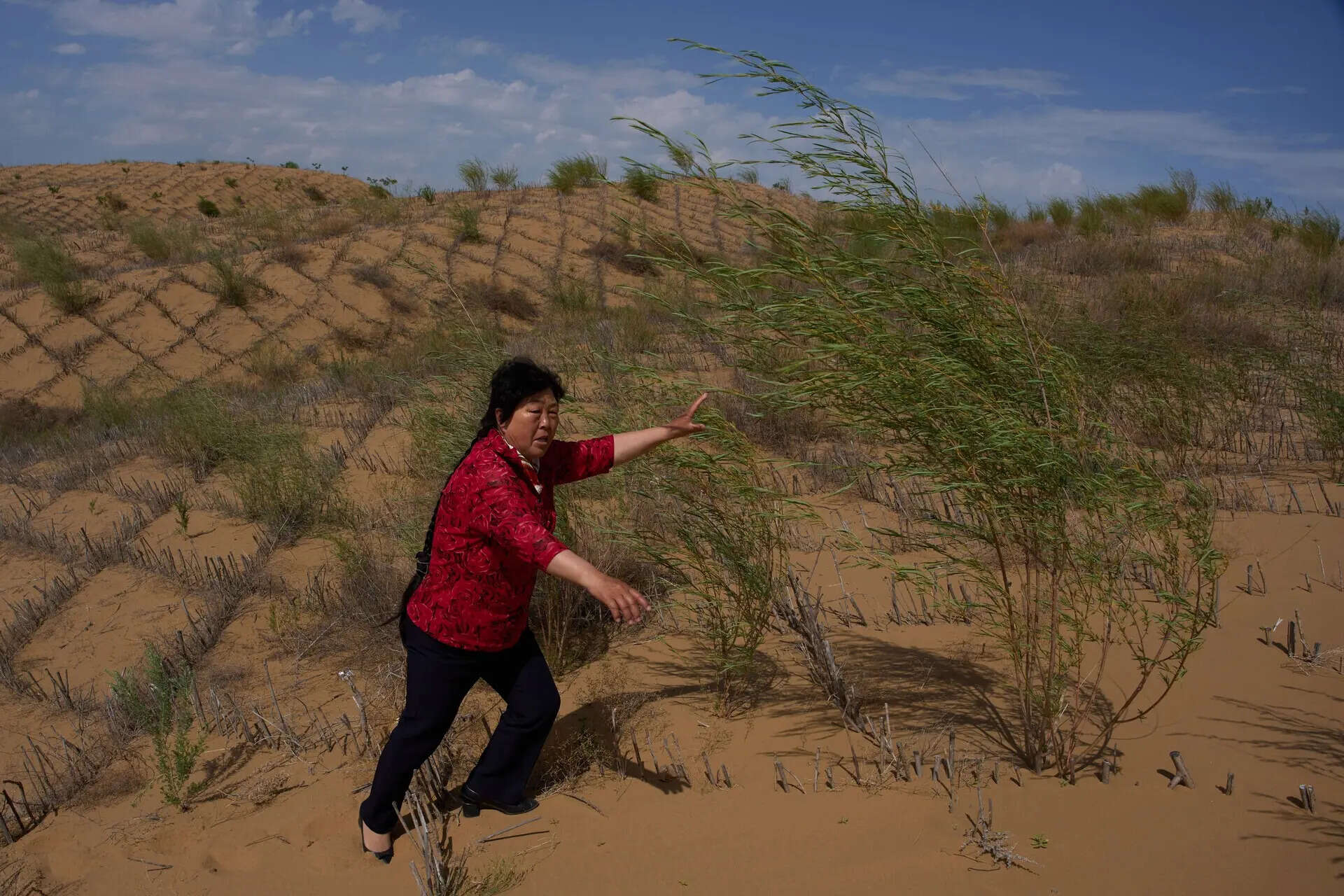
China has been fighting desertification for nearly fifty years through its Green Great Wall project. The project has made significant progress in reducing desertified land and increasing forest cover.
Millions of rural laborers have been involved in the project, using straw checkerboards and planting saplings to achieve this goal. The use of straw grids has been particularly effective, helping to reduce desert size by over 1,000 square kilometers every year.
The Green Great Wall project demonstrates China's long-term political commitment to environmental restoration. The project's success can be attributed to the involvement of local communities and the adaptation of strategies to suit the local environment.
The project has not only helped to reduce desertification but also increased forest cover, which has numerous benefits for the environment. Forests help to absorb carbon dioxide, reduce soil erosion, and provide habitat for wildlife.
China's approach to fighting desertification is a model that can be replicated in other countries. The use of straw grids and saplings is a simple yet effective way to reduce desert size and increase forest cover.
The success of the Green Great Wall project is a testament to the power of sustained effort and commitment to environmental restoration. It shows that with the right approach and involvement of local communities, it is possible to make a significant impact on the environment.
The project's impact is not limited to the environment; it also has social and economic benefits. The involvement of local communities in the project has helped to create jobs and improve livelihoods.
In conclusion, China's Green Great Wall project is a remarkable example of how a long-term commitment to environmental restoration can make a significant difference. The project's success is a result of the combined efforts of the government, local communities, and rural laborers.
The project's achievements are a reminder that environmental restoration is a collective effort that requires the involvement of all stakeholders. It is a call to action for other countries to follow China's example and make a commitment to environmental restoration.
China's straw grids are a simple yet effective solution to a complex problem. They are a testament to the power of innovation and community involvement in environmental restoration.
The reduction of desert size by over 1,000 square kilometers every year is a significant achievement, and it demonstrates the potential for environmental restoration to make a real difference.
In the context of global environmental efforts, China's Green Great Wall project is a shining example of what can be achieved with determination and collective effort. It is a reminder that environmental restoration is a long-term process that requires sustained commitment and effort.
The project's success has significant implications for India and other countries facing similar environmental challenges. It highlights the importance of community involvement and adaptation in environmental restoration efforts.
Overall, China's Green Great Wall project is a remarkable achievement that demonstrates the potential for environmental restoration to make a significant impact. It is a call to action for other countries to follow China's example and make a commitment to environmental restoration.
The project's achievements are a reminder that environmental restoration is a collective effort that requires the involvement of all stakeholders. It is a testament to the power of innovation, community involvement, and sustained commitment to environmental restoration.
What it means for the world is that there is hope for restoring degraded environments and fighting desertification. China's example shows that with the right approach and commitment, it is possible to make a significant difference and create a better future for generations to come.