DMK Passes 9 Resolutions for Overhaul
DMK adopts age limit and term caps.
'%3E%3Crect%20width%3D'96'%20height%3D'96'%20fill%3D'%231A5276'%2F%3E%3Ccircle%20cx%3D'30'%20cy%3D'24'%20r%3D'44'%20fill%3D'%23fff'%20opacity%3D'.12'%2F%3E%3Ccircle%20cx%3D'60'%20cy%3D'74'%20r%3D'40'%20fill%3D'%23000'%20opacity%3D'.10'%2F%3E%3C%2Fg%3E%3Cg%20fill%3D'%23fff'%3E%3Cpath%20d%3D'M31%2041%20L48%2031%20L65%2041%20Z'%2F%3E%3Crect%20x%3D'33'%20y%3D'43'%20width%3D'4'%20height%3D'17'%2F%3E%3Crect%20x%3D'41'%20y%3D'43'%20width%3D'4'%20height%3D'17'%2F%3E%3Crect%20x%3D'51'%20y%3D'43'%20width%3D'4'%20height%3D'17'%2F%3E%3Crect%20x%3D'59'%20y%3D'43'%20width%3D'4'%20height%3D'17'%2F%3E%3Crect%20x%3D'30'%20y%3D'62'%20width%3D'36'%20height%3D'4'%20rx%3D'1'%2F%3E%3C%2Fg%3E%3C%2Fsvg%3E)
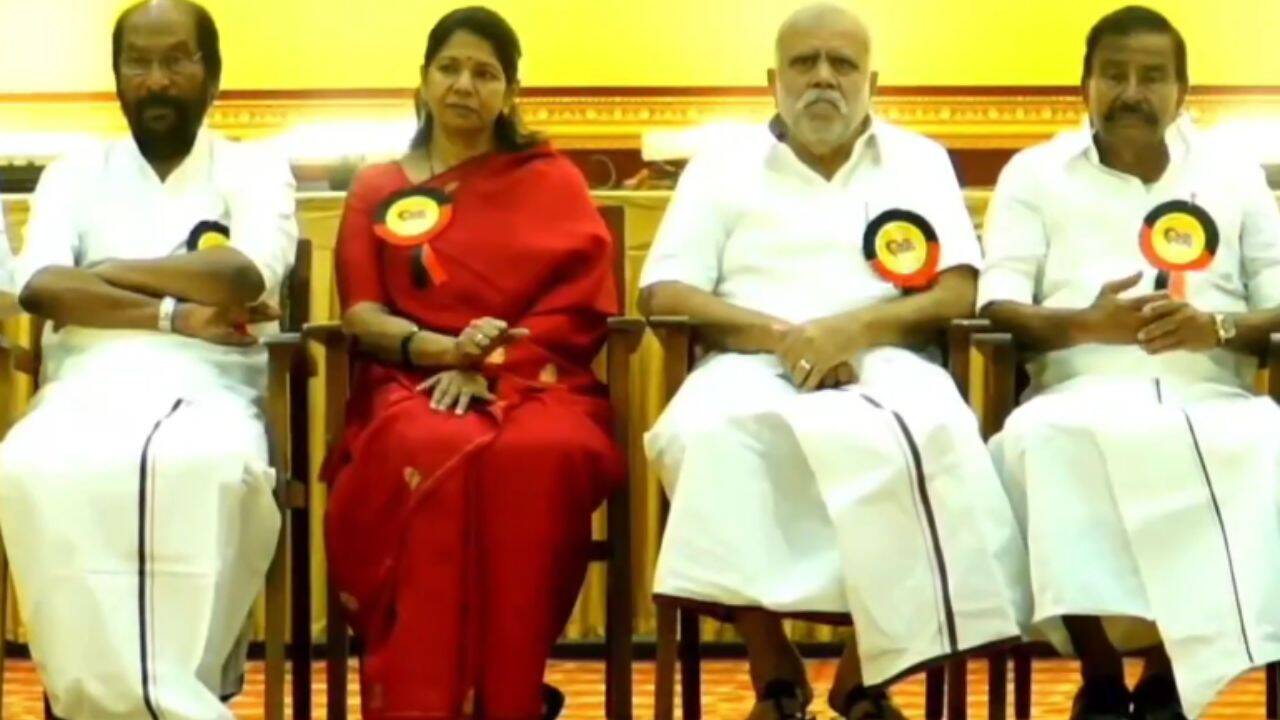
The Dravida Munnetra Kazhagam (DMK) has passed nine resolutions aimed at overhauling the organisation.
The key resolutions include the introduction of an age limit for party positions and a two-term cap for certain roles.
These changes are seen as a significant shift in the party's approach to leadership and governance.
The DMK is a major political party in the state of Tamil Nadu, and these resolutions are expected to have a significant impact on the party's structure and functioning.
The age limit is intended to bring in fresh faces and ideas, while the two-term cap is aimed at preventing the concentration of power in the hands of a few individuals.
The party has also resolved to increase representation for women and youth in party positions.
The resolutions were passed at a recent party meeting, and are seen as a major step towards reforming the party.
The DMK has a long history in Tamil Nadu, and has been a major player in the state's politics for decades.
The party was founded in 1949, and has since become a dominant force in the state.
The current president of the DMK is MK Stalin, who has been instrumental in pushing for these reforms.
The party's overhaul is seen as a significant development in Tamil Nadu politics, and is expected to have a major impact on the state's political landscape.
The DMK's reforms are also seen as a response to changing political dynamics in the state, and an attempt to stay relevant and competitive in a rapidly changing political environment.
The party's resolutions have been welcomed by many as a positive step towards reform and renewal, and are seen as a major step towards strengthening the party's position in the state.
Frequently asked questions
What are the key resolutions passed by the DMK?
The DMK has passed resolutions introducing an age limit and a two-term cap for certain roles, as well as increasing representation for women and youth.
Why has the DMK introduced these reforms?
The DMK has introduced these reforms in an attempt to stay relevant and competitive in a rapidly changing political environment, and to strengthen the party's position in the state.