Nasa Explores Human Hibernation for Mars Mission
Nasa considers hibernation for Mars travel, but challenges exist.
'%3E%3Crect%20width%3D'96'%20height%3D'96'%20fill%3D'%23B3261E'%2F%3E%3Ccircle%20cx%3D'30'%20cy%3D'24'%20r%3D'44'%20fill%3D'%23fff'%20opacity%3D'.12'%2F%3E%3Ccircle%20cx%3D'60'%20cy%3D'74'%20r%3D'40'%20fill%3D'%23000'%20opacity%3D'.10'%2F%3E%3C%2Fg%3E%3Cg%20fill%3D'%23fff'%3E%3Crect%20x%3D'29'%20y%3D'49'%20width%3D'8'%20height%3D'19'%20rx%3D'1'%2F%3E%3Crect%20x%3D'39'%20y%3D'40'%20width%3D'9'%20height%3D'28'%20rx%3D'1'%2F%3E%3Crect%20x%3D'50'%20y%3D'45'%20width%3D'8'%20height%3D'23'%20rx%3D'1'%2F%3E%3Crect%20x%3D'60'%20y%3D'53'%20width%3D'7'%20height%3D'15'%20rx%3D'1'%2F%3E%3Crect%20x%3D'41'%20y%3D'34'%20width%3D'5'%20height%3D'6'%2F%3E%3C%2Fg%3E%3C%2Fsvg%3E)
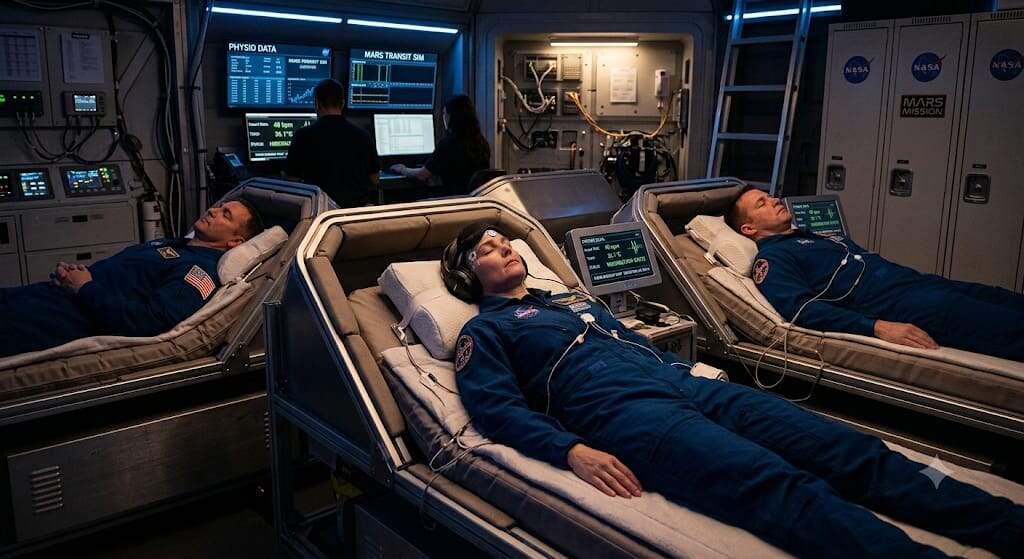
Nasa is currently exploring the concept of human hibernation as a potential solution for its upcoming Mars mission. The idea involves putting astronauts in a state of torpor, a period of decreased physiological activity, to reduce the need for food, water, and oxygen during the long journey to the red planet. This approach could help mitigate the effects of prolonged space travel on the human body.
The concept of human hibernation is not new, but applying it to space travel is a complex task. Nasa scientists are working to understand the effects of torpor on the human body and how to induce it safely. The space agency is also investigating the use of medications and other techniques to reduce the risks associated with hibernation.
One of the major challenges facing Nasa is the development of a reliable and safe method for inducing and maintaining torpor in astronauts. The agency must also ensure that the astronauts can be revived safely and quickly in case of an emergency. Additionally, the effects of prolonged torpor on the human body are not yet fully understood, and Nasa must conduct extensive research to determine the long-term consequences of this approach.
The idea of human hibernation for space travel has been inspired by the natural hibernation patterns of certain animals, such as bears and bats. These animals are able to survive for extended periods without food or water by reducing their metabolic rates and entering a state of torpor. Nasa scientists hope to replicate this process in humans, but it is a daunting task.
The Mars mission is expected to take several months, and the astronauts will have to endure extreme conditions, including radiation exposure, isolation, and confinement. The use of human hibernation could help reduce the physical and mental stresses associated with long-duration space travel.
Nasa's exploration of human hibernation is part of its broader efforts to develop innovative solutions for deep space missions. The agency is working to push the boundaries of space travel and to develop new technologies that will enable humans to explore and settle other planets.
In conclusion, while the concept of human hibernation for Mars travel is promising, significant challenges remain. Nasa must conduct extensive research and development to overcome the technical and scientific hurdles associated with this approach. However, if successful, human hibernation could revolutionize the field of space travel and enable humans to explore and settle other planets.
The success of this mission could have a major impact on the future of space travel and exploration. It could also lead to breakthroughs in the field of medicine, as the study of torpor and hibernation could provide new insights into the human body and its ability to survive in extreme conditions.
The exploration of human hibernation is a complex and challenging task, but it has the potential to transform the field of space travel and enable humans to explore and settle other planets. Nasa's efforts to develop this technology are a significant step forward in the pursuit of deep space missions.
The idea of human hibernation for space travel is not without its risks, but it is a necessary step towards the development of sustainable and long-duration space missions. As Nasa continues to explore this concept, it is likely that new challenges and opportunities will arise, and the agency must be prepared to adapt and innovate in response.
In the coming years, Nasa will continue to conduct research and development on human hibernation, with the goal of making it a viable option for deep space missions. The success of this mission could have a major impact on the future of space travel and exploration, and it could lead to breakthroughs in the field of medicine and beyond.