Brain, Not Heart, Is Seat Of Love
Love is a brain experience, neuroscience reveals. Cultural associations mislead.
'%3E%3Crect%20width%3D'96'%20height%3D'96'%20fill%3D'%23B3261E'%2F%3E%3Ccircle%20cx%3D'30'%20cy%3D'24'%20r%3D'44'%20fill%3D'%23fff'%20opacity%3D'.12'%2F%3E%3Ccircle%20cx%3D'60'%20cy%3D'74'%20r%3D'40'%20fill%3D'%23000'%20opacity%3D'.10'%2F%3E%3C%2Fg%3E%3Cg%20fill%3D'%23fff'%3E%3Crect%20x%3D'29'%20y%3D'49'%20width%3D'8'%20height%3D'19'%20rx%3D'1'%2F%3E%3Crect%20x%3D'39'%20y%3D'40'%20width%3D'9'%20height%3D'28'%20rx%3D'1'%2F%3E%3Crect%20x%3D'50'%20y%3D'45'%20width%3D'8'%20height%3D'23'%20rx%3D'1'%2F%3E%3Crect%20x%3D'60'%20y%3D'53'%20width%3D'7'%20height%3D'15'%20rx%3D'1'%2F%3E%3Crect%20x%3D'41'%20y%3D'34'%20width%3D'5'%20height%3D'6'%2F%3E%3C%2Fg%3E%3C%2Fsvg%3E)
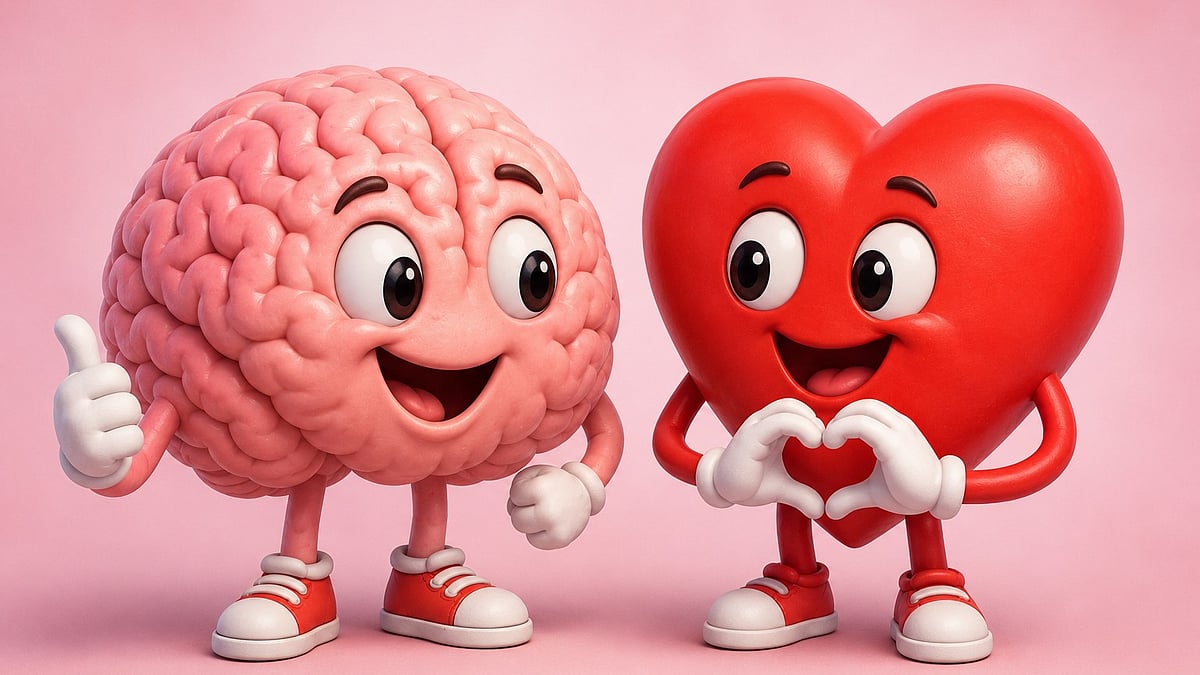
Love has long been culturally associated with the heart, with expressions like 'from the bottom of our heart' and heartbreak feeling like a physical wound in the chest. However, modern neuroscience suggests that love is fundamentally a brain experience.
When we fall in love, our brain is flooded with dopamine, a reward chemical also involved in addiction, which explains why early love can feel euphoric and obsessive. Oxytocin, released during physical intimacy, deepens attachment and trust, while norepinephrine causes the racing thoughts and sleepless nights that often accompany new love.
fMRI scans have shown that distinct regions of the brain light up during romantic love, including the ventral tegmental area, caudate nucleus, and nucleus accumbens, all part of the brain's reward circuitry.
The heart, however, is not entirely innocent in the experience of love. When the brain registers attraction or emotional intensity, it signals the autonomic nervous system to release adrenaline, which accelerates heart rate, tightens the chest, and produces those unmistakable physical sensations.
In cases of extreme emotional stress, such as grief or rejection, the heart can even be temporarily weakened, a condition known as 'broken heart syndrome' or takotsubo cardiomyopathy.
The cultural association of love with the heart can be traced back to ancient thinkers like Aristotle, who believed that the heart housed the soul and emotions. This idea has stuck across millennia of poetry, religion, and art, despite being biologically inaccurate.
In reality, love is a complex interplay between the brain and the heart, with the brain composing the music and the heart performing it. Both are essential to the experience of love, and understanding their roles can help us better appreciate the complexities of human emotion.
The distinction between the brain and heart's roles in love is not just a matter of semantics; it has real implications for our understanding of human relationships and behavior. By recognizing that love is a brain experience, we can better appreciate the neural mechanisms that underlie it, and perhaps even develop new strategies for cultivating and maintaining healthy relationships.
Ultimately, the experience of love is a rich and multifaceted one, and understanding its biological basis can help us appreciate its beauty and complexity.
Frequently asked questions
What is the biological basis of love?
Love is a complex interplay between the brain and the heart, with the brain composing the music and the heart performing it.
Why do we associate love with the heart?
The cultural association of love with the heart can be traced back to ancient thinkers like Aristotle, who believed that the heart housed the soul and emotions.