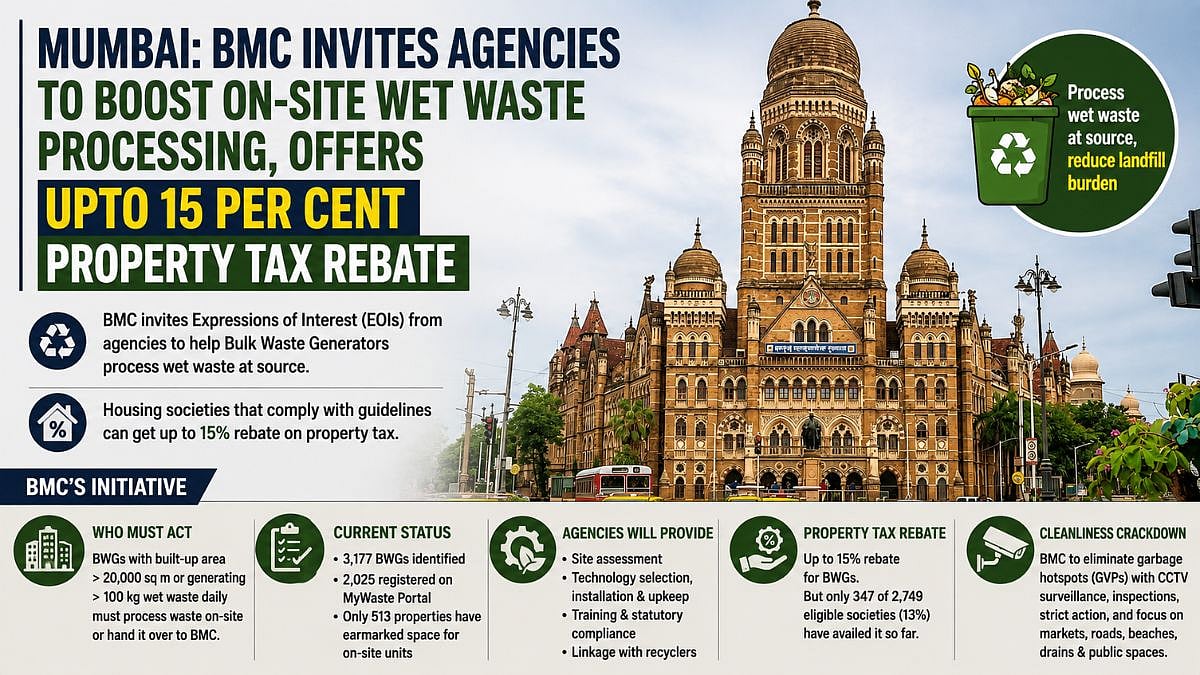
Bombay HC Rejects CIDCO's Plea In Navi Mumbai Land Case
CIDCO's plea rejected, court says it's state's agent. Navi Mumbai land compensation appeals to proceed without CIDCO.
'%3E%3Crect%20width%3D'96'%20height%3D'96'%20fill%3D'%23B3261E'%2F%3E%3Ccircle%20cx%3D'30'%20cy%3D'24'%20r%3D'44'%20fill%3D'%23fff'%20opacity%3D'.12'%2F%3E%3Ccircle%20cx%3D'60'%20cy%3D'74'%20r%3D'40'%20fill%3D'%23000'%20opacity%3D'.10'%2F%3E%3C%2Fg%3E%3Cg%20fill%3D'%23fff'%3E%3Crect%20x%3D'29'%20y%3D'49'%20width%3D'8'%20height%3D'19'%20rx%3D'1'%2F%3E%3Crect%20x%3D'39'%20y%3D'40'%20width%3D'9'%20height%3D'28'%20rx%3D'1'%2F%3E%3Crect%20x%3D'50'%20y%3D'45'%20width%3D'8'%20height%3D'23'%20rx%3D'1'%2F%3E%3Crect%20x%3D'60'%20y%3D'53'%20width%3D'7'%20height%3D'15'%20rx%3D'1'%2F%3E%3Crect%20x%3D'41'%20y%3D'34'%20width%3D'5'%20height%3D'6'%2F%3E%3C%2Fg%3E%3C%2Fsvg%3E)
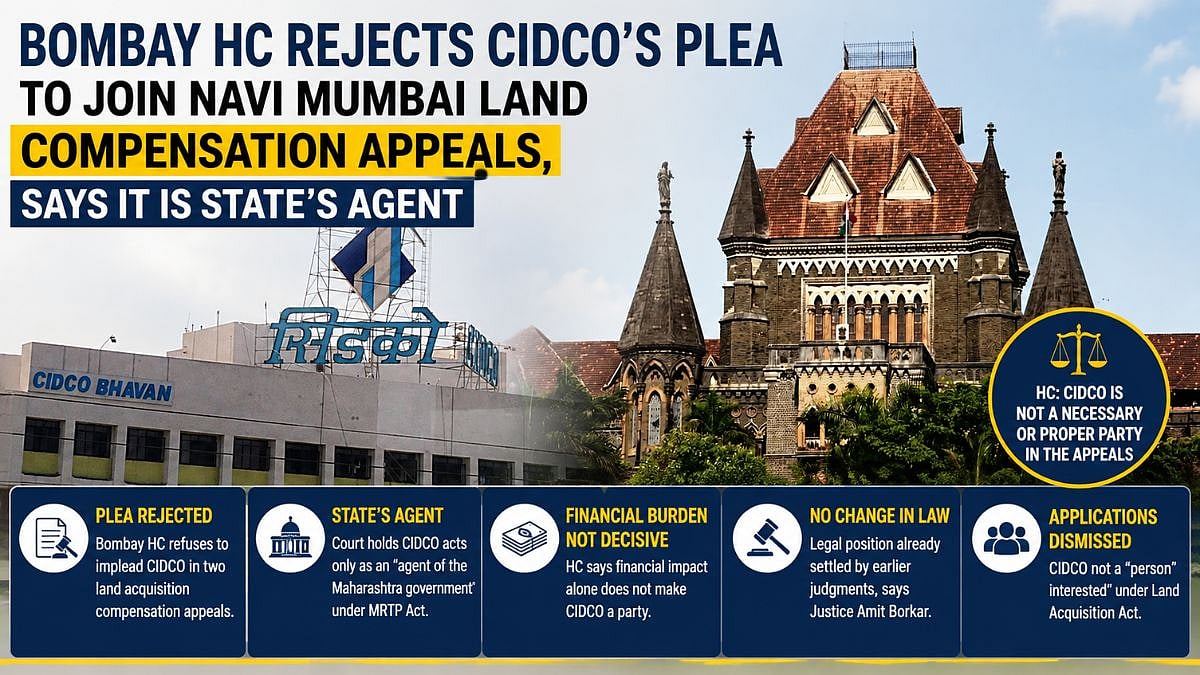
The Bombay High Court has rejected the City and Industrial Development Corporation's (CIDCO) plea to join two land acquisition appeals related to the Navi Mumbai project. On August 1, 2026, Justice Amit Borkar refused CIDCO's request, stating that it acts as an agent of the Maharashtra government in developing Navi Mumbai.
CIDCO had filed two interim applications seeking to be impleaded in appeals arising from compensation disputes over land acquired at Bokadvira village in Uran taluka, Raigad district. The appeals were filed by the State government, challenging enhanced compensation awarded by the Reference Court to landowners. CIDCO argued that it should be allowed to participate in the proceedings as it bears the financial burden of enhanced compensation and is responsible for developing Navi Mumbai.
The corporation relied on government resolutions issued in 2008, which require acquiring bodies to be made parties in land acquisition proceedings. CIDCO contended that since it funds development projects and compensation through the sale of developed land, any increase in compensation directly affects its finances. However, the landowners' advocates argued that under Section 113(3A) of the Maharashtra Regional and Town Planning (MRTP) Act, CIDCO functions only as an agent of the State government.
The court examined the MRTP Act, the Land Acquisition Act, government resolutions, and previous judgments, and held that the legal position had already been settled by earlier decisions. The court noted that while CIDCO may face a financial burden if compensation is enhanced, that alone does not make it a party to every land acquisition case. The court observed that CIDCO's role is limited to planning, development, and disposal of land as the government's agent.
The court's decision is significant, as it clarifies the role of CIDCO in land acquisition cases related to the Navi Mumbai project. The case highlights the complexities of land acquisition and the need for clear guidelines on the roles and responsibilities of various agencies involved. The decision is also expected to have implications for similar cases in the future.
The Navi Mumbai project is a major infrastructure development initiative aimed at creating a new city near Mumbai. The project involves the acquisition of large tracts of land, which has led to disputes over compensation with landowners. The case is a reminder of the challenges faced by infrastructure development projects in India, where land acquisition is often a contentious issue.
In recent years, there have been several cases related to land acquisition and compensation in the Navi Mumbai area. The Bombay High Court's decision in this case is expected to provide clarity on the legal position and help resolve similar disputes in the future. The court's ruling is also a reminder of the importance of following established legal procedures and guidelines in land acquisition cases.
The Maharashtra government has been working to develop the Navi Mumbai area as a major economic hub. The project involves the creation of new infrastructure, including roads, bridges, and public transportation systems. The government has also announced plans to develop new residential and commercial areas in the region. The project is expected to create new job opportunities and stimulate economic growth in the region.
In conclusion, the Bombay High Court's decision to reject CIDCO's plea in the Navi Mumbai land case is a significant development. The decision clarifies the role of CIDCO in land acquisition cases and provides guidance on the legal position. The case highlights the complexities of land acquisition and the need for clear guidelines on the roles and responsibilities of various agencies involved.
Frequently asked questions
What is the role of CIDCO in the Navi Mumbai project?
CIDCO acts as an agent of the Maharashtra government in developing Navi Mumbai, responsible for planning, development, and disposal of land.
Why did the Bombay High Court reject CIDCO's plea?
The court rejected CIDCO's plea because it is neither a necessary nor a proper party to the land acquisition proceedings, and its financial burden alone does not make it a party to every land acquisition case.