Gang Steals 70 Times in 40 Days from Ram Temple Donations
A gang carried out 70 thefts in 40 days, stealing cash from Ram Temple donations. Probe reveals coordinated effort.
'%3E%3Crect%20width%3D'96'%20height%3D'96'%20fill%3D'%23B3261E'%2F%3E%3Ccircle%20cx%3D'30'%20cy%3D'24'%20r%3D'44'%20fill%3D'%23fff'%20opacity%3D'.12'%2F%3E%3Ccircle%20cx%3D'60'%20cy%3D'74'%20r%3D'40'%20fill%3D'%23000'%20opacity%3D'.10'%2F%3E%3C%2Fg%3E%3Cg%20fill%3D'%23fff'%3E%3Crect%20x%3D'29'%20y%3D'49'%20width%3D'8'%20height%3D'19'%20rx%3D'1'%2F%3E%3Crect%20x%3D'39'%20y%3D'40'%20width%3D'9'%20height%3D'28'%20rx%3D'1'%2F%3E%3Crect%20x%3D'50'%20y%3D'45'%20width%3D'8'%20height%3D'23'%20rx%3D'1'%2F%3E%3Crect%20x%3D'60'%20y%3D'53'%20width%3D'7'%20height%3D'15'%20rx%3D'1'%2F%3E%3Crect%20x%3D'41'%20y%3D'34'%20width%3D'5'%20height%3D'6'%2F%3E%3C%2Fg%3E%3C%2Fsvg%3E)
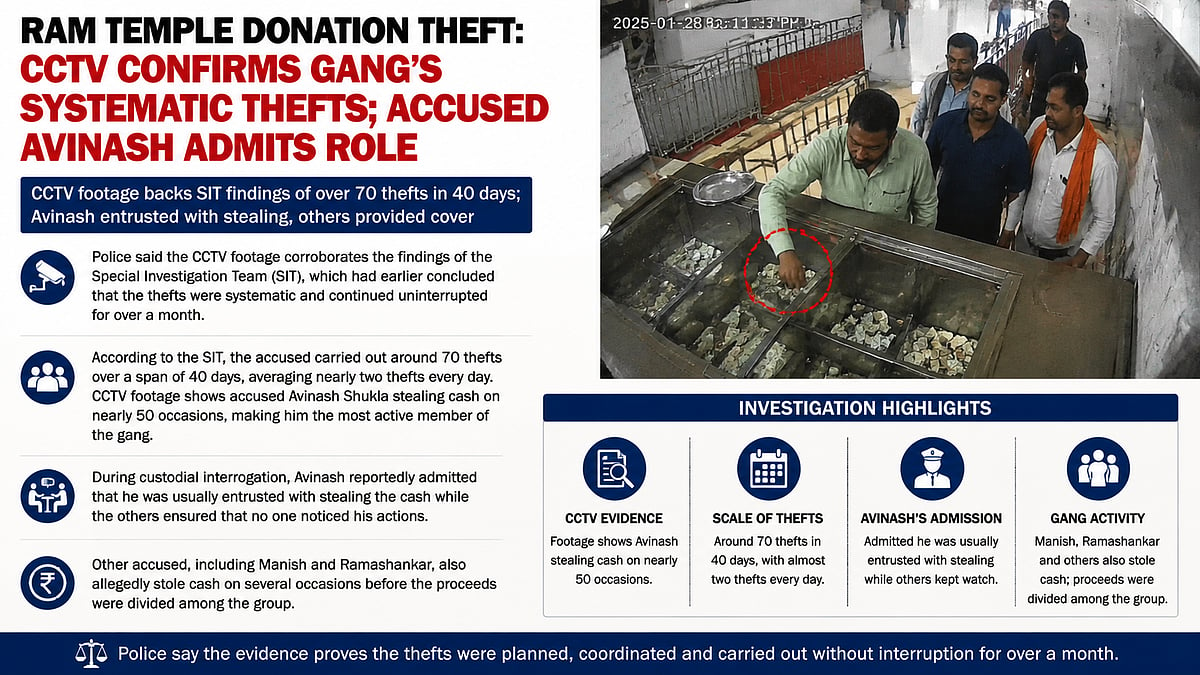
A shocking case of theft has come to light in Ayodhya, where a gang of individuals carried out a series of coordinated thefts from the Ram Temple donation collection. According to investigators, the gang stole cash on nearly 70 occasions over a span of 40 days, averaging almost two thefts per day.
The probe, led by the Special Investigation Team (SIT) and the police, has revealed that one member of the gang, Avinash Shukla, was primarily responsible for physically stealing the cash. CCTV footage, which is now part of the police evidence, shows Avinash stealing money on nearly 50 occasions, making him the most active member of the gang.
Other accused individuals, including Manish and Ramashankar, also allegedly stole cash on several occasions before the proceeds were divided among the group. The police have stated that the CCTV footage corroborates the findings of the SIT, which had earlier concluded that the thefts were systematic and continued uninterrupted for over a month.
During custodial interrogation, Avinash reportedly admitted that he was usually entrusted with stealing the cash while the others ensured that no one noticed his actions. The probe has also uncovered the roles played by the other accused individuals. Anukalp Mishra and Lavkush Mishra allegedly planned the execution of the thefts, deciding when and how the money would be taken.
Tinnu Yadav and counting staff member Subhash Srivastava allegedly kept watch to ensure that no employee or devotee became suspicious while the thefts were being carried out. Once the timing was decided, Avinash would remove the cash from the donation collection, while Manish and Ramashankar occasionally carried out similar thefts.
The stolen money was later shared among the members of the group, investigators said. The CCTV footage further indicates that the accused usually stole money twice a day and, on some occasions, even three times. During police remand, Avinash, Anukalp, and Lavkush allegedly admitted that they generally struck twice daily, although there were days when circumstances made it difficult to carry out the thefts.
The SIT's detailed inquiry is in its final stages, while the police investigation is expected to continue as officers gather additional evidence and record statements before filing the final chargesheet. The case has sparked widespread outrage and concern, with many questioning the security measures in place at the Ram Temple.
The Ram Temple, a sacred site for Hindus, has been at the center of controversy and attention in recent years. The thefts have not only caused financial loss but also damaged the trust of devotees who donate to the temple. The investigation is ongoing, and it remains to be seen what further action will be taken against the accused individuals.
The case highlights the need for increased security and vigilance at places of worship and donation collection centers. It also raises questions about the accountability and transparency of those responsible for managing donations. As the investigation continues, it is likely that more details will emerge about the extent of the thefts and the involvement of the accused individuals.
In the meantime, the Ram Temple and its management will need to reassure devotees that their donations are safe and secure. The case is a reminder that even in places of worship, there is a need for robust security measures to prevent such incidents from occurring in the future.
The significance of this case extends beyond the immediate incident, as it highlights the importance of accountability and transparency in the management of donations and funds at places of worship. It also underscores the need for increased vigilance and security measures to prevent such incidents from occurring in the future.
In conclusion, the Ram Temple donation theft case is a shocking example of coordinated theft and highlights the need for increased security and vigilance at places of worship and donation collection centers. The investigation is ongoing, and it remains to be seen what further action will be taken against the accused individuals. The case serves as a reminder of the importance of accountability and transparency in the management of donations and funds at places of worship.