India's Surveillance Debate Misses Digital Threats
India's surveillance debate focuses on CCTV cameras, but digital threats are more pervasive. Smartphones and apps collect vast personal data, raising concerns about privacy and security.
'%3E%3Crect%20width%3D'96'%20height%3D'96'%20fill%3D'%231B5E20'%2F%3E%3Ccircle%20cx%3D'30'%20cy%3D'24'%20r%3D'44'%20fill%3D'%23fff'%20opacity%3D'.12'%2F%3E%3Ccircle%20cx%3D'60'%20cy%3D'74'%20r%3D'40'%20fill%3D'%23000'%20opacity%3D'.10'%2F%3E%3C%2Fg%3E%3Cg%3E%3Ccircle%20cx%3D'48'%20cy%3D'48'%20r%3D'15'%20fill%3D'%23fff'%2F%3E%3Cpath%20d%3D'M43%2034%20Q50%2048%2043%2062'%20fill%3D'none'%20stroke%3D'%238a94a6'%20stroke-width%3D'2.4'%2F%3E%3Cpath%20d%3D'M47%2033%20Q54%2048%2047%2063'%20fill%3D'none'%20stroke%3D'%238a94a6'%20stroke-width%3D'1.8'%20stroke-dasharray%3D'1.5%203'%2F%3E%3C%2Fg%3E%3C%2Fsvg%3E)
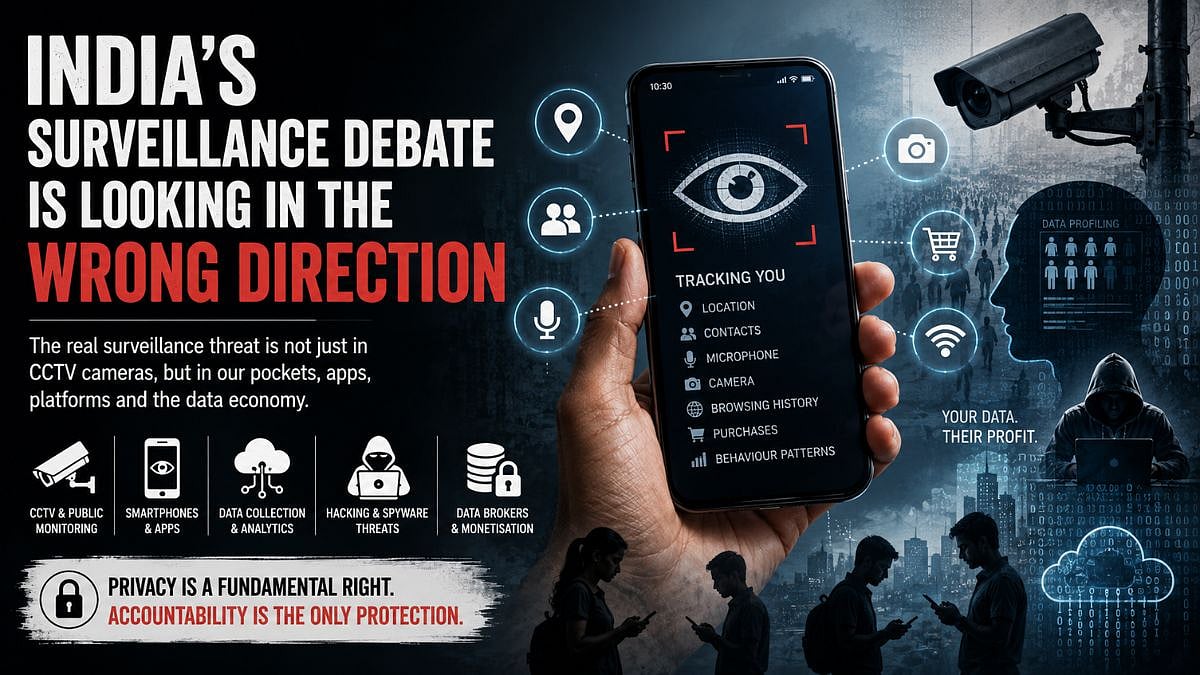
India's surveillance debate is stuck in the past, focusing on CCTV cameras and facial recognition systems in public spaces. However, the most significant surveillance threats today come from smartphones, apps, and digital platforms that collect and analyze personal data.
The widespread use of smartphones in India has created a vast amount of personal data, including location information, contacts, and online activities. Many apps seek access to this data, often beyond what is necessary for their stated purpose. Users may provide consent, but few understand the scale of information being collected or how it may be used.
The issue extends beyond apps and permissions. Modern smartphones continuously generate data about movement, habits, preferences, purchases, relationships, and communication patterns. This information is highly valuable and can be used to create detailed profiles of individual lives.
The surveillance debate in India often focuses on government overreach, but it overlooks the vast quantities of information already held by private entities. Technology companies, digital platforms, advertising networks, and data analytics firms possess unprecedented insight into the behavior of ordinary citizens. Individuals have little visibility into how their information is processed once it enters these systems.
The growing threat of unethical hacking and covert digital intrusion is also a concern. Spyware scandals and cyber espionage incidents have demonstrated that personal devices can be converted into surveillance tools without the owner's knowledge. This raises legitimate concerns about accountability and the need for robust protections for privacy and data security.
India's digital transformation has created enormous opportunities for inclusion and economic efficiency, but it has also created new challenges for protecting individual privacy. If India is serious about protecting the constitutional right to privacy, it must recognize that surveillance has evolved far beyond the lens of a CCTV camera.
The government and private companies must work together to create robust protections for privacy and data security. This includes implementing stricter regulations on data collection and use, as well as providing users with more control over their personal data.
In conclusion, India's surveillance debate must shift its focus from traditional forms of surveillance to the more pervasive digital threats. By recognizing the risks and challenges associated with digital surveillance, India can take steps to protect individual privacy and ensure that its digital transformation benefits all citizens.
The Indian government has a crucial role to play in regulating the collection and use of personal data. It must establish clear guidelines and regulations for companies that collect and process personal data. Additionally, the government must invest in education and awareness programs to help citizens understand the risks and benefits of digital technologies.
Ultimately, protecting individual privacy in the digital age requires a collective effort from government, private companies, and citizens. By working together, India can create a digital ecosystem that is both secure and respectful of individual rights.
The surveillance debate in India is not just about protecting individual privacy; it is also about promoting economic growth and development. By creating a secure and trustworthy digital ecosystem, India can attract more investment and create new opportunities for economic growth.
In the end, India's surveillance debate must prioritize the protection of individual privacy and the promotion of digital security. By doing so, India can ensure that its digital transformation benefits all citizens and promotes economic growth and development.
Frequently asked questions
What is the main focus of India's surveillance debate?
The main focus of India's surveillance debate is on traditional forms of surveillance, such as CCTV cameras and facial recognition systems.
What is the most significant surveillance threat in India today?
The most significant surveillance threat in India today comes from smartphones, apps, and digital platforms that collect and analyze personal data.