Air India Flight Loses Altitude, 17 Injured
Air India flight AI-2379 drops 300 feet, injuring 17. French agency joins probe.
'%3E%3Crect%20width%3D'96'%20height%3D'96'%20fill%3D'%23B3261E'%2F%3E%3Ccircle%20cx%3D'30'%20cy%3D'24'%20r%3D'44'%20fill%3D'%23fff'%20opacity%3D'.12'%2F%3E%3Ccircle%20cx%3D'60'%20cy%3D'74'%20r%3D'40'%20fill%3D'%23000'%20opacity%3D'.10'%2F%3E%3C%2Fg%3E%3Cg%20fill%3D'%23fff'%3E%3Crect%20x%3D'29'%20y%3D'49'%20width%3D'8'%20height%3D'19'%20rx%3D'1'%2F%3E%3Crect%20x%3D'39'%20y%3D'40'%20width%3D'9'%20height%3D'28'%20rx%3D'1'%2F%3E%3Crect%20x%3D'50'%20y%3D'45'%20width%3D'8'%20height%3D'23'%20rx%3D'1'%2F%3E%3Crect%20x%3D'60'%20y%3D'53'%20width%3D'7'%20height%3D'15'%20rx%3D'1'%2F%3E%3Crect%20x%3D'41'%20y%3D'34'%20width%3D'5'%20height%3D'6'%2F%3E%3C%2Fg%3E%3C%2Fsvg%3E)
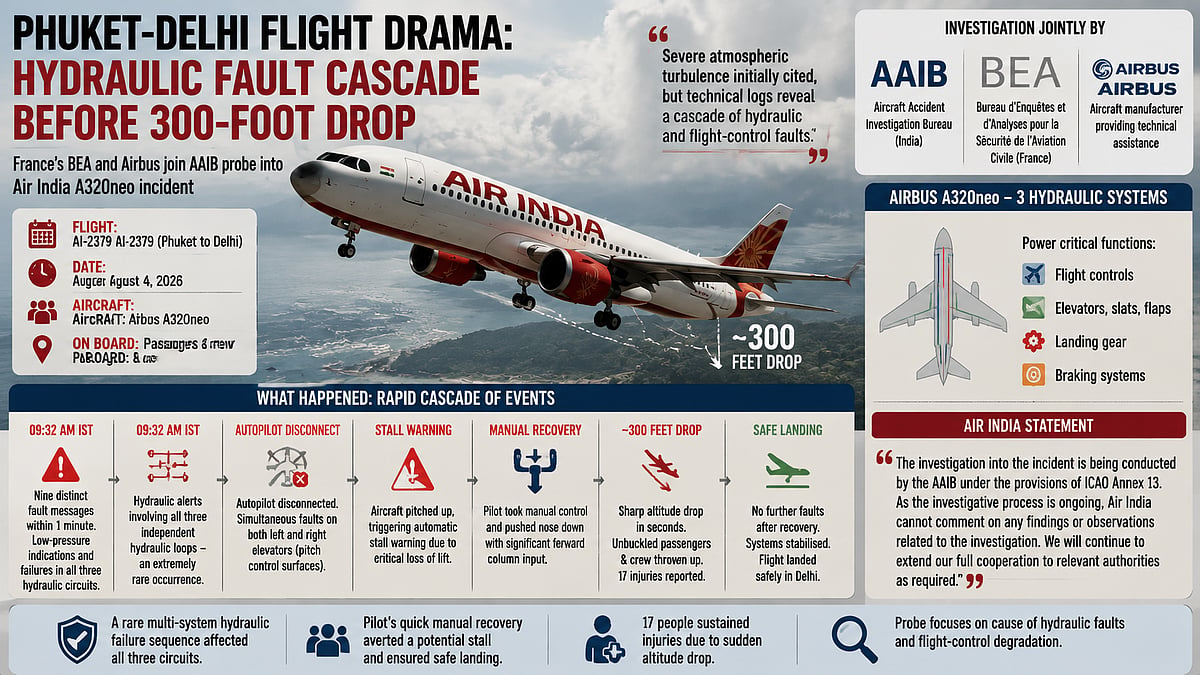
An Air India flight from Phuket to Delhi experienced a sudden loss of altitude on August 4, resulting in injuries to 17 passengers and crew members. The incident occurred nearly two and a half hours into the flight, when the Airbus A320neo aircraft was cruising at altitude.
According to technical logs, the aircraft encountered a rapid sequence of system warnings at 9:32 am IST, including nine distinct fault messages within a span of one minute. The automated systems flagged low-pressure indications and failures affecting the A320neo's three independent hydraulic circuits.
The aircraft's three hydraulic systems power critical flight parameters, including primary flight controls, elevators, slats, flaps, landing gear, and braking systems. Following the initial hydraulic alerts, the aircraft reportedly experienced an automatic disconnection of the autopilot, accompanied by simultaneous fault indications on both the left and right elevators.
As the flight-control system degraded, the aircraft pitched up, triggering an automated stall warning indicating a critical loss of lift. One of the pilots assumed manual control and executed a nose-down pitch command to recover the aircraft from the impending stall. The pilot reportedly applied significant forward control column input during the recovery maneuver.
This manual intervention successfully broke the stall but resulted in a sharp altitude drop of approximately 300 feet in a matter of seconds. The sudden negative G-forces unseated unbuckled passengers and crew, throwing them upward against the cabin ceiling.
The French Aviation Accident Agency, the Bureau of Enquiry and Analysis for Civil Aviation Safety (BEA), and aircraft manufacturer Airbus are set to join the investigation into the incident. The development comes after technical logs revealed a rapid cascade of hydraulic and flight-control faults immediately before the aircraft dropped 300 feet.
The incident highlights the importance of robust safety measures and rigorous maintenance protocols in the aviation industry. The Air India flight incident is a reminder of the potential risks associated with technical failures and the need for prompt investigation and corrective action.
The investigation into the incident is ongoing, and the findings are expected to provide valuable insights into the causes of the technical failures and the measures that can be taken to prevent such incidents in the future.
The Air India flight incident has significant implications for the aviation industry, and the investigation's findings are likely to have a major impact on the safety protocols and maintenance procedures of airlines worldwide.
In conclusion, the Air India flight incident is a serious reminder of the importance of safety in the aviation industry, and the need for airlines, manufacturers, and regulatory agencies to work together to prevent such incidents from occurring in the future.
Frequently asked questions
What happened to the Air India flight?
The Air India flight from Phuket to Delhi experienced a sudden loss of altitude, resulting in injuries to 17 passengers and crew members.
What is the current status of the investigation?
The French Aviation Accident Agency and aircraft manufacturer Airbus are set to join the investigation into the incident.