Bombay HC Limits RTI Scope
Bombay HC rules on RTI, public authorities not required to collect private info
'%3E%3Crect%20width%3D'96'%20height%3D'96'%20fill%3D'%23B3261E'%2F%3E%3Ccircle%20cx%3D'30'%20cy%3D'24'%20r%3D'44'%20fill%3D'%23fff'%20opacity%3D'.12'%2F%3E%3Ccircle%20cx%3D'60'%20cy%3D'74'%20r%3D'40'%20fill%3D'%23000'%20opacity%3D'.10'%2F%3E%3C%2Fg%3E%3Cg%20fill%3D'%23fff'%3E%3Crect%20x%3D'29'%20y%3D'49'%20width%3D'8'%20height%3D'19'%20rx%3D'1'%2F%3E%3Crect%20x%3D'39'%20y%3D'40'%20width%3D'9'%20height%3D'28'%20rx%3D'1'%2F%3E%3Crect%20x%3D'50'%20y%3D'45'%20width%3D'8'%20height%3D'23'%20rx%3D'1'%2F%3E%3Crect%20x%3D'60'%20y%3D'53'%20width%3D'7'%20height%3D'15'%20rx%3D'1'%2F%3E%3Crect%20x%3D'41'%20y%3D'34'%20width%3D'5'%20height%3D'6'%2F%3E%3C%2Fg%3E%3C%2Fsvg%3E)
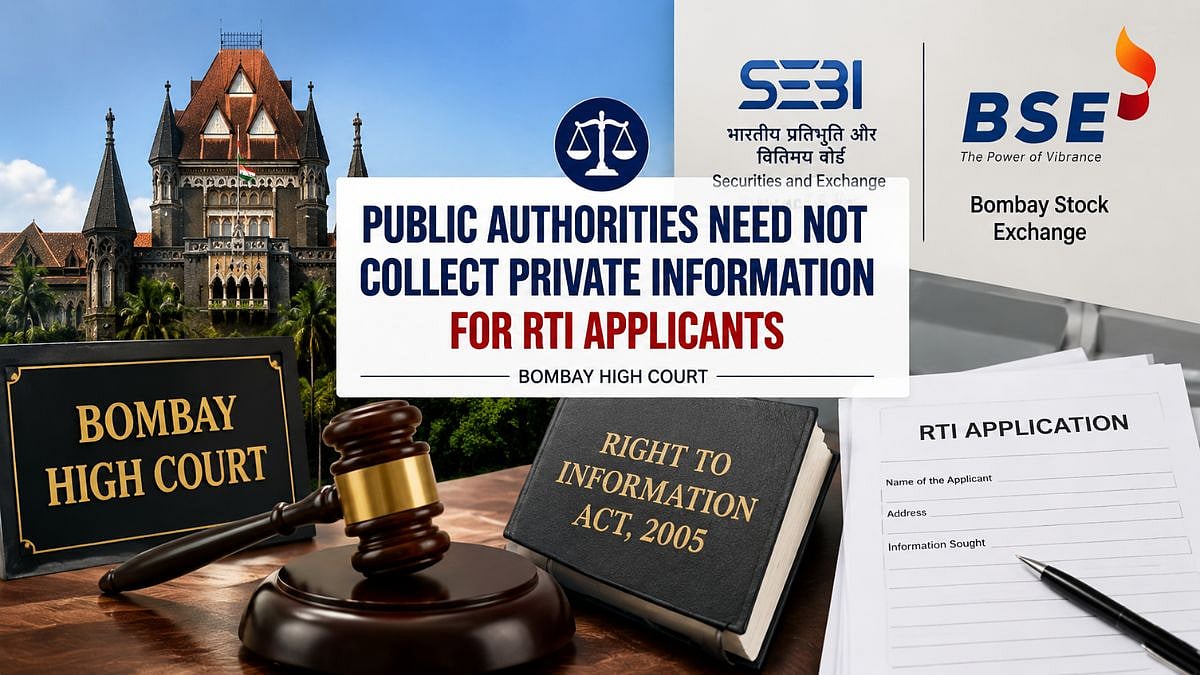
The Bombay High Court has ruled that public authorities are not required to collect information from private entities to answer Right to Information (RTI) queries.
This decision was made by a Bench of Justices Manish Pitale and Shreeram Shirsat while setting aside orders of the Central Information Commission (CIC) that directed the Securities and Exchange Board of India (SEBI) to obtain information from the Bombay Stock Exchange (BSE) and provide it to RTI applicants.
SEBI and BSE had challenged the CIC's directions before the High Court, arguing that they should not be required to gather information from third parties to satisfy RTI applicants.
The CIC had interpreted the term 'information' under the RTI Act to mean that SEBI was required to disclose not only information already available in its records but also to obtain information from third parties like BSE to answer RTI queries.
However, the High Court rejected this interpretation, stating that the fact that SEBI has regulatory powers to seek information from entities like BSE does not mean it has a corresponding obligation to gather such information for RTI applicants.
The court noted that the RTI Act requires a public authority to provide information that is already held by it, and does not require the authority to act as an information-gathering agency by collecting or compiling material that it does not possess.
The High Court found merit in SEBI's argument and referred to earlier Supreme Court rulings that have clarified that the RTI Act does not oblige public authorities to collect or collate information that is not already available with them.
The bench held that the CIC's reasoning was contrary to the law laid down by the Supreme Court and quashed the CIC orders challenged by SEBI and BSE.
This ruling provides clarity on the scope of the RTI Act and the obligations of public authorities in responding to RTI queries.
The decision is significant as it limits the scope of information that public authorities are required to provide under the RTI Act, and prevents them from being forced to collect information from private entities.
In conclusion, the Bombay High Court's ruling is a significant development in the interpretation of the RTI Act, and provides guidance on the obligations of public authorities in responding to RTI queries.
Frequently asked questions
What is the Bombay High Court's ruling on RTI?
The Bombay High Court has ruled that public authorities are not required to collect information from private entities to answer RTI queries.
What were the CIC orders challenged by SEBI and BSE?
The CIC orders directed SEBI to obtain information from the Bombay Stock Exchange (BSE) and provide it to RTI applicants.