AfD Faces Protests in Germany
Protesters block AfD conference, opposing far-right agenda. Tensions escalate in Germany.
'%3E%3Crect%20width%3D'96'%20height%3D'96'%20fill%3D'%234A235A'%2F%3E%3Ccircle%20cx%3D'30'%20cy%3D'24'%20r%3D'44'%20fill%3D'%23fff'%20opacity%3D'.12'%2F%3E%3Ccircle%20cx%3D'60'%20cy%3D'74'%20r%3D'40'%20fill%3D'%23000'%20opacity%3D'.10'%2F%3E%3C%2Fg%3E%3Cg%20fill%3D'none'%20stroke%3D'%23fff'%20stroke-width%3D'3'%3E%3Ccircle%20cx%3D'48'%20cy%3D'48'%20r%3D'16'%2F%3E%3Cellipse%20cx%3D'48'%20cy%3D'48'%20rx%3D'6.5'%20ry%3D'16'%2F%3E%3Cline%20x1%3D'32'%20y1%3D'42'%20x2%3D'64'%20y2%3D'42'%2F%3E%3Cline%20x1%3D'32'%20y1%3D'54'%20x2%3D'64'%20y2%3D'54'%2F%3E%3C%2Fg%3E%3C%2Fsvg%3E)
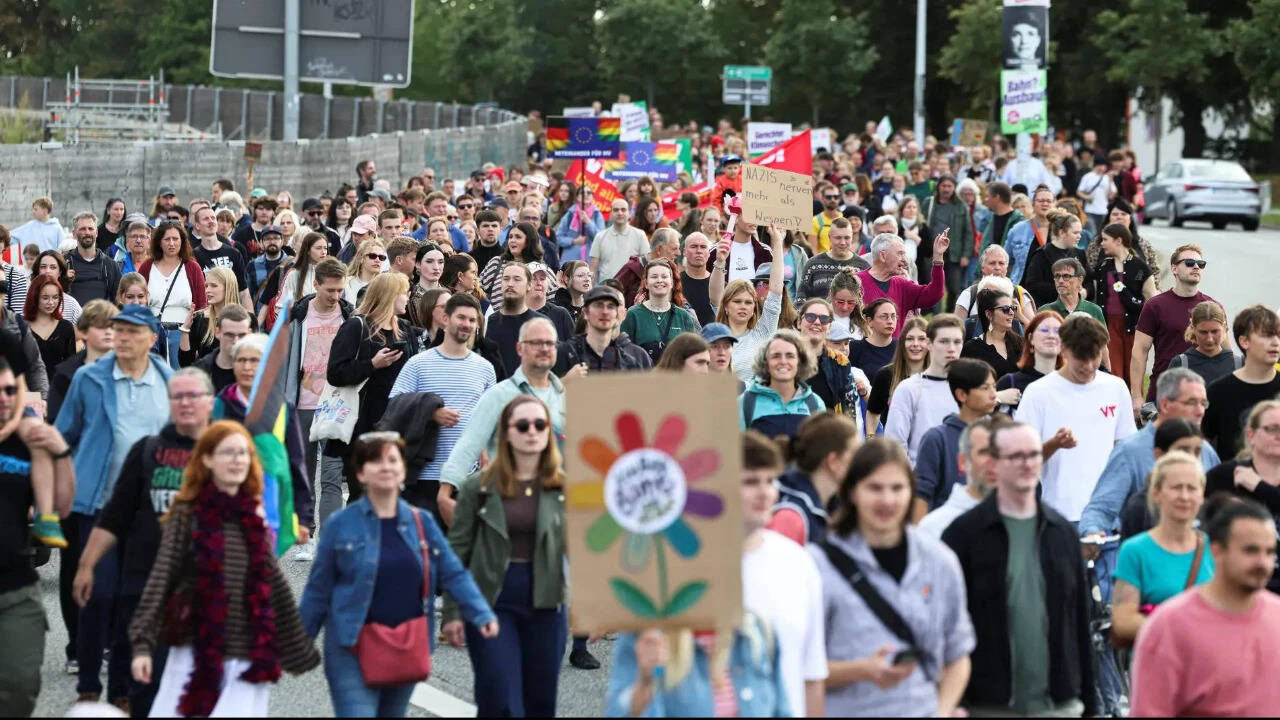
A large-scale protest erupted in Erfurt, Germany, as demonstrators actively blocked access to the Alternative for Germany (AfD) party's annual conference. This strong display of opposition comes as the AfD is gaining momentum in national opinion polls and setting its sights on upcoming elections in eastern states.
The AfD's rising popularity has raised concerns over its increasing influence in German politics. Mainstream parties have responded by adopting a strategy of isolation, refusing to collaborate with the AfD. This approach has contributed to escalating tensions between the AfD and other political parties in Germany.
The protest in Erfurt highlights the deep-seated opposition to the AfD's far-right agenda. Demonstrators are concerned about the party's stance on issues such as immigration and nationalism. The AfD's lead in national opinion polls has also sparked fears about the potential consequences of its policies.
The eastern states of Germany are seen as a key battleground for the AfD. The party has been actively campaigning in these regions, seeking to capitalize on discontent with the current government. The upcoming elections in these states are expected to be closely watched, as they may indicate the AfD's potential for future growth.
The AfD's rise to prominence has been met with resistance from mainstream parties, who are determined to prevent the party from gaining further power. However, the AfD's persistence and growing popularity suggest that it may continue to be a force in German politics.
The situation in Germany is being closely monitored by observers, who are concerned about the potential implications of the AfD's growing influence. As tensions continue to escalate, it remains to be seen how the situation will unfold.
In the broader context, the AfD's rise is part of a larger trend of far-right parties gaining traction in Europe. This shift has sparked concerns about the potential consequences for European politics and society.
The protests against the AfD in Germany serve as a reminder of the deep-seated divisions within the country. As the party continues to push its agenda, it is likely that tensions will remain high.
In conclusion, the AfD's growing influence in Germany has sparked concerns and protests. The party's far-right agenda has been met with resistance from mainstream parties and demonstrators, who are determined to prevent the AfD from gaining further power. As the situation continues to unfold, it remains to be seen what the future holds for the AfD and German politics.
The increasing power of the AfD has significant implications for Germany and Europe as a whole. The party's policies and ideology have the potential to shape the future of German politics and society. As such, the situation in Germany will be closely watched by observers in the coming months and years.
The protests and tensions surrounding the AfD are a reminder of the importance of democratic values and the need for constructive dialogue in politics. As the situation in Germany continues to evolve, it is essential that all parties involved engage in respectful and open communication to address the concerns and fears of all citizens.
The future of German politics remains uncertain, with the AfD's growing influence being a key factor. However, one thing is clear: the situation in Germany will have significant implications for the country and Europe as a whole.
Frequently asked questions
What is the AfD party in Germany?
The Alternative for Germany (AfD) is a far-right political party in Germany.
Why are protesters opposing the AfD?
Protesters are opposing the AfD due to its far-right agenda, including its stance on immigration and nationalism.