Trump Signs Orders To Restrict Birthright Citizenship
US President Donald Trump signs two executive orders, US Supreme Court rejected earlier effort, legal challenges expected
'%3E%3Crect%20width%3D'96'%20height%3D'96'%20fill%3D'%234A235A'%2F%3E%3Ccircle%20cx%3D'30'%20cy%3D'24'%20r%3D'44'%20fill%3D'%23fff'%20opacity%3D'.12'%2F%3E%3Ccircle%20cx%3D'60'%20cy%3D'74'%20r%3D'40'%20fill%3D'%23000'%20opacity%3D'.10'%2F%3E%3C%2Fg%3E%3Cg%20fill%3D'none'%20stroke%3D'%23fff'%20stroke-width%3D'3'%3E%3Ccircle%20cx%3D'48'%20cy%3D'48'%20r%3D'16'%2F%3E%3Cellipse%20cx%3D'48'%20cy%3D'48'%20rx%3D'6.5'%20ry%3D'16'%2F%3E%3Cline%20x1%3D'32'%20y1%3D'42'%20x2%3D'64'%20y2%3D'42'%2F%3E%3Cline%20x1%3D'32'%20y1%3D'54'%20x2%3D'64'%20y2%3D'54'%2F%3E%3C%2Fg%3E%3C%2Fsvg%3E)
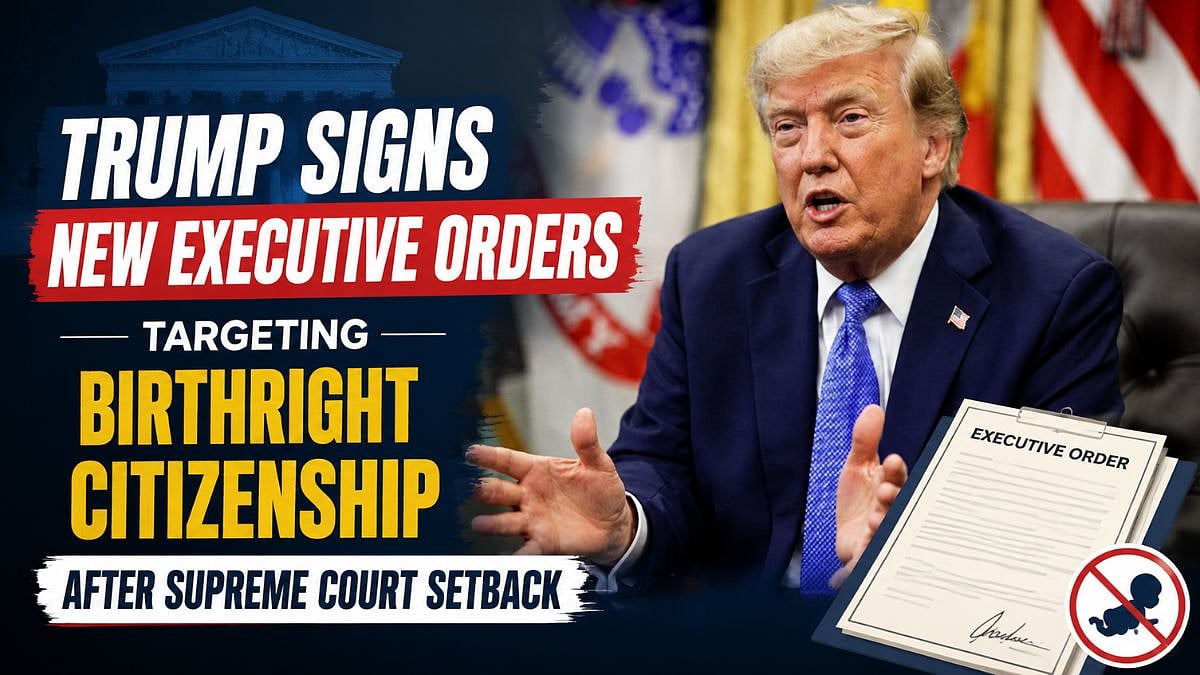
US President Donald Trump has signed two executive orders aimed at restricting birthright citizenship, just weeks after the US Supreme Court rejected his earlier attempt to deny automatic citizenship to children born to undocumented immigrants and temporary foreign residents. The move is part of Trump's long-standing immigration agenda, which has so far been unsuccessful in changing the constitutional guarantee of birthright citizenship.
The first executive order seeks to expand the categories of children who would not automatically qualify for US citizenship. Currently, exceptions to the citizenship clause of the 14th Amendment include children born in the US to foreign sovereigns and diplomats, children of occupying foreign forces, children born on foreign ships, and children of Indigenous Americans. The new order aims to add children of members of “foreign terrorist organizations” and “large categories of people who lobby and act on behalf of foreign governments” to this list.
White House Deputy Chief of Staff Stephen Miller, a key architect of Trump's immigration agenda, stated that the administration wants to broaden the existing exception covering children of foreign ambassadors to include more foreign government employees. The order also identifies people born in “a territory or territorial waters of the United States where citizenship is not conferred by federal statute” as ineligible for automatic citizenship, which currently applies only to American Samoa.
Furthermore, the order would deny birthright citizenship to children whose parents “engaged in fraudulent activity to obtain citizenship”. Trump criticized the Supreme Court's earlier ruling, calling it “a very unfortunate decision in the supreme court concerning birthright”. He claimed that the decision was “very unfair” and that his administration is making adjustments to address the issue.
The second executive order targets “birth tourism”, which refers to travel to the US with the intention of giving birth there so that the child acquires US citizenship. Trump claimed, without providing evidence, that “hundreds of thousands” of people had engaged in this practice. The measures are expected to face legal challenges, as restricting birthright citizenship has been a contentious issue in the US.
The US Supreme Court's earlier ruling rejected Trump's broader effort to deny automatic citizenship to children born to undocumented immigrants and temporary foreign residents. The court's decision was seen as a setback for Trump's immigration agenda, which has been a key focus of his presidency.
Trump's attempts to restrict birthright citizenship have been met with opposition from various groups, including civil rights organizations and immigrant advocacy groups. The issue is likely to remain a contentious one in the US, with ongoing debates about the meaning and scope of the 14th Amendment's citizenship clause.
In the context of US immigration policy, the issue of birthright citizenship is complex and multifaceted. The 14th Amendment, which was ratified in 1868, guarantees citizenship to all persons born or naturalized in the US. However, there have been ongoing debates about the scope and meaning of this amendment, particularly with regards to children born to undocumented immigrants or temporary foreign residents.
The significance of Trump's executive orders lies in their potential impact on US immigration policy and the lives of individuals affected by these policies. The orders are likely to face legal challenges and ongoing debates about their constitutionality and implications. As the issue continues to unfold, it remains to be seen how the US will navigate the complex and contentious issue of birthright citizenship.
In conclusion, Trump's signing of the two executive orders marks a new development in the ongoing debate about birthright citizenship in the US. The orders are likely to face legal challenges and ongoing opposition from various groups, and their implications for US immigration policy and the lives of individuals affected by these policies remain to be seen.
Frequently asked questions
What is birthright citizenship?
Birthright citizenship refers to the automatic granting of citizenship to individuals born in a particular country.
Why is Trump trying to restrict birthright citizenship?
Trump is trying to restrict birthright citizenship as part of his immigration agenda, which aims to limit the number of people who can become US citizens.