Uttarakhand Flash Flood Destroys New Bailey Bridge
Flash flood hits Tamak Nala, sweeps away month-old bridge. No major casualties reported.
'%3E%3Crect%20width%3D'96'%20height%3D'96'%20fill%3D'%234A235A'%2F%3E%3Ccircle%20cx%3D'30'%20cy%3D'24'%20r%3D'44'%20fill%3D'%23fff'%20opacity%3D'.12'%2F%3E%3Ccircle%20cx%3D'60'%20cy%3D'74'%20r%3D'40'%20fill%3D'%23000'%20opacity%3D'.10'%2F%3E%3C%2Fg%3E%3Cg%20fill%3D'none'%20stroke%3D'%23fff'%20stroke-width%3D'3'%3E%3Ccircle%20cx%3D'48'%20cy%3D'48'%20r%3D'16'%2F%3E%3Cellipse%20cx%3D'48'%20cy%3D'48'%20rx%3D'6.5'%20ry%3D'16'%2F%3E%3Cline%20x1%3D'32'%20y1%3D'42'%20x2%3D'64'%20y2%3D'42'%2F%3E%3Cline%20x1%3D'32'%20y1%3D'54'%20x2%3D'64'%20y2%3D'54'%2F%3E%3C%2Fg%3E%3C%2Fsvg%3E)
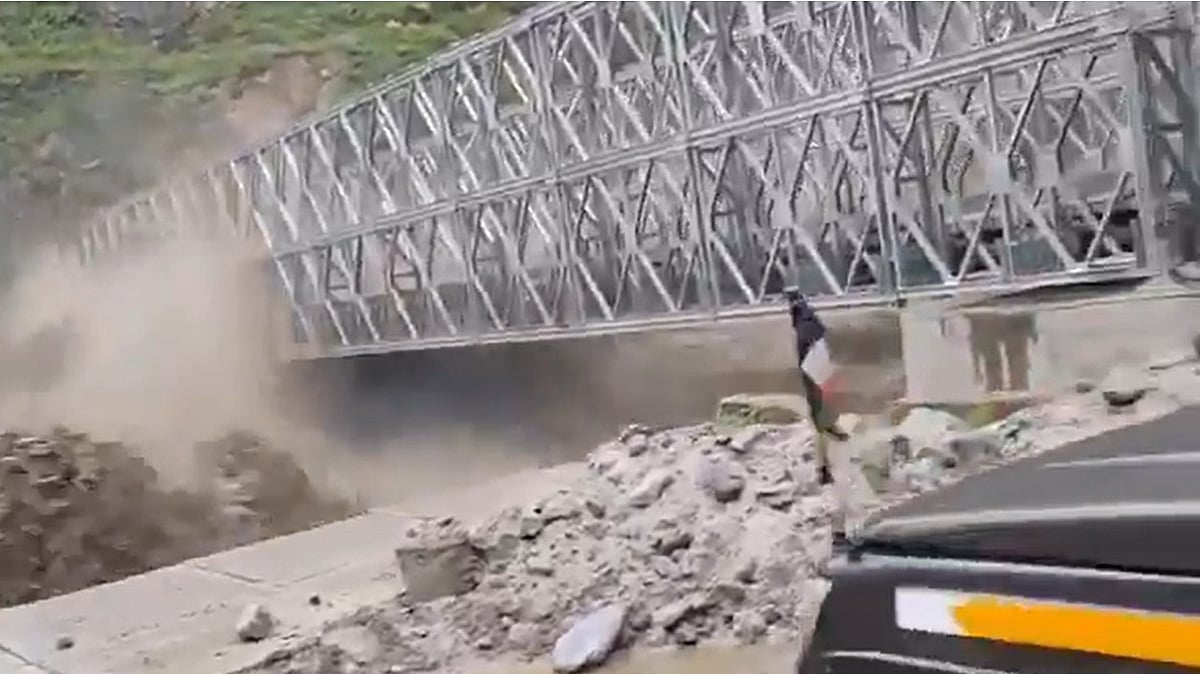
A sudden flash flood struck Tamak Nala on the Niti Valley-Malari Road in Chamoli, Uttarakhand, following heavy rainfall in the region. The flood triggered a strong flow of muddy water and debris through the Himalayan terrain, damaging areas along the river, including apple orchards.
The powerful currents also damaged a recently constructed Bailey bridge, which was reportedly swept away by the force of the floodwaters. Dramatic visuals from the site show muddy floodwaters surging through the valley, carrying rocks, mud, and debris at high speed.
The bridge, which was constructed around a month ago, was eventually heavily damaged and washed away by the strong current. The flash flood has disrupted road connectivity in the remote area, with debris covering portions of the road. Vehicles are struggling to navigate the affected stretch amid the muddy water and debris.
The disruption is particularly significant for remote border villages in the Niti Valley region, located close to the India-China frontier. Teams from the State Disaster Response Force (SDRF), National Disaster Response Force (NDRF), and police were deployed to assess the situation and assist with rescue and relief operations.
Initial reports indicated no major casualties, although authorities were assessing the situation and checking for people who may have been affected or reported missing. The flash flood has once again highlighted the vulnerability of infrastructure in Uttarakhand's mountainous regions to sudden heavy rainfall and extreme weather events.
The region's geography, with its steep slopes and fragile ecosystem, makes it prone to landslides and flash floods. The incident has raised concerns about the need for more resilient infrastructure and better disaster management strategies in the region.
The Indian government has been working to improve infrastructure in the region, including the construction of new roads and bridges. However, the flash flood has shown that more needs to be done to protect the region from the impacts of extreme weather events.
The incident has also highlighted the importance of early warning systems and emergency preparedness in the region. The authorities have been working to improve early warning systems, but more needs to be done to ensure that people in the region are prepared for extreme weather events.
In conclusion, the flash flood in Tamak Nala has highlighted the vulnerability of infrastructure in Uttarakhand's mountainous regions and the need for more resilient infrastructure and better disaster management strategies. The incident has also raised concerns about the importance of early warning systems and emergency preparedness in the region.
The flash flood has significant implications for the people living in the region, particularly those in remote border villages. The disruption to road connectivity has made it difficult for people to access essential services, including healthcare and education. The incident has also affected the local economy, with many businesses and farms damaged by the flood.
Overall, the flash flood in Tamak Nala is a reminder of the importance of disaster management and the need for more resilient infrastructure in the region. The authorities must take immediate action to assess the damage and provide relief to those affected, while also working to improve infrastructure and disaster management strategies in the region.
The incident has also raised concerns about the impact of climate change on the region. The frequency and intensity of extreme weather events are expected to increase in the coming years, making it essential for the authorities to develop strategies to mitigate the impacts of these events.
In the coming days, the authorities will be working to assess the damage and provide relief to those affected. The incident has highlighted the need for more resilient infrastructure and better disaster management strategies in the region, and it is essential that the authorities take immediate action to address these concerns.
The people living in the region are also playing a crucial role in the relief efforts, with many volunteering to help with the cleanup and rescue operations. The incident has brought the community together, with people working to support each other in the aftermath of the disaster.
In conclusion, the flash flood in Tamak Nala has highlighted the vulnerability of infrastructure in Uttarakhand's mountainous regions and the need for more resilient infrastructure and better disaster management strategies. The incident has significant implications for the people living in the region, and it is essential that the authorities take immediate action to address these concerns.
The flash flood has also raised concerns about the importance of early warning systems and emergency preparedness in the region. The authorities must work to improve early warning systems and ensure that people in the region are prepared for extreme weather events.
Overall, the flash flood in Tamak Nala is a reminder of the importance of disaster management and the need for more resilient infrastructure in the region. The authorities must take immediate action to assess the damage and provide relief to those affected, while also working to improve infrastructure and disaster management strategies in the region.
Frequently asked questions
What caused the flash flood in Tamak Nala?
The flash flood was caused by heavy rainfall in the region.
Was anyone injured in the flash flood?
No major casualties were reported, although authorities are still assessing the situation.