KYS Leads Delhi University Protest Over Fee Hikes, Study Material
Delhi University students protest fee hikes, faulty study material. KYS leads march.
'%3E%3Crect%20width%3D'96'%20height%3D'96'%20fill%3D'%231A5276'%2F%3E%3Ccircle%20cx%3D'30'%20cy%3D'24'%20r%3D'44'%20fill%3D'%23fff'%20opacity%3D'.12'%2F%3E%3Ccircle%20cx%3D'60'%20cy%3D'74'%20r%3D'40'%20fill%3D'%23000'%20opacity%3D'.10'%2F%3E%3C%2Fg%3E%3Cg%20fill%3D'%23fff'%3E%3Cpath%20d%3D'M31%2041%20L48%2031%20L65%2041%20Z'%2F%3E%3Crect%20x%3D'33'%20y%3D'43'%20width%3D'4'%20height%3D'17'%2F%3E%3Crect%20x%3D'41'%20y%3D'43'%20width%3D'4'%20height%3D'17'%2F%3E%3Crect%20x%3D'51'%20y%3D'43'%20width%3D'4'%20height%3D'17'%2F%3E%3Crect%20x%3D'59'%20y%3D'43'%20width%3D'4'%20height%3D'17'%2F%3E%3Crect%20x%3D'30'%20y%3D'62'%20width%3D'36'%20height%3D'4'%20rx%3D'1'%2F%3E%3C%2Fg%3E%3C%2Fsvg%3E)
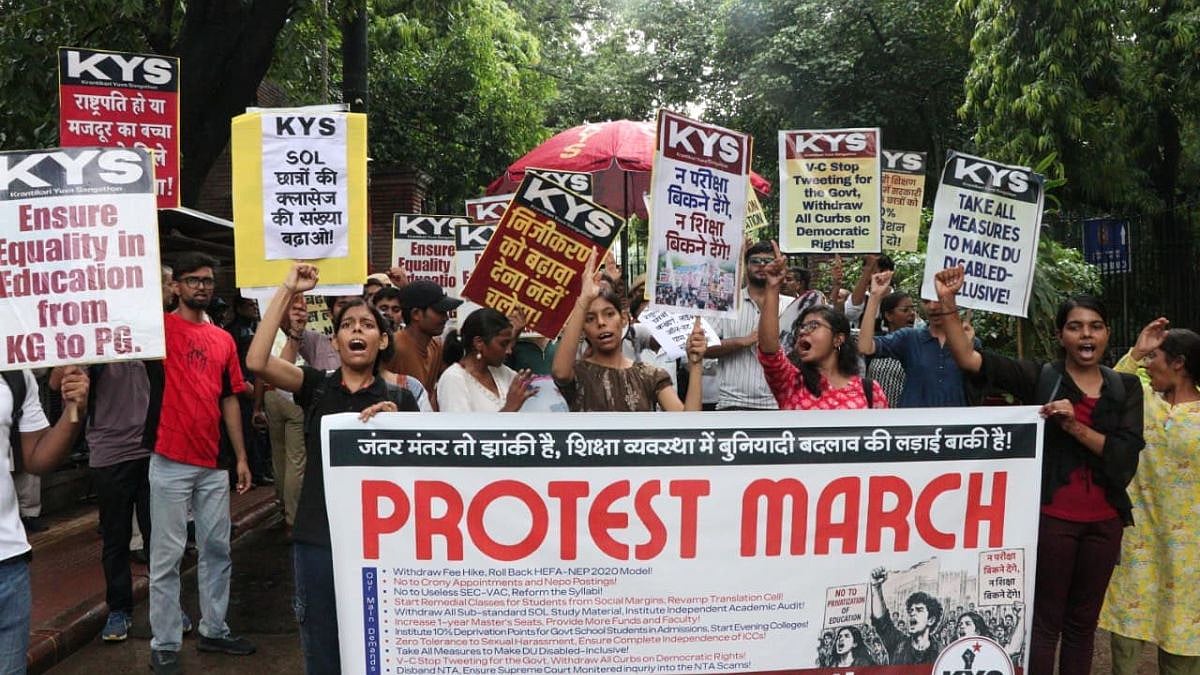
A massive protest march was organised by Krantikari Yuva Sangathan (KYS) activists and students from different colleges of Delhi University, including the School of Open Learning (SOL), in North Campus. The march, which saw massive participation despite rain and water-logging, aimed to raise concerns over various issues affecting students in DU.
The issues raised during the march included steep fee hikes, with some courses reporting over 300 per cent increase in fees. This hike is attributed to the Higher Education Financing Agency - National Education Policy 2020 (HEFA-NEP 2020) model, which provides loans instead of grants to Higher Education Institutions (HEIs). The protesters demanded that this model and its appended fee hike policy be immediately rolled back.
Another issue raised was the sub-standard SOL study materials, which have been endangering the academic life of students from marginalised sections. Despite repeated objections, these poor-quality materials remain in circulation, affecting lakhs of students who are largely first-generation learners. The protesters demanded that these materials be withdrawn and an independent academic audit be instituted.
The issue of students from social margins dropping out or falling behind due to lack of academic support was also emphasised. The protesters demanded remedial classes for these students and a revamp of DU's Translation Cell to ensure that texts are available in vernacular languages.
Furthermore, the protesters highlighted the issue of a minuscule number of seats for 1-year postgraduate courses. With over 31,000 students eligible to pursue these courses, the low number of seats across 46 departments is a major concern. The protesters argued that this goes against the National Education Policy 2020, which promised one-year master's courses to four-year undergraduates.
The protest march was a culmination of the campaign to raise concerns over these burning issues. The students and KYS activists are demanding immediate action from the authorities to address these issues and ensure a better future for students in DU.
The National Education Policy 2020 has been a topic of debate among educators and students. While it aims to transform the education system, its implementation has raised several concerns. The protesters argue that the policy's focus on loans instead of grants has led to a significant increase in fees, making education unaffordable for many.
The issue of sub-standard study materials is also a concern that needs to be addressed. The School of Open Learning (SOL) provides study materials to lakhs of students, and it is essential that these materials are of good quality. The protesters' demand for an independent academic audit is a step in the right direction.
The protest march has brought attention to the issues affecting students in DU. It remains to be seen how the authorities will respond to these concerns. The students and KYS activists are likely to continue their campaign until their demands are met.
In conclusion, the protest march organised by KYS and students from Delhi University has highlighted the need for immediate action to address the issues affecting students. The steep fee hikes, sub-standard study materials, and lack of academic support are concerns that need to be addressed to ensure a better future for students in DU.
The significance of this protest lies in its ability to bring attention to the issues affecting students in DU. It has sparked a debate about the implementation of the National Education Policy 2020 and its impact on students. The protest has also highlighted the need for authorities to take immediate action to address these concerns and ensure that education is accessible and affordable for all.
Frequently asked questions
What is the main issue behind the protest in Delhi University?
The main issues behind the protest are steep fee hikes, sub-standard study materials, and low number of seats for postgraduate courses.
What is the HEFA-NEP 2020 model?
The HEFA-NEP 2020 model provides loans instead of grants to Higher Education Institutions (HEIs), leading to a significant increase in fees.