Trump: Iran Will Never Have Nuclear Weapon
US President accuses Iran of duplicitous approach, claims Tehran sought meeting while denying talks. Tensions rise over nuclear ambitions and Strait of Hormuz control.
'%3E%3Crect%20width%3D'96'%20height%3D'96'%20fill%3D'%234A235A'%2F%3E%3Ccircle%20cx%3D'30'%20cy%3D'24'%20r%3D'44'%20fill%3D'%23fff'%20opacity%3D'.12'%2F%3E%3Ccircle%20cx%3D'60'%20cy%3D'74'%20r%3D'40'%20fill%3D'%23000'%20opacity%3D'.10'%2F%3E%3C%2Fg%3E%3Cg%20fill%3D'none'%20stroke%3D'%23fff'%20stroke-width%3D'3'%3E%3Ccircle%20cx%3D'48'%20cy%3D'48'%20r%3D'16'%2F%3E%3Cellipse%20cx%3D'48'%20cy%3D'48'%20rx%3D'6.5'%20ry%3D'16'%2F%3E%3Cline%20x1%3D'32'%20y1%3D'42'%20x2%3D'64'%20y2%3D'42'%2F%3E%3Cline%20x1%3D'32'%20y1%3D'54'%20x2%3D'64'%20y2%3D'54'%2F%3E%3C%2Fg%3E%3C%2Fsvg%3E)
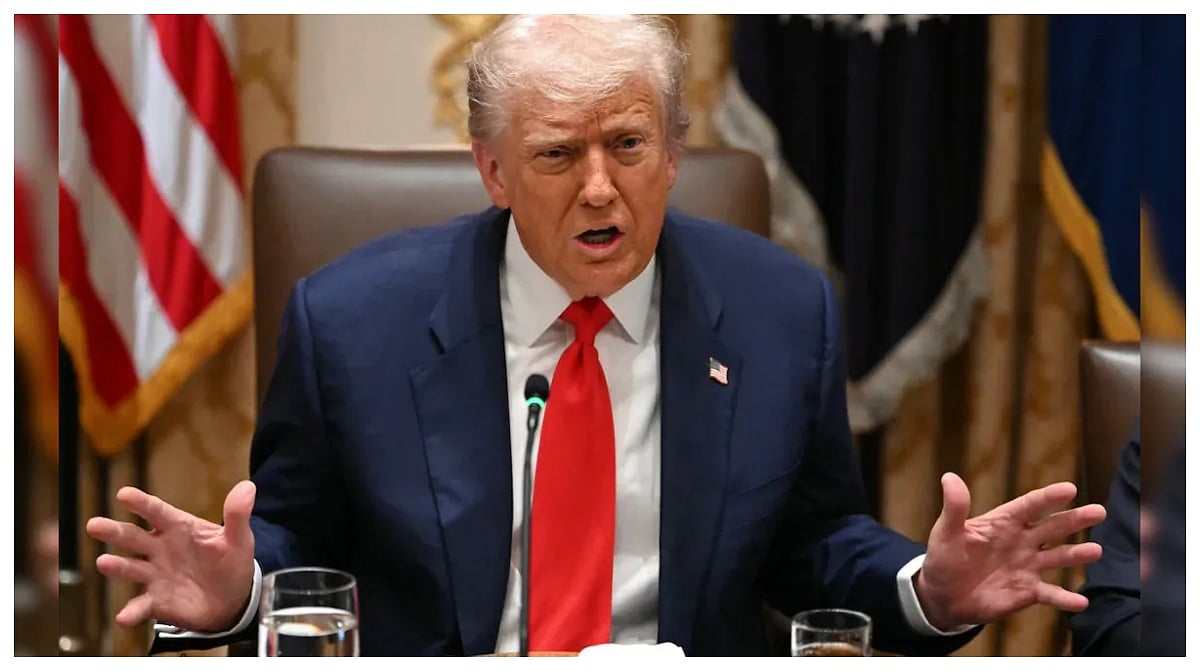
US President Donald Trump has accused Iran's leadership of being 'unbelievably duplicitous' over talks, claiming Tehran had sought a meeting with the United States while publicly denying that discussions were taking place.
In a recent post, Trump stated that Iranian officials had asked for a meeting and that talks had begun, with further discussions scheduled in the near future. However, he alleged that Iran was simultaneously claiming that it was not engaged in negotiations and was only dealing with Oman.
Trump also addressed the strategic Strait of Hormuz, rejecting Iranian assertions about control over the crucial waterway. He claimed that the strait was already 'completely controlled' by the US Navy and referred to the American blockade as the 'United States Wall of Steel.' The US President further warned that nothing would enter Iran unless Washington allowed it, asserting that the situation would continue until a deal was reached or Iran agreed to what he termed 'total surrender.'
The US President reiterated his administration's position on Tehran's nuclear programme, declaring that 'Iran will never have a nuclear weapon.' This statement comes amid heightened tensions between Washington and Tehran and growing international focus on Iran's nuclear ambitions and the security of the Strait of Hormuz.
The Strait of Hormuz is one of the world's most strategically important energy routes, with a significant portion of global oil trade passing through it. The US has long been concerned about Iran's attempts to exert control over the strait, which could potentially disrupt global energy supplies.
Trump's remarks have been met with concern from other nations, including Saudi Arabia. Saudi Crown Prince Mohammed bin Salman has urged Trump to step back from potential military action against Iran, citing fears of a wider Middle East war.
The situation between the US and Iran remains tense, with both nations engaging in a war of words over issues such as nuclear ambitions and regional influence. The international community is watching the situation closely, with many nations calling for a peaceful resolution to the conflict.
The US has made it clear that it will not tolerate a nuclear-armed Iran, and Trump's statement is the latest in a series of warnings to Tehran. The Iranian government has consistently denied that it is seeking to develop nuclear weapons, but the US and other nations remain skeptical.
As the situation continues to unfold, it remains to be seen how the US and Iran will resolve their differences. One thing is certain, however: the US will not back down from its stance on Iran's nuclear programme.
The implications of this situation are far-reaching, with potential consequences for global energy supplies, regional stability, and international relations. The world is watching as the US and Iran engage in a high-stakes game of diplomacy and brinksmanship.
In the end, the US President's statement on Iran's nuclear programme is a clear indication of his administration's position on the issue. The international community will be watching closely as the situation develops, and it remains to be seen how Iran will respond to Trump's warnings.
The US-Iran conflict has significant implications for Mumbai and India, as the country relies heavily on imported oil and is sensitive to fluctuations in global energy prices. Any disruption to the supply of oil from the Middle East could have a major impact on India's economy, making it essential for the country to monitor the situation closely.
As the world waits with bated breath to see how the situation will unfold, one thing is certain: the US will not back down from its stance on Iran's nuclear programme, and Iran will continue to face pressure from the international community to abandon its nuclear ambitions.
Frequently asked questions
What is the current situation between the US and Iran?
The US and Iran are engaged in a tense standoff over issues such as nuclear ambitions and regional influence, with the US accusing Iran of being 'unbelievably duplicitous' over talks.
What is the significance of the Strait of Hormuz?
The Strait of Hormuz is a crucial waterway through which a significant portion of global oil trade passes, and the US has long been concerned about Iran's attempts to exert control over it.