Supreme Court Allows Release Of Mahaprabhu Jagannath Film
Supreme Court refuses to ban animated film, says creativity cannot be curtailed over religious sensitivity.
'%3E%3Crect%20width%3D'96'%20height%3D'96'%20fill%3D'%23C2185B'%2F%3E%3Ccircle%20cx%3D'30'%20cy%3D'24'%20r%3D'44'%20fill%3D'%23fff'%20opacity%3D'.12'%2F%3E%3Ccircle%20cx%3D'60'%20cy%3D'74'%20r%3D'40'%20fill%3D'%23000'%20opacity%3D'.10'%2F%3E%3C%2Fg%3E%3Cpath%20fill%3D'%23fff'%20d%3D'M48%2031%20l4.6%2010.2%2011.2%201%20-8.4%207.5%202.5%2011%20-9.9%20-5.8%20-9.9%205.8%202.5%20-11%20-8.4%20-7.5%2011.2%20-1%20z'%2F%3E%3C%2Fsvg%3E)
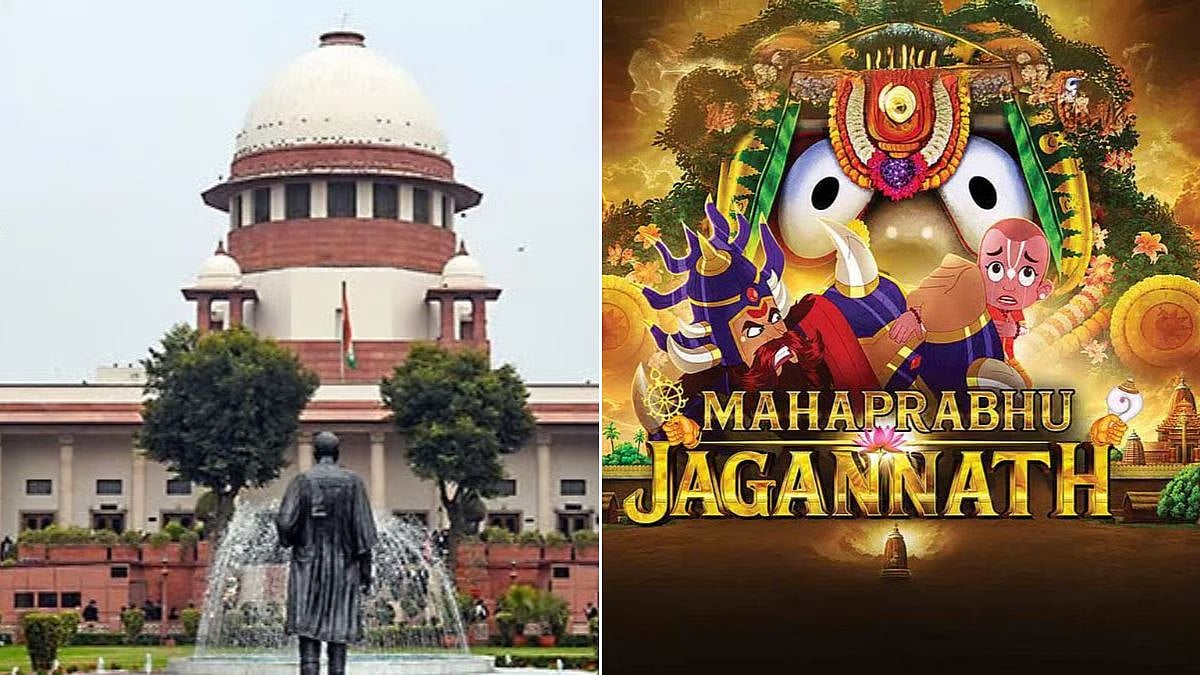
The Supreme Court on Wednesday refused to ban the release of the animated film Mahaprabhu Jagannath, dismissing applications seeking to modify its earlier order.
A Bench of Justice BV Nagarathna and Justice R Mahadevan declined to interfere with its July 17 order, observing that objections based on religious sensitivity cannot become a ground to stifle artistic expression.
The court also rejected the argument that depicting Lord Jagannath in animated form was inherently offensive, noting that the film was intended for children.
The film had already been certified by the Central Board of Film Certification (CBFC), which was also taken into consideration by the court.
Justice Nagarathna questioned the growing tendency to seek judicial intervention against creative works merely because they do not align with the sentiments of a section of people.
She warned that accepting such arguments would mean no films, television shows, paintings or sculptures on Hindu deities could ever be made.
The applications seeking a modification of the July 17 order had been filed by the temple trust and a devotee, who objected to the depiction of Lord Jagannath in cartoon form.
The Temple Committee argued that the producer had breached the trust of religious authorities and had assured them that the film would be modified in line with their concerns.
However, Senior Advocate Devadatt Kamat, appearing for the producer, denied that any assurance had been given.
He submitted that members of the temple committee had themselves walked out of the screening.
The court's decision is a significant one, as it draws a line on artistic freedom and the limits of judicial intervention in creative works.
It emphasizes that creativity and artistic expression cannot be curtailed by the sensitivities of a few people.
The film Mahaprabhu Jagannath is an animated movie intended for children, and its release had been allowed by the court after the conclusion of the Lord Jagannath Rath Yatra in Puri on July 28.
The court's decision to allow the release of the film is a victory for artistic freedom and creative expression.
In a country with diverse cultures and religions, the court's decision is a significant one, as it sets a precedent for the protection of artistic freedom and creative expression.
It emphasizes that the judiciary will not interfere with creative works merely because they do not align with the sentiments of a section of people.
The decision is also a reflection of the evolving nature of storytelling and artistic expression in India.
With the rise of animation and digital media, the court's decision recognizes the importance of creative freedom in these new and emerging forms of storytelling.
In conclusion, the Supreme Court's decision to allow the release of Mahaprabhu Jagannath is a significant one, as it protects artistic freedom and creative expression in India.
It sets a precedent for the judiciary to respect the creative freedom of artists and filmmakers, and not to interfere with their work merely because it does not align with the sentiments of a section of people.
Frequently asked questions
What is the name of the animated film that was allowed to be released by the Supreme Court?
The name of the animated film is Mahaprabhu Jagannath.
Why did the Supreme Court allow the release of the film?
The Supreme Court allowed the release of the film because it said that creativity and artistic expression cannot be curtailed by the sensitivities of a few people.