Bombay HC Grants Interim Relief To Former TISS Student
Former TISS student Kamakhya Das gets interim protection from arrest, court says custody not necessary
'%3E%3Crect%20width%3D'96'%20height%3D'96'%20fill%3D'%23B3261E'%2F%3E%3Ccircle%20cx%3D'30'%20cy%3D'24'%20r%3D'44'%20fill%3D'%23fff'%20opacity%3D'.12'%2F%3E%3Ccircle%20cx%3D'60'%20cy%3D'74'%20r%3D'40'%20fill%3D'%23000'%20opacity%3D'.10'%2F%3E%3C%2Fg%3E%3Cg%20fill%3D'%23fff'%3E%3Crect%20x%3D'29'%20y%3D'49'%20width%3D'8'%20height%3D'19'%20rx%3D'1'%2F%3E%3Crect%20x%3D'39'%20y%3D'40'%20width%3D'9'%20height%3D'28'%20rx%3D'1'%2F%3E%3Crect%20x%3D'50'%20y%3D'45'%20width%3D'8'%20height%3D'23'%20rx%3D'1'%2F%3E%3Crect%20x%3D'60'%20y%3D'53'%20width%3D'7'%20height%3D'15'%20rx%3D'1'%2F%3E%3Crect%20x%3D'41'%20y%3D'34'%20width%3D'5'%20height%3D'6'%2F%3E%3C%2Fg%3E%3C%2Fsvg%3E)
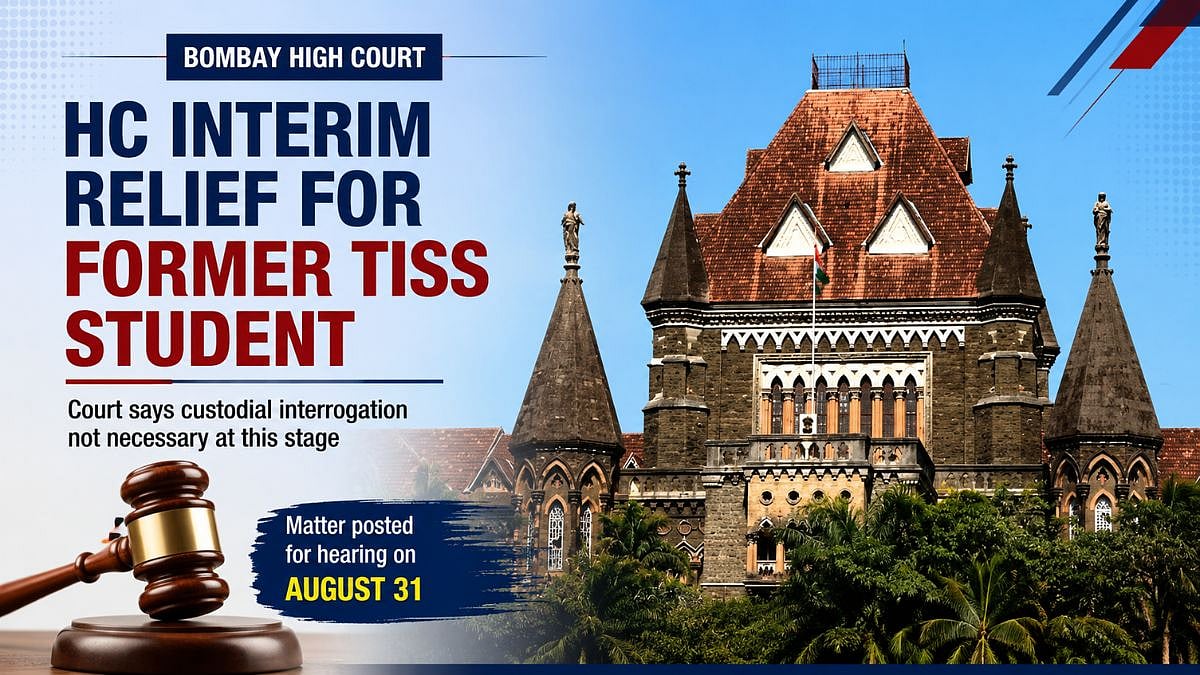
The Bombay High Court on Friday granted interim protection from arrest to former Tata Institute of Social Sciences (TISS) student Kamakhya Das, who is accused of raising inflammatory slogans at an unauthorised campus event.
The event in question was held on October 12, 2025, where nine students gathered to pay tribute to former Delhi University professor GN Saibaba. The gathering allegedly involved candle lighting, reading revolutionary poetry and slogans demanding the release of Sharjeel Imam and Umar Khalid, both accused under the Unlawful Activities (Prevention) Act.
Justice Prafulla Khubalkar observed that Das's mobile phone and laptop had already been seized and held that custodial interrogation was not necessary at this stage. The court said that considering the nature of the allegations and the fact that the mobile phone and laptop of the applicant are already seized, at this stage, custodial interrogation need not be insisted upon.
Das was directed to appear at the concerned police station and before investigators whenever called, until the next hearing on August 31. The case stems from an FIR registered at Trombay police station on a complaint by the TISS Registrar.
Senior Advocate Mihir Desai, appearing for Das, said his client had cooperated with the investigation and had no criminal antecedents. He argued that merely attending a commemoration or using expressions such as “Rest in Power” could not constitute a criminal offence. Desai pointed out that seven of the nine accused students had already secured anticipatory bail.
Chief Public Prosecutor Shishir Hiray opposed the plea, alleging that the investigation had revealed a deeper conspiracy involving secession. He said forensic examination found deleted applications and electronic literature allegedly advocating secession, Khalistan and the ideology of the banned CPI (Maoist).
After considering the submissions, the High Court granted Das temporary protection from arrest and posted the matter for further hearing on August 31. The decision is significant as it highlights the court's approach to balancing individual freedoms with the need to investigate potential criminal activity.
The case has also sparked debate about the limits of free speech and the role of universities in promoting critical thinking and dissent. The TISS has been at the center of controversy in recent years, with students and faculty members facing scrutiny for their alleged links to leftist and separatist groups.
The Bombay High Court's decision to grant interim relief to Das is likely to be seen as a victory for free speech advocates, who argue that the state should not be allowed to stifle dissenting voices, especially in academic institutions. However, the prosecution's allegations of a deeper conspiracy involving secession will likely be closely watched as the case proceeds.
In the end, the court's decision will have significant implications for the ongoing debate about free speech, dissent, and the role of universities in promoting critical thinking and intellectual freedom. The case will be closely watched as it proceeds to the next hearing on August 31.
The Bombay High Court's approach to the case will be seen as a test of its commitment to upholding individual freedoms and the rule of law. The decision to grant interim relief to Das is a significant development in the case, and it will be interesting to see how the prosecution responds to the court's ruling.
The case has also highlighted the need for universities to promote critical thinking and intellectual freedom, while also ensuring that students and faculty members are not involved in any illegal activities. The TISS has a reputation for being a hub of intellectual and academic activity, and it will be important for the institution to ensure that it maintains its commitment to free speech and dissent.
In conclusion, the Bombay High Court's decision to grant interim relief to Kamakhya Das is a significant development in the case, and it will be closely watched as the case proceeds to the next hearing on August 31. The decision highlights the court's approach to balancing individual freedoms with the need to investigate potential criminal activity, and it will have significant implications for the ongoing debate about free speech, dissent, and the role of universities in promoting critical thinking and intellectual freedom.
Frequently asked questions
What was Kamakhya Das accused of?
Kamakhya Das was accused of raising inflammatory slogans at an unauthorised campus event at TISS.
What was the court's decision in the case?
The Bombay High Court granted interim protection from arrest to Kamakhya Das, saying that custodial interrogation was not necessary at this stage.