Centre Defends Protest Videography in Delhi HC
Centre opposes PIL, claims videography necessary for law and order. Petitioner argues it's intrusive surveillance.
'%3E%3Crect%20width%3D'96'%20height%3D'96'%20fill%3D'%231A5276'%2F%3E%3Ccircle%20cx%3D'30'%20cy%3D'24'%20r%3D'44'%20fill%3D'%23fff'%20opacity%3D'.12'%2F%3E%3Ccircle%20cx%3D'60'%20cy%3D'74'%20r%3D'40'%20fill%3D'%23000'%20opacity%3D'.10'%2F%3E%3C%2Fg%3E%3Cg%20fill%3D'%23fff'%3E%3Cpath%20d%3D'M31%2041%20L48%2031%20L65%2041%20Z'%2F%3E%3Crect%20x%3D'33'%20y%3D'43'%20width%3D'4'%20height%3D'17'%2F%3E%3Crect%20x%3D'41'%20y%3D'43'%20width%3D'4'%20height%3D'17'%2F%3E%3Crect%20x%3D'51'%20y%3D'43'%20width%3D'4'%20height%3D'17'%2F%3E%3Crect%20x%3D'59'%20y%3D'43'%20width%3D'4'%20height%3D'17'%2F%3E%3Crect%20x%3D'30'%20y%3D'62'%20width%3D'36'%20height%3D'4'%20rx%3D'1'%2F%3E%3C%2Fg%3E%3C%2Fsvg%3E)
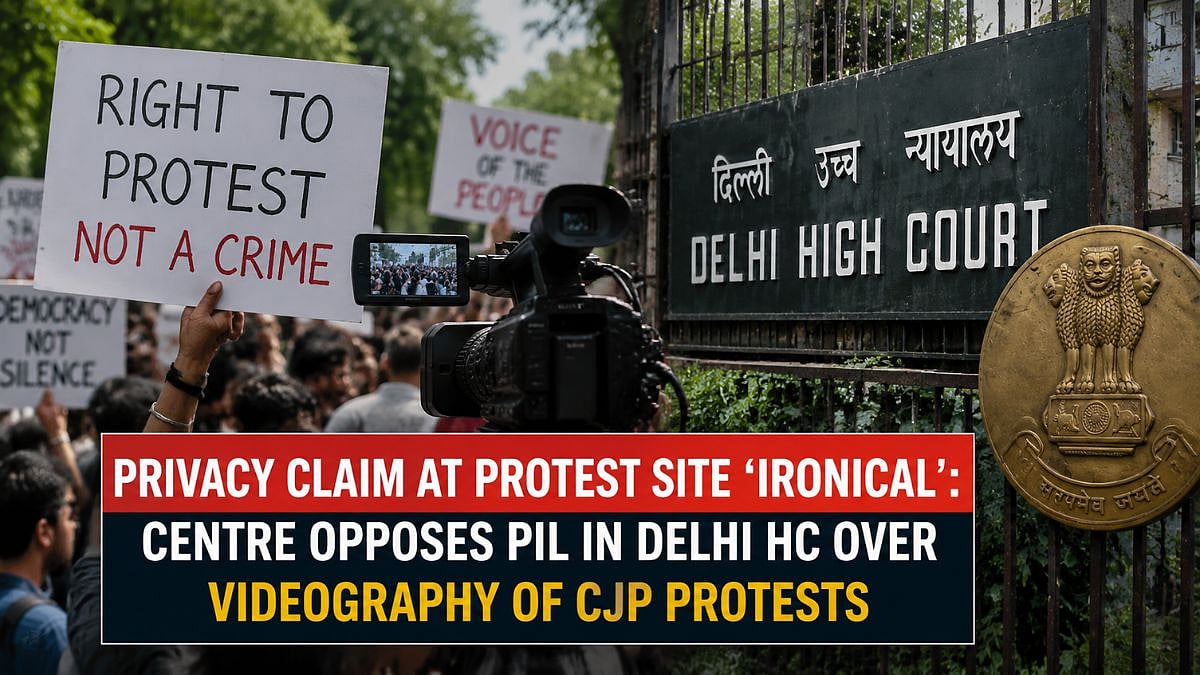
The Central government defended the videography of protests at Delhi's Jantar Mantar in the Delhi High Court on Friday.
The government argued that claiming a right to privacy at a public protest site was 'ironical' and that videography is a routine practice to maintain law and order.
Solicitor General Tushar Mehta opposed the issuance of notice on a public interest litigation (PIL) filed by former Jawaharlal Nehru University Students' Union (JNUSU) president Aishe Ghosh.
The petition alleges that Delhi Police has been carrying out continuous and intrusive surveillance of protesters associated with the Cockroach Janta Party (CJP) and others at Jantar Mantar.
Mehta told the court that videography is not specific to CJP protests but is conducted during every demonstration at the venue as a standard law-and-order measure.
He also argued that CJP's own social media handle regularly encourages supporters to record events on their mobile phones.
Senior Advocate Nandita Rao, appearing for Ghosh, argued that there is a fundamental difference between videos recorded by journalists or protesters and surveillance carried out by the State.
She said the government was creating a false equivalence by comparing police videography with recordings made by private individuals.
Rao also questioned the lack of safeguards governing the storage and use of the recorded data and raised concerns over the alleged use of facial recognition technology by the police.
The Delhi High Court is yet to decide on the matter.
The case highlights the ongoing debate about the balance between the right to privacy and the need for law and order in public spaces.
The use of videography and surveillance technology by law enforcement agencies has been a topic of concern for civil liberties groups and privacy advocates.
The outcome of this case may have implications for the use of such technology in public protests and demonstrations across the country.
In recent years, there have been several instances of police using videography and surveillance technology to monitor protests and demonstrations, raising concerns about privacy and freedom of speech.
The Centre's argument that videography is necessary for law and order may be seen as a attempt to justify the use of such technology, but the petitioner's concerns about the lack of safeguards and the potential for misuse of recorded data are valid and need to be addressed.
The Delhi High Court's decision in this case will be closely watched by civil liberties groups and privacy advocates, and may have significant implications for the right to privacy in public spaces.
Frequently asked questions
What is the Centre's argument in favour of videography at protests?
The Centre argues that videography is necessary for law and order and is a routine practice carried out at every protest.
What are the concerns raised by the petitioner?
The petitioner raises concerns about the lack of safeguards governing the storage and use of recorded data and the potential for misuse of facial recognition technology.