Political Labels Hurt Democratic Debate
Labels like 'andhbhakt' and 'anti-national' simplify complex issues, stifling debate. Experts weigh in.
'%3E%3Crect%20width%3D'96'%20height%3D'96'%20fill%3D'%231A5276'%2F%3E%3Ccircle%20cx%3D'30'%20cy%3D'24'%20r%3D'44'%20fill%3D'%23fff'%20opacity%3D'.12'%2F%3E%3Ccircle%20cx%3D'60'%20cy%3D'74'%20r%3D'40'%20fill%3D'%23000'%20opacity%3D'.10'%2F%3E%3C%2Fg%3E%3Cg%20fill%3D'%23fff'%3E%3Cpath%20d%3D'M31%2041%20L48%2031%20L65%2041%20Z'%2F%3E%3Crect%20x%3D'33'%20y%3D'43'%20width%3D'4'%20height%3D'17'%2F%3E%3Crect%20x%3D'41'%20y%3D'43'%20width%3D'4'%20height%3D'17'%2F%3E%3Crect%20x%3D'51'%20y%3D'43'%20width%3D'4'%20height%3D'17'%2F%3E%3Crect%20x%3D'59'%20y%3D'43'%20width%3D'4'%20height%3D'17'%2F%3E%3Crect%20x%3D'30'%20y%3D'62'%20width%3D'36'%20height%3D'4'%20rx%3D'1'%2F%3E%3C%2Fg%3E%3C%2Fsvg%3E)
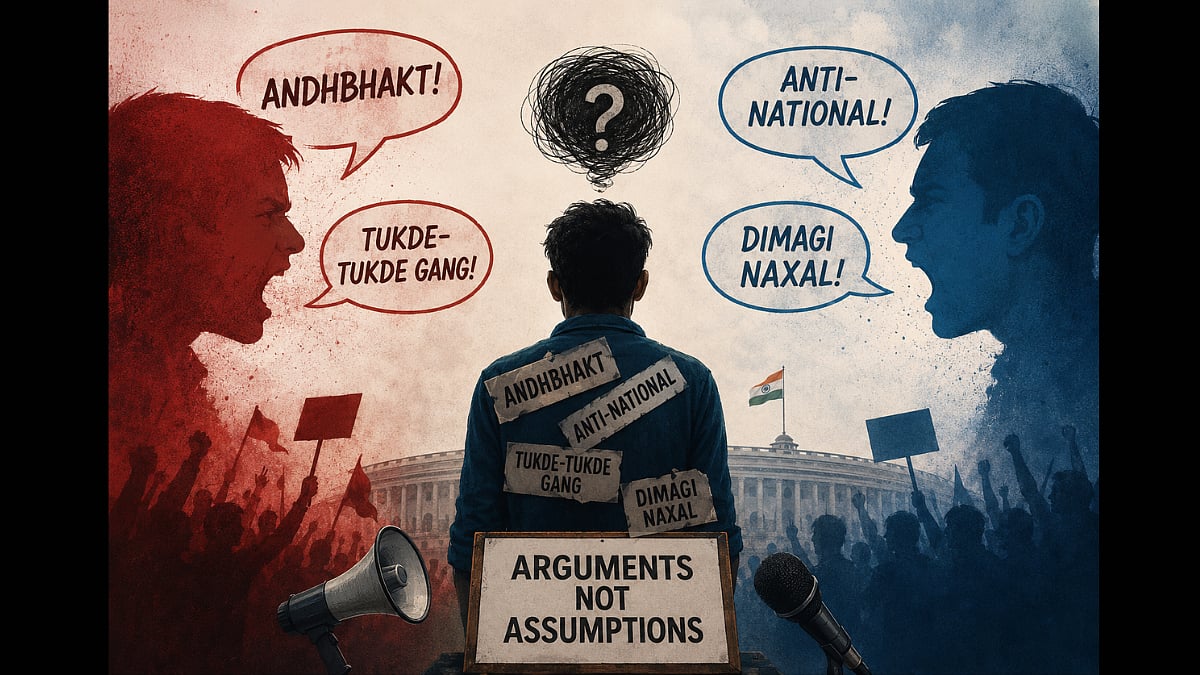
In today's polarized political climate, the use of labels such as 'andhbhakt', 'anti-national', and 'dimagi naxal' has become increasingly prevalent. These terms often replace nuanced arguments with simplistic assumptions, making it challenging to engage in meaningful democratic debates.
The consequences of relying on such labels are far-reaching. For instance, young people may be discouraged from participating in online discussions due to the fear of being mocked or abused. This can lead to a decline in constructive dialogue and the formation of echo chambers, where individuals only interact with like-minded individuals.
According to Sourja Sarkar, a 23-year-old professional photographer, labels can be damaging as they compress complex issues into insults, making real conversations nearly impossible. Sarkar emphasizes that once someone is labeled, they stop being a person with reasons and become a caricature, easy to dismiss but impossible to persuade.
Minesh Raja, the founder of Carmine Communications LLP, also highlights the problems associated with relying on labels and stereotypes in political conversations. Raja notes that supporters of the BJP are often dismissed as 'andhbhakts', while critics of the government are branded 'anti-national' or anti-Hindutva. This can shut down discussions before they even begin, leaving little room for those who do not view politics in black and white.
Raja suggests that citizens should be able to evaluate governments based on various factors, such as economic growth, national security, and infrastructure, without being constrained by party loyalty. They should also be able to demand accountability on issues such as governance and corruption.
To reverse the trend of relying on labels, effort is needed from all sides. The younger generation needs to choose curiosity over contempt, influencers should resist the temptation to farm engagement through division, and platforms must redesign algorithms that currently profit from conflict.
Respectful disagreement is essential for democracy to function effectively. By engaging in constructive debates and avoiding the use of simplistic labels, individuals can promote a more nuanced understanding of complex issues.
In conclusion, the use of political labels can have a detrimental impact on democratic debates. By recognizing the problems associated with relying on such labels and making a concerted effort to promote respectful disagreement, individuals can help create a more constructive and inclusive public discourse.
The issue of political labels is not unique to India, but it is particularly pronounced in the country's current political climate. As the nation continues to grapple with complex issues, it is essential to promote a culture of respectful debate and disagreement.
By doing so, individuals can help create a more informed and engaged citizenry, which is essential for a healthy democracy. Ultimately, the ability to engage in constructive debates and discussions is critical for the functioning of a democratic system.
In the end, it is up to individuals to choose how they want to engage in public discourse. By choosing curiosity over contempt and promoting respectful disagreement, individuals can help create a more nuanced and inclusive public discourse.
Frequently asked questions
What is the impact of political labels on democratic debate?
Political labels can simplify complex issues and stifle debate, leading to a decline in constructive dialogue.
How can individuals promote respectful disagreement?
Individuals can promote respectful disagreement by choosing curiosity over contempt, avoiding simplistic labels, and engaging in constructive debates.