Congress MLAs Protest Fertiliser Shortage, NEET Paper Leak in MP Assembly
Congress MLAs stage protest, demand action on farmers' issues and new education policy.
'%3E%3Crect%20width%3D'96'%20height%3D'96'%20fill%3D'%231A5276'%2F%3E%3Ccircle%20cx%3D'30'%20cy%3D'24'%20r%3D'44'%20fill%3D'%23fff'%20opacity%3D'.12'%2F%3E%3Ccircle%20cx%3D'60'%20cy%3D'74'%20r%3D'40'%20fill%3D'%23000'%20opacity%3D'.10'%2F%3E%3C%2Fg%3E%3Cg%20fill%3D'%23fff'%3E%3Cpath%20d%3D'M31%2041%20L48%2031%20L65%2041%20Z'%2F%3E%3Crect%20x%3D'33'%20y%3D'43'%20width%3D'4'%20height%3D'17'%2F%3E%3Crect%20x%3D'41'%20y%3D'43'%20width%3D'4'%20height%3D'17'%2F%3E%3Crect%20x%3D'51'%20y%3D'43'%20width%3D'4'%20height%3D'17'%2F%3E%3Crect%20x%3D'59'%20y%3D'43'%20width%3D'4'%20height%3D'17'%2F%3E%3Crect%20x%3D'30'%20y%3D'62'%20width%3D'36'%20height%3D'4'%20rx%3D'1'%2F%3E%3C%2Fg%3E%3C%2Fsvg%3E)
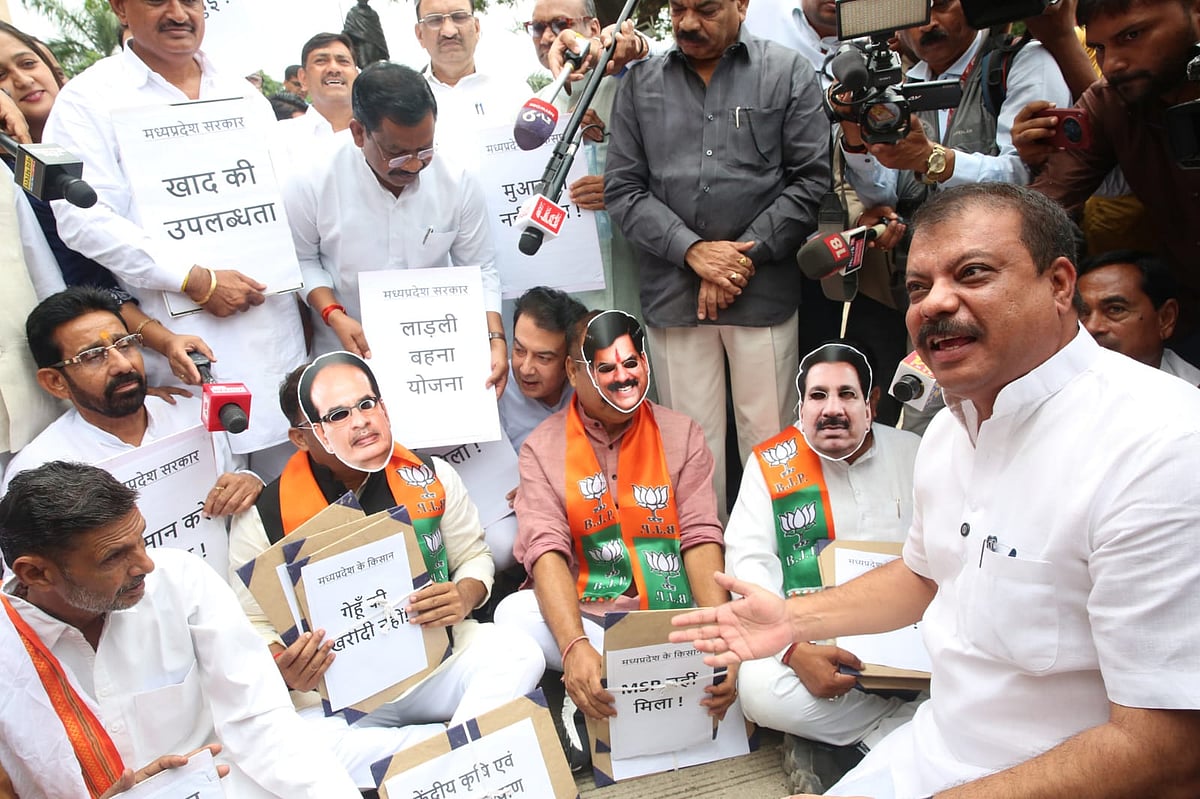
The first day of the Madhya Pradesh Monsoon Assembly session saw Congress MLAs staging a protest inside the assembly premises. Led by Leader of Opposition Umang Singhar, the MLAs raised concerns over the alleged shortage of fertilisers, irregularities in government procurement, and the lack of proper compensation for farmers.
The protest was a symbolic gesture, with Congress legislators wearing masks of Chief Minister Mohan Yadav, Union Agriculture Minister Shivraj Singh Chouhan, and the state Agriculture Minister. The MLAs accused the government of following anti-farmer policies and demanded action to address the problems faced by farmers in the state.
During the protest, Congress MLA Jaivardhan Singh emphasized the need for a new education policy in the country. He cited the recent NEET paper leak scam as an example of the government's failure to conduct examinations properly. Singh demanded the resignation of the country's Education Minister and called for a Uniform Education Code to ensure quality education and fair government examinations.
The Uniform Civil Code (UCC) was also a topic of discussion during the protest. Congress MLA Phoolsingh Bariya stated that the UCC should only be implemented in a country where political, social, and economic equality already exist. He argued that the government should focus on addressing these underlying issues rather than diverting attention to the UCC.
The Monsoon Session of the MP Assembly is expected to be contentious, with the opposition planning to raise issues such as farmers' problems, law and order concerns, and the UCC. The government, on the other hand, is likely to table the UCC Bill, which is expected to be a major point of debate.
The protest by Congress MLAs highlights the ongoing tensions between the government and the opposition in Madhya Pradesh. The state has been facing several challenges, including farmers' distress and irregularities in government procurement. The opposition is seeking to capitalize on these issues to corner the government and push for policy changes.
The Monsoon Session of the MP Assembly will be closely watched, as it is expected to be a crucial test of the government's ability to address the concerns of the opposition and the people of Madhya Pradesh. The session will also provide an opportunity for the opposition to raise important issues and push for accountability from the government.
In the context of Indian politics, the protest by Congress MLAs in Madhya Pradesh is significant. It reflects the ongoing struggle between the ruling party and the opposition, as well as the challenges faced by farmers and other marginalized groups. The demand for a new education policy and the debate over the UCC are also important issues that will be closely watched in the coming days.
The developments in the MP Assembly will have implications for the state and the country as a whole. The government's response to the opposition's demands and the outcome of the Monsoon Session will be closely watched, as it will reflect the government's commitment to addressing the concerns of the people and promoting accountability and transparency in governance.
In conclusion, the protest by Congress MLAs in the Madhya Pradesh Assembly highlights the importance of addressing the concerns of farmers and other marginalized groups. The demand for a new education policy and the debate over the UCC are also significant issues that require careful consideration. The outcome of the Monsoon Session will be closely watched, as it will reflect the government's ability to address the concerns of the opposition and the people of Madhya Pradesh.