MRVC Uses Railway As Construction Highway For Virar-Dahanu Project
MRVC deploys RO-RO trolley to transport material, Virar-Dahanu project 47% complete
'%3E%3Crect%20width%3D'96'%20height%3D'96'%20fill%3D'%23B3261E'%2F%3E%3Ccircle%20cx%3D'30'%20cy%3D'24'%20r%3D'44'%20fill%3D'%23fff'%20opacity%3D'.12'%2F%3E%3Ccircle%20cx%3D'60'%20cy%3D'74'%20r%3D'40'%20fill%3D'%23000'%20opacity%3D'.10'%2F%3E%3C%2Fg%3E%3Cg%20fill%3D'%23fff'%3E%3Crect%20x%3D'29'%20y%3D'49'%20width%3D'8'%20height%3D'19'%20rx%3D'1'%2F%3E%3Crect%20x%3D'39'%20y%3D'40'%20width%3D'9'%20height%3D'28'%20rx%3D'1'%2F%3E%3Crect%20x%3D'50'%20y%3D'45'%20width%3D'8'%20height%3D'23'%20rx%3D'1'%2F%3E%3Crect%20x%3D'60'%20y%3D'53'%20width%3D'7'%20height%3D'15'%20rx%3D'1'%2F%3E%3Crect%20x%3D'41'%20y%3D'34'%20width%3D'5'%20height%3D'6'%2F%3E%3C%2Fg%3E%3C%2Fsvg%3E)
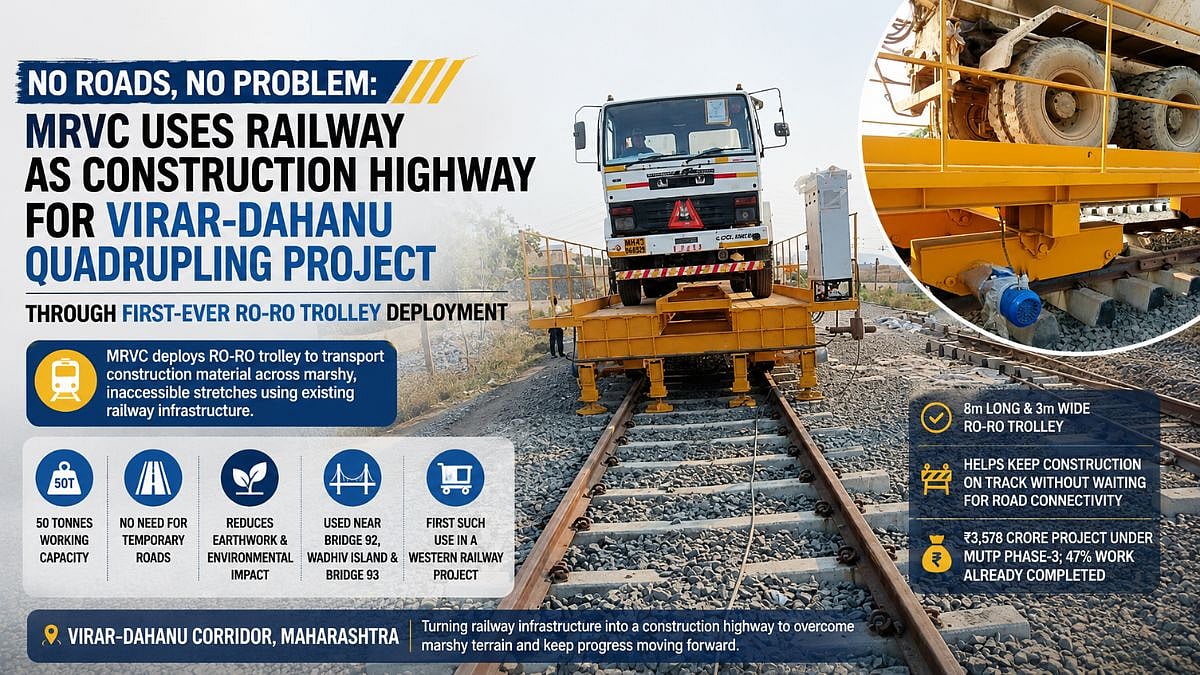
The Mumbai Railway Vikas Corporation (MRVC) has found a unique solution to transport construction material for the Virar-Dahanu quadrupling project. Due to the marshy terrain and lack of conventional road access to certain areas, MRVC has deployed a Roll-On Roll-Off (RO-RO) trolley to transport concrete, earth, and other construction material.
The RO-RO trolley, which is 8 meters long and 3 meters wide, has a theoretical capacity of 70 metric tonnes and a working capacity of around 50 tonnes. The trolley is loaded with material and transported directly over the existing Dedicated Freight Corridor Corporation of India Ltd (DFCCIL) bridge, allowing construction teams to reach locations where creating a conventional road would be difficult.
The arrangement is being used on the north side of Bridge 92, Wadhiv Island, and the south-side approach to Bridge 93. The marshy terrain at these locations has made the construction of temporary roads particularly challenging. Instead of carrying out extensive earthwork or accessing the riverbed, MRVC is using the existing railway infrastructure to maintain the supply of construction material.
According to officials, the arrangement has helped construction continue without waiting for temporary road connectivity. It has also reduced the need for earthwork in the marshy area and limited disturbance to the surrounding environment. The RO-RO system is being used for the first time in a Western Railway project, making it a notable construction-logistics solution for the quadrupling work.
The Virar-Dahanu Road quadrupling project, which is being implemented under Mumbai Urban Transport Project (MUTP) Phase 3, has reached around 47% completion. A substantial portion of the civil work is already underway, with more than 88% of earthwork completed and over 50 bridges and road underbridges constructed. Bridge works, station redevelopment, and construction of utility buildings are progressing at several locations along the corridor.
Station redevelopment work is also underway at Virar, Vaitarna, Saphale, Kelve Road, Palghar, Umroli, Boisar, Vangaon, and Dahanu Road. The project, which is valued at Rs 3,578 crore, is expected to improve the transportation infrastructure in the region.
The use of the RO-RO trolley has effectively turned the existing railway infrastructure into a temporary construction highway, allowing work to continue while avoiding additional road construction. This innovative solution has helped MRVC overcome the challenges posed by the marshy terrain and has ensured that the project remains on track.
The completion of the Virar-Dahanu quadrupling project will have a significant impact on the region, improving transportation infrastructure and reducing congestion. The project is expected to benefit commuters and residents in the area, providing them with faster and more reliable transportation options.
In conclusion, the use of the RO-RO trolley by MRVC is a testament to the organization's commitment to finding innovative solutions to complex problems. The Virar-Dahanu quadrupling project is an important infrastructure development project that will have a significant impact on the region, and the use of the RO-RO trolley has helped ensure its timely completion.
Frequently asked questions
What is the purpose of the RO-RO trolley in the Virar-Dahanu project?
The RO-RO trolley is used to transport construction material, such as concrete and earth, to areas with no conventional road access.
What is the current status of the Virar-Dahanu quadrupling project?
The project has reached around 47% completion, with a substantial portion of the civil work already underway.