Maharashtra Hikes PUC Charges, Diesel Vehicles To Pay ₹180
PUC charges revised, two-wheelers to pay ₹60, diesel vehicles ₹180. Revised rates effective now.
'%3E%3Crect%20width%3D'96'%20height%3D'96'%20fill%3D'%23B3261E'%2F%3E%3Ccircle%20cx%3D'30'%20cy%3D'24'%20r%3D'44'%20fill%3D'%23fff'%20opacity%3D'.12'%2F%3E%3Ccircle%20cx%3D'60'%20cy%3D'74'%20r%3D'40'%20fill%3D'%23000'%20opacity%3D'.10'%2F%3E%3C%2Fg%3E%3Cg%20fill%3D'%23fff'%3E%3Crect%20x%3D'29'%20y%3D'49'%20width%3D'8'%20height%3D'19'%20rx%3D'1'%2F%3E%3Crect%20x%3D'39'%20y%3D'40'%20width%3D'9'%20height%3D'28'%20rx%3D'1'%2F%3E%3Crect%20x%3D'50'%20y%3D'45'%20width%3D'8'%20height%3D'23'%20rx%3D'1'%2F%3E%3Crect%20x%3D'60'%20y%3D'53'%20width%3D'7'%20height%3D'15'%20rx%3D'1'%2F%3E%3Crect%20x%3D'41'%20y%3D'34'%20width%3D'5'%20height%3D'6'%2F%3E%3C%2Fg%3E%3C%2Fsvg%3E)
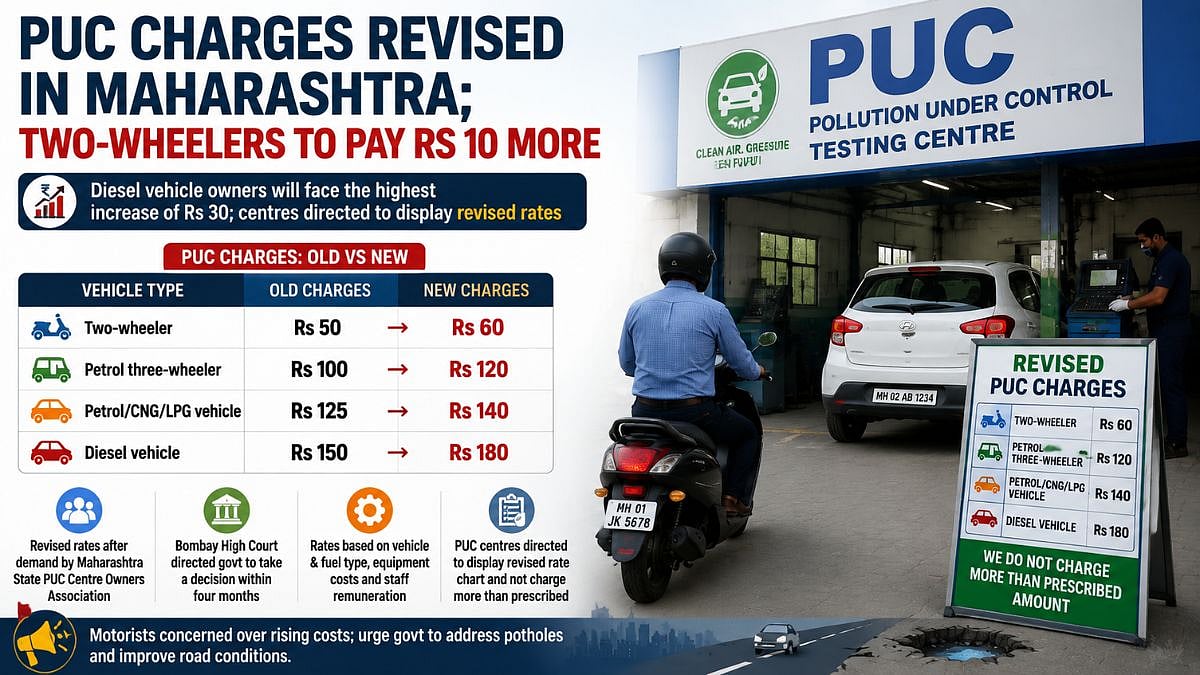
Vehicle owners in Maharashtra will now have to pay more for Pollution Under Control (PUC) certificates after the Transport Department implemented revised testing charges. The new rates are ₹60 for two-wheelers, ₹120 for petrol three-wheelers, ₹140 for petrol/CNG/LPG vehicles and ₹180 for diesel vehicles.
The revised rates are a result of a demand from the Maharashtra State PUC Centre Owners Association for an increase in testing charges. The association had approached the Bombay High Court, which directed the government to take a decision within four months. The Transport Department subsequently formed a three-member committee to study PUC charges, rules and testing procedures followed in different states.
The committee's recommendations and the court's directions led to the approval of the revised rates. While fixing the charges, the department considered vehicle and fuel types, testing equipment costs and staff remuneration. The Transport Commissioner's office has directed PUC centres to prominently display the revised rate chart and not charge more than the prescribed amount.
The old rates were ₹50 for two-wheelers, ₹100 for petrol three-wheelers, ₹125 for petrol/CNG/LPG vehicles and ₹150 for diesel vehicles. The revised rates are effective now, and motorists are concerned about the additional burden amid rising fuel, toll, insurance and vehicle maintenance costs.
Motorists have also urged the government to address pothole-related road damage and improve road conditions. The revised PUC charges are expected to affect vehicle owners across Maharashtra, including those in Mumbai and other major cities.
The Maharashtra State PUC Centre Owners Association had been demanding a hike in testing charges for some time now. The association's efforts finally led to the revision of PUC charges, which will impact vehicle owners in the state.
The Transport Department's decision to revise PUC charges is aimed at ensuring that PUC centres are able to cover their costs and provide quality services to vehicle owners. However, the revised rates may add to the financial burden of vehicle owners, who are already facing rising costs of fuel, toll, insurance and vehicle maintenance.
In recent years, the Maharashtra government has taken several steps to improve air quality and reduce pollution in the state. The revision of PUC charges is part of these efforts, as it aims to ensure that vehicles in the state meet certain pollution standards.
The impact of the revised PUC charges will be felt by vehicle owners across Maharashtra, including those in urban and rural areas. While the revised rates may add to the financial burden of vehicle owners, they are expected to contribute to improved air quality and reduced pollution in the state.
The Maharashtra government's decision to revise PUC charges is a significant step towards improving air quality and reducing pollution in the state. The revised rates will help ensure that PUC centres are able to provide quality services to vehicle owners, while also contributing to a cleaner and healthier environment.
In conclusion, the revision of PUC charges in Maharashtra is a significant development that will impact vehicle owners across the state. While the revised rates may add to the financial burden of vehicle owners, they are expected to contribute to improved air quality and reduced pollution in the state.
Frequently asked questions
What are the revised PUC charges in Maharashtra?
The revised PUC charges in Maharashtra are ₹60 for two-wheelers, ₹120 for petrol three-wheelers, ₹140 for petrol/CNG/LPG vehicles and ₹180 for diesel vehicles.
Why were the PUC charges revised in Maharashtra?
The PUC charges were revised in Maharashtra due to a demand from the Maharashtra State PUC Centre Owners Association for an increase in testing charges, and the Transport Department's subsequent decision to approve the revised rates based on a committee's recommendations and the Bombay High Court's directions.