India Sees Sharp Decline in Unvaccinated Children
India no longer among top 10 countries with most unvaccinated children. Zero-dose children decreased to 679,000 in 2025.
'%3E%3Crect%20width%3D'96'%20height%3D'96'%20fill%3D'%231B5E20'%2F%3E%3Ccircle%20cx%3D'30'%20cy%3D'24'%20r%3D'44'%20fill%3D'%23fff'%20opacity%3D'.12'%2F%3E%3Ccircle%20cx%3D'60'%20cy%3D'74'%20r%3D'40'%20fill%3D'%23000'%20opacity%3D'.10'%2F%3E%3C%2Fg%3E%3Cg%3E%3Ccircle%20cx%3D'48'%20cy%3D'48'%20r%3D'15'%20fill%3D'%23fff'%2F%3E%3Cpath%20d%3D'M43%2034%20Q50%2048%2043%2062'%20fill%3D'none'%20stroke%3D'%238a94a6'%20stroke-width%3D'2.4'%2F%3E%3Cpath%20d%3D'M47%2033%20Q54%2048%2047%2063'%20fill%3D'none'%20stroke%3D'%238a94a6'%20stroke-width%3D'1.8'%20stroke-dasharray%3D'1.5%203'%2F%3E%3C%2Fg%3E%3C%2Fsvg%3E)
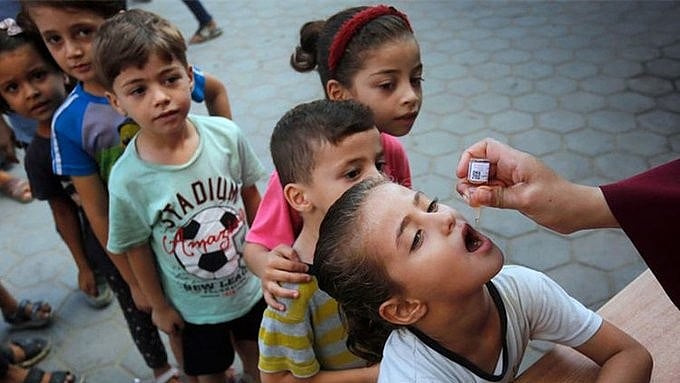
India has recorded a significant decline in the number of zero-dose children, with 679,000 children missing all routine vaccinations in 2025, according to the World Health Organization (WHO)-UNICEF estimates. This marks a sharp improvement from 909,000 in 2024 and 1,592,000 in 2023.
The decline is attributed to the country's sustained efforts under the Expanded Programme of Immunisation (EPI) and its commitment to universal vaccination. India has launched focused campaigns targeting zero-dose children in urban slums, migratory populations, hard-to-reach regions, and communities affected by vaccine hesitancy.
As a result, 95% of children in the country are now fully protected against diphtheria, tetanus, and pertussis (DTP3) as well as the second dose of the measles vaccine (MCV2). This achievement reflects the country's progress in improving vaccine coverage.
Globally, 90% of infants received at least one dose of the DTP vaccine in 2025, while 85% completed the recommended three-dose schedule. Although both indicators improved by one percentage point compared to 2024, global vaccination coverage remains one percentage point below 2019 levels and has largely stagnated since 2009.
The report estimates that 13.5 million children remained zero-dose in 2025, about 750,000 fewer than the previous year. However, progress has been offset by a growing number of children who begin vaccination but fail to complete the schedule. Measles coverage also remains below target, with 7.3 million infants receiving the first DTP dose but dropping out before receiving their first measles vaccine dose.
UNICEF Executive Director Catherine Russell stated that while global vaccination rates have bounced back after dropping significantly during the COVID-19 pandemic, millions of vulnerable children are still being left unprotected due to conflict, displacement, and poverty.
The decline in unvaccinated children in India is a significant achievement, and the country's efforts to improve vaccine coverage are a step in the right direction. However, there is still a need to address the challenges that remain, including vaccine hesitancy and access to immunization services in hard-to-reach areas.
In the context of global immunization, India's progress is a positive trend. The country's commitment to universal vaccination and its efforts to target zero-dose children have yielded results. The report highlights the need for sustained efforts to improve vaccine coverage and address the challenges that remain.
The significance of this achievement cannot be overstated. India's decline in unvaccinated children is a testament to the country's progress in improving public health. The country's efforts to improve vaccine coverage have the potential to prevent outbreaks and protect vulnerable children.
In conclusion, India's sharp decline in unvaccinated children is a significant achievement that reflects the country's commitment to universal vaccination. While challenges remain, the country's progress is a positive trend that has the potential to improve public health and prevent outbreaks.