Robot Discovers 121 Marine Species Near Scottish Wind Turbines
A robot has found 121 marine species beneath five Scottish wind turbines. The discovery was made in the North Sea.
'%3E%3Crect%20width%3D'96'%20height%3D'96'%20fill%3D'%230B6E4F'%2F%3E%3Ccircle%20cx%3D'30'%20cy%3D'24'%20r%3D'44'%20fill%3D'%23fff'%20opacity%3D'.12'%2F%3E%3Ccircle%20cx%3D'60'%20cy%3D'74'%20r%3D'40'%20fill%3D'%23000'%20opacity%3D'.10'%2F%3E%3C%2Fg%3E%3Cg%20fill%3D'none'%20stroke%3D'%23fff'%20stroke-width%3D'3.2'%20stroke-linecap%3D'round'%20stroke-linejoin%3D'round'%3E%3Cpolyline%20points%3D'31%2C59%2041%2C49%2049%2C54%2063%2C37'%2F%3E%3Cpolyline%20points%3D'55%2C37%2063%2C37%2063%2C45'%2F%3E%3C%2Fg%3E%3C%2Fsvg%3E)
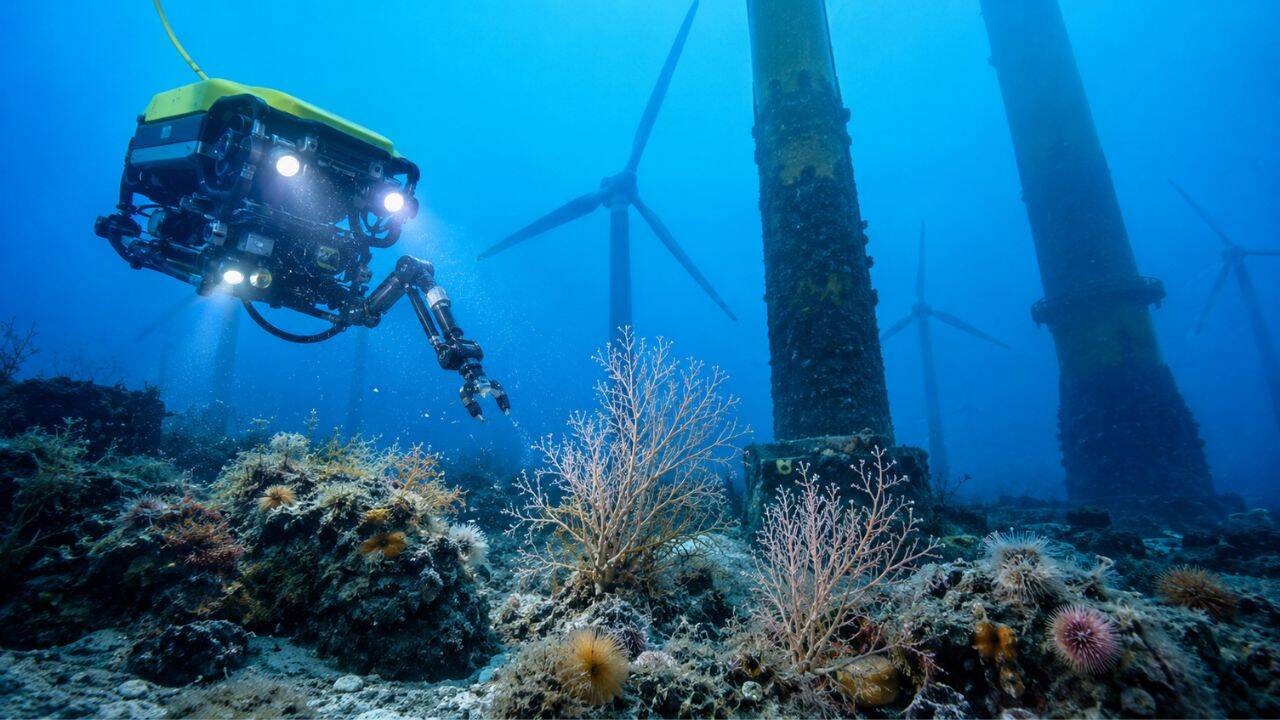
A significant discovery has been made in the North Sea, where a robot has identified 121 marine species living beneath five Scottish wind turbines. This finding is crucial in understanding the impact of offshore wind farms on marine life.
The robot, which was used to explore the seafloor, has provided valuable insights into the biodiversity of the area. The discovery of 121 marine species, including fish, crustaceans, and mollusks, highlights the importance of these wind turbines as artificial reefs.
The study was conducted to assess the environmental impact of offshore wind farms on marine ecosystems. The results suggest that these structures can support a wide range of marine life, which is essential for maintaining healthy and diverse ecosystems.
The North Sea, where the discovery was made, is a significant location for offshore wind farms. The area is home to several wind turbine installations, and the findings of this study can inform the development of future offshore wind projects.
The use of robots in marine research is becoming increasingly popular, as they provide a cost-effective and efficient way to explore the seafloor. This technology has enabled scientists to study marine ecosystems in greater detail, which is essential for conservation and management efforts.
The discovery of 121 marine species beneath the Scottish wind turbines highlights the importance of considering the environmental impact of offshore wind farms. While these structures can support marine life, they can also pose risks to certain species. Therefore, it is essential to conduct thorough environmental assessments before constructing offshore wind farms.
In conclusion, the discovery of 121 marine species beneath five Scottish wind turbines is a significant finding that highlights the importance of offshore wind farms as artificial reefs. The use of robots in marine research has enabled scientists to study these ecosystems in greater detail, which is essential for conservation and management efforts.
The findings of this study can inform the development of future offshore wind projects, ensuring that they are designed and constructed with minimal environmental impact. As the world continues to transition towards renewable energy sources, it is essential to consider the potential effects on marine ecosystems and to take steps to mitigate any negative impacts.
The study's results are a positive indication of the potential for offshore wind farms to support marine biodiversity. However, further research is needed to fully understand the effects of these structures on marine ecosystems and to ensure that they are developed in a sustainable and environmentally responsible manner.
Frequently asked questions
What was discovered near the Scottish wind turbines?
A robot discovered 121 marine species, including fish, crustaceans, and mollusks, living beneath five Scottish wind turbines.
Why is this discovery important?
The discovery highlights the importance of offshore wind farms as artificial reefs and informs the development of future offshore wind projects to minimize environmental impact.