RBI Seeks Comments On Standardised Loan Interest Rates
RBI proposes new rules for loan interest rates. Comments invited until September 11.
'%3E%3Crect%20width%3D'96'%20height%3D'96'%20fill%3D'%230B6E4F'%2F%3E%3Ccircle%20cx%3D'30'%20cy%3D'24'%20r%3D'44'%20fill%3D'%23fff'%20opacity%3D'.12'%2F%3E%3Ccircle%20cx%3D'60'%20cy%3D'74'%20r%3D'40'%20fill%3D'%23000'%20opacity%3D'.10'%2F%3E%3C%2Fg%3E%3Cg%20fill%3D'none'%20stroke%3D'%23fff'%20stroke-width%3D'3.2'%20stroke-linecap%3D'round'%20stroke-linejoin%3D'round'%3E%3Cpolyline%20points%3D'31%2C59%2041%2C49%2049%2C54%2063%2C37'%2F%3E%3Cpolyline%20points%3D'55%2C37%2063%2C37%2063%2C45'%2F%3E%3C%2Fg%3E%3C%2Fsvg%3E)
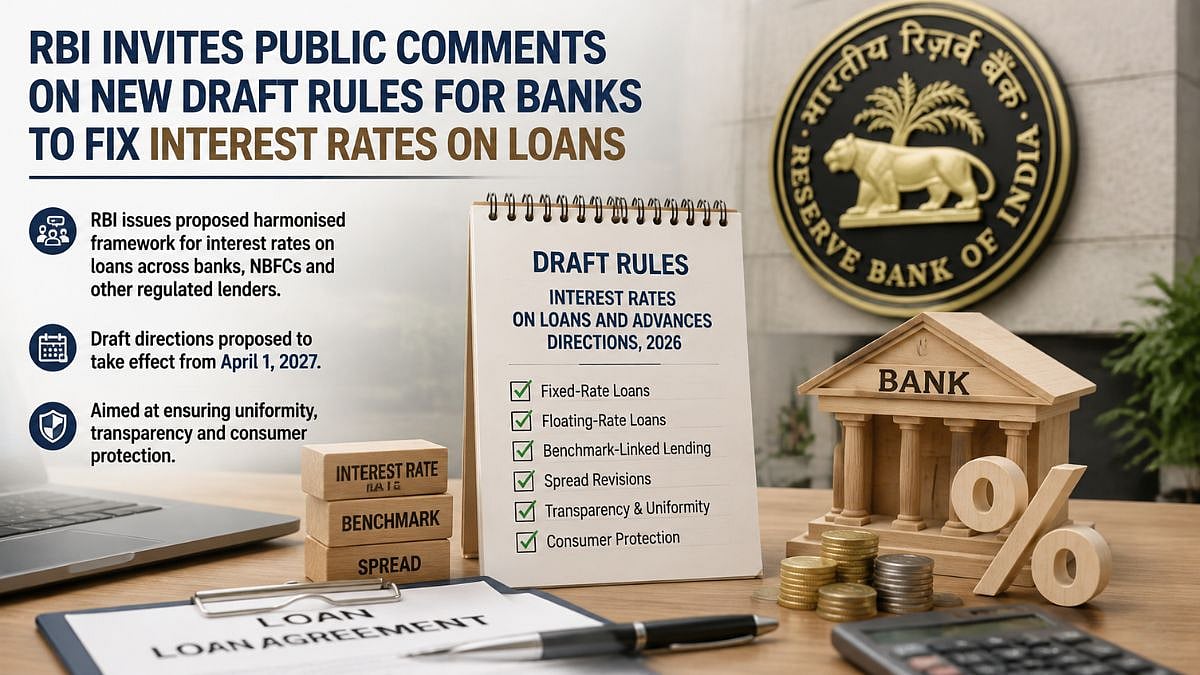
The Reserve Bank of India has issued a draft framework to standardise interest rates on loans from banks and non-banking financial companies (NBFCs). The proposed rules aim to increase transparency and uniformity in fixing interest rates on loans.
The draft directions, which are open for public comments until September 11, will apply to commercial banks, NBFCs, regional rural banks, and other regulated lenders. The RBI aims to harmonise rules across these entities while maintaining proportionality.
The proposed framework allows lenders to offer loans at either fixed or floating rates, with the interest rate linked to an internal or external benchmark and a risk-based spread. Lenders will not be allowed to price loans below the applicable benchmark.
For floating-rate loans, the benchmark, reset frequency, and reset date must be clearly specified in the loan agreement. The benchmark can be reset at a frequency chosen by the lender, but not more than once every three months.
The RBI has also proposed special provisions for agricultural loans, where the reset period will be linked to the crop season, but cannot exceed 12 months.
The proposed directions are part of the RBI's efforts to rationalise the regulatory framework for interest rates on loans. The RBI had announced on August 5 that it would standardise the rules for interest rates on loans.
The new framework is expected to increase transparency and protect consumers. The RBI has invited comments from the public on the draft directions, which can be submitted through its website or via email.
The proposed rules are expected to take effect from April 1, 2027. The RBI has fixed September 11 as the deadline for receiving public comments.
The move is seen as a step towards increasing transparency and uniformity in the lending sector. The RBI's efforts to standardise interest rates on loans are expected to benefit consumers and promote fair lending practices.
The proposed framework is a significant development in the banking and finance sector. The RBI's decision to invite public comments on the draft directions reflects its commitment to transparency and consumer protection.
In conclusion, the RBI's proposed framework for standardising interest rates on loans is a welcome move. The new rules are expected to increase transparency, uniformity, and consumer protection in the lending sector. The public can submit their comments on the draft directions until September 11, and the proposed rules are expected to take effect from April 1, 2027.
The significance of this development lies in its potential to promote fair lending practices and protect consumers. The RBI's efforts to standardise interest rates on loans are expected to have a positive impact on the banking and finance sector, and contribute to the overall growth and development of the economy.
Frequently asked questions
What is the deadline for submitting comments on the draft directions?
The deadline for submitting comments is September 11.
When are the proposed rules expected to take effect?
The proposed rules are expected to take effect from April 1, 2027.