Bombay HC Questions Mahalaxmi Dhobighat Redevelopment Plan
Bombay HC seeks explanations on Dhobighat redevelopment, warns against diverting municipal land without due process.
'%3E%3Crect%20width%3D'96'%20height%3D'96'%20fill%3D'%23B3261E'%2F%3E%3Ccircle%20cx%3D'30'%20cy%3D'24'%20r%3D'44'%20fill%3D'%23fff'%20opacity%3D'.12'%2F%3E%3Ccircle%20cx%3D'60'%20cy%3D'74'%20r%3D'40'%20fill%3D'%23000'%20opacity%3D'.10'%2F%3E%3C%2Fg%3E%3Cg%20fill%3D'%23fff'%3E%3Crect%20x%3D'29'%20y%3D'49'%20width%3D'8'%20height%3D'19'%20rx%3D'1'%2F%3E%3Crect%20x%3D'39'%20y%3D'40'%20width%3D'9'%20height%3D'28'%20rx%3D'1'%2F%3E%3Crect%20x%3D'50'%20y%3D'45'%20width%3D'8'%20height%3D'23'%20rx%3D'1'%2F%3E%3Crect%20x%3D'60'%20y%3D'53'%20width%3D'7'%20height%3D'15'%20rx%3D'1'%2F%3E%3Crect%20x%3D'41'%20y%3D'34'%20width%3D'5'%20height%3D'6'%2F%3E%3C%2Fg%3E%3C%2Fsvg%3E)
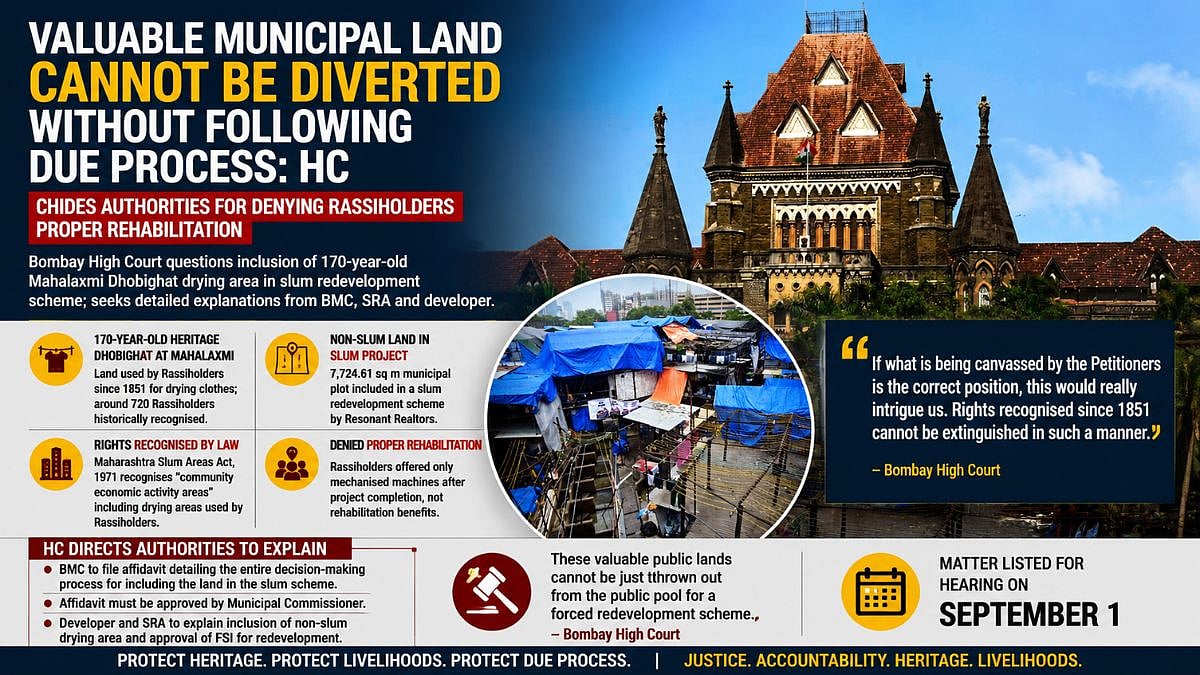
The Bombay High Court has raised concerns over the inclusion of a 170-year-old Dhobighat drying area at Mahalaxmi in a slum redevelopment project. The court warned that valuable municipal land cannot be diverted without following due process and protecting the rights of those who have used it for generations.
The Dhobighat area has been used by hundreds of washermen, known as 'Rassiholders', since 1851 for drying clothes. The petitioners claimed that the land was never occupied by slum structures and was instead an open municipal plot forming part of the heritage Dhobighat precinct.
A bench of Justices Girish Kulkarni and Neela Gokhale sought detailed explanations from the Brihanmumbai Municipal Corporation (BMC), Slum Rehabilitation Authority (SRA), and the developer, Resonant Realtors Projects Pvt Ltd, over the decision to include the open land in the project.
The petitioners argued that the land has been used for generations and that the Rassiholders were being offered only mechanised drying machines after completion of the project, instead of rehabilitation benefits. The court noted that the Maharashtra Slum Areas (Improvement, Clearance and Redevelopment) Act, 1971 recognises 'community economic activity areas', which include drying areas and other facilities used by Rassiholders for their traditional livelihood.
The court observed that the situation was 'not only peculiar but alarming' and that the rights of persons using the Dhobighat area since 1851 had 'substantially crystallized'. The bench directed the Additional Municipal Commissioner to file an affidavit explaining the entire decision-making process through which the municipal land was included in the slum scheme.
The developer and SRA have also been directed to explain how the non-slum drying area was included in the project and how the FSI attached to the land was approved for redevelopment. The court has kept the matter for hearing.
The Mahalaxmi Dhobighat is a historic area that has been in use for over a century. The redevelopment project has raised concerns among the Rassiholders, who fear that they will lose their traditional livelihood. The court's decision to seek explanations from the BMC, SRA, and the developer is a significant step towards protecting the rights of the Rassiholders and ensuring that valuable municipal land is not diverted without due process.
The case highlights the importance of following due process and protecting the rights of those who have used municipal land for generations. It also raises questions about the inclusion of non-slum areas in slum redevelopment projects and the use of FSI for such projects.
In conclusion, the Bombay High Court's decision to question the Mahalaxmi Dhobighat redevelopment plan is a significant step towards protecting the rights of the Rassiholders and ensuring that valuable municipal land is not diverted without due process. The court's observations and directions will have a significant impact on the future of the Dhobighat area and the livelihood of the Rassiholders.
The court's decision is also a reminder of the importance of preserving the city's heritage and traditional livelihoods. The Mahalaxmi Dhobighat is an important part of Mumbai's history and culture, and its preservation is essential for maintaining the city's unique character.
Overall, the case is a significant development in the ongoing debate over slum redevelopment and the use of municipal land in Mumbai. The court's decision will have far-reaching implications for the city's development and the livelihood of its citizens.
The Bombay High Court's warning against diverting municipal land without due process is a timely reminder of the need for transparency and accountability in the city's development projects. The court's decision will be closely watched by citizens and developers alike, and its implications will be felt for years to come.
In the end, the court's decision is a victory for the Rassiholders and a reminder of the importance of protecting the rights of those who have used municipal land for generations. The case is a significant step towards ensuring that valuable municipal land is not diverted without due process, and its implications will be felt for years to come.
Frequently asked questions
What is the Mahalaxmi Dhobighat redevelopment project about?
The project involves the redevelopment of a 170-year-old Dhobighat drying area at Mahalaxmi, which has been used by hundreds of washermen, known as 'Rassiholders', since 1851.
Why has the Bombay High Court questioned the project?
The court has questioned the project because it involves the diversion of valuable municipal land without due process and the potential extinguishing of the rights of the Rassiholders, who have used the land for generations.